Water Softener Installation & Repair in Raleigh, NC
If hard water is slowly destroying your water heater, coating fixtures with white crust, and making soap useless, a water softener stops it. The Raleigh and Triangle area wells often run 10 to 20 grains per gallon of hardness, which is enough to shorten your water heater by years. We size, install, and repair softeners so you stop fighting scale and start saving on energy.
Why hard water is slowly wrecking your Raleigh home
Hard water is packed with dissolved calcium and magnesium minerals. The moment that water heats up in your water heater, those minerals fall out of solution and form rock-hard scale that coats the heating element. This layer of scale acts as an insulator, forcing your water heater to work harder to reach the same temperature, burning more natural gas or electricity every single day. Over five to ten years, that scale buildup can cut your water heater's lifespan in half.
The same minerals coat the insides of dishwashers, coffee makers, ice makers, and washing machines. They leave soap scum that never quite rinses away, leaving your skin feeling sticky and your hair dull even after you shower. On well water in Raleigh's outlying areas, hardness often runs 10 to 20 grains per gallon, which is severe enough to cause visible damage within two to three years.
A water softener uses ion exchange to remove those hardness minerals at the point where water enters your home, before they have a chance to scale anything. The result is water that lathers immediately, appliances that run clean and efficient, and a water heater that stays young. Homes in Chatham, Wake Forest, and the rural stretches of Wake County see the biggest payoff, but even city-water homes benefit.
Real situations we handle in Raleigh
- The new homeowner on well water: You test the water and find 15 GPG hardness, plus iron and sulfur. The previous owner never treated it. We design a multi-stage system starting with iron removal, then softening, so the softener stays clean and lasts.
- The water heater that quit early: A homeowner's five-year-old water heater is already failing, and a plumber tells them scale is the cause. A softener installed now stops it from happening to the next unit.
- The spotty dishes and dull hair: A family notices their dishwasher output has become increasingly spotty despite using name-brand detergent. A water test shows 8 GPG hardness on city water. A whole-house softener fixes it in days.
- The saltwater odor complaint: An older softener stopped regenerating and runs salty water. We diagnose a valve failure, rebuild the valve, and reprogram the regeneration cycle for how the household actually uses water.
Where hard water shows up around the Triangle
Raleigh city water from Falls Lake is moderately soft, so not every city home needs a softener. The bigger hard water problems in our area are on well water. Homes on private wells in Chatham, Franklin, Johnston, and the rural edges of Wake County commonly test at 10 to 20 grains per gallon or more. That is hard enough to wreck a water heater years early.
Because the Triangle is growing so fast, city-water neighborhoods and well-water properties often sit a few miles apart, and their water is nothing alike. That is why we never assume. In places like Wake Forest and the outer towns, a softener is often the first thing well owners need. We test your specific water before recommending anything.
Why hardness is worse than an annoyance
Scale is an insulator. When it coats the heating element in your water heater, the unit has to work harder and burn more energy to heat the same water. Hard water also stiffens laundry, dulls colors, dries out skin and hair, and clogs the small passages in dishwashers and coffee makers. Softening is not a luxury upgrade; on hard water it pays for itself in appliance life and energy.
Ion-exchange softeners versus salt-free conditioners
You will see two kinds of products advertised, and they are not the same thing. We think you deserve the straight version.
- Ion-exchange softeners genuinely remove hardness minerals. This is true softening. You get slick water, zero new scale, easy lather, and full protection for appliances. They use salt to recharge, and they send a small amount of backwash water down the drain during regeneration.
- Salt-free conditioners do not remove hardness at all. They use template-assisted crystallization to turn some of the minerals into stable crystals that stick less. That can cut down new scale on surfaces, but your water is still technically hard, it will not feel slick, and it will not lather like softened water.
Conditioners have a place for people who cannot use salt or discharge brine, but they are not a substitute for a real softener when your water is very hard. We will tell you honestly which fits your situation instead of pushing whichever one has the bigger margin.
How we install and set up your softener
Every softener install starts with a free consultation. We measure your hardness in grains per gallon along with iron, pH, and other factors, because iron and low pH change how a softener needs to be built and set. A softener installed without accounting for iron in well water will foul and lose capacity fast.
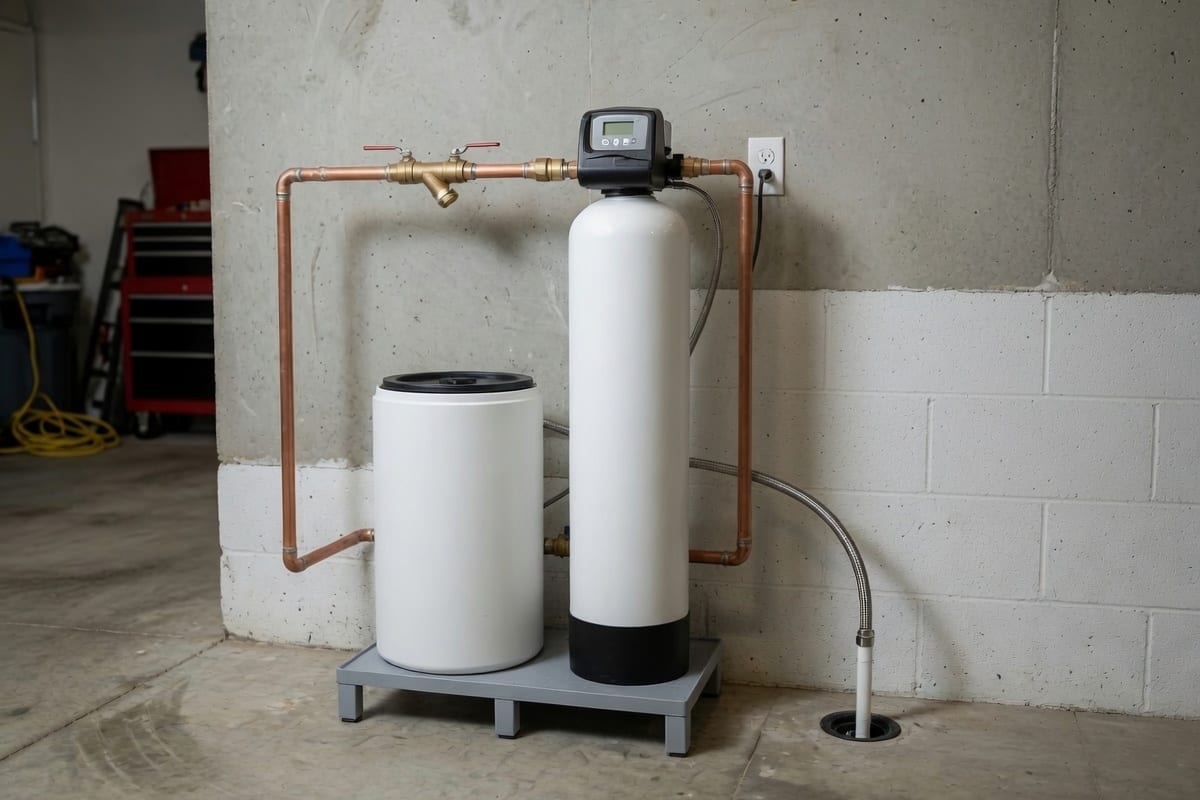
From there our licensed installers place the unit where your main line enters, usually the garage or a utility space, plumb it in with a bypass valve, and program the regeneration cycle to your household size and hardness. Correct programming matters: set it right and the system uses the least salt and water needed to keep you soft. We walk you through refilling the salt and answer every question before we leave.
Softeners and well water go together
On a well, a softener is usually one piece of a larger setup. If you also have orange staining or a rotten-egg smell, you may need iron and sulfur removal ahead of the softener. If your water is acidic, it needs pH correction first. Our full well water treatment page covers how these stages stack together into one system that is built for your water.
The signs your home has hard water
You do not need a lab to suspect hard water; your house is already telling you. The clearest signs show up in the same places every time, and once you know what to look for they are hard to unsee:
- White crust building up on faucets, shower heads, and around drains.
- Spotty, cloudy glasses coming out of the dishwasher no matter the detergent.
- Soap and shampoo that will not lather, leaving a filmy feel on skin.
- Stiff, scratchy laundry and colors that fade faster than they should.
- A water heater that runs out sooner or fails years before it should.
If several of these sound familiar, a free consultation will put a number on it in minutes. That number, measured in grains per gallon, is what tells us how large a softener you need and how to program it.
Water softener repair in Raleigh
Already own a softener that is not doing its job? We repair existing units across Raleigh and the Triangle, including softeners other companies installed. The failure patterns are familiar: a unit that stopped regenerating overnight, water that suddenly tastes salty, a brine tank that stays full of water, or hard-water spots creeping back onto glasses after years of soft water.
Most of these have inexpensive fixes. Salt bridges in the brine tank break up in minutes, control valves can be rebuilt, timers and settings can be reprogrammed for how your household actually uses water, and worn resin can be replaced without swapping the whole system. On well water, the most common killer is iron fouling the resin bed; if a test shows iron is what took your softener down, we fix the root cause with iron pre-treatment so the repair lasts.
If a softener is genuinely at the end of its life, we say so and quote a correctly sized replacement instead of billing you for repairs that will not hold. Either way, the visit starts with the same free consultation, because the water tells us whether the unit failed or was simply never right for the job.
Living with a softener day to day
People sometimes worry a softener is high maintenance. In practice it is one of the easier systems to own. You add salt to the brine tank every month or two, and the unit regenerates on its own overnight. That is most of it. A correctly sized softener uses the least salt and water needed to stay ahead of your hardness, so you are not hauling bags of salt constantly.
The payoff shows up quickly. Scale stops forming, so faucets and glassware stay clear, soap lathers with less product, and your water heater stops fighting an insulating layer of mineral. Many homeowners notice softer laundry and skin within the first couple of weeks, and the appliance savings add up quietly over the years that follow.
A softener also cuts how much soap, shampoo, and detergent you go through, because these lather and rinse far better in soft water. That is a small saving on its own, but combined with longer appliance life and lower water heating costs, the unit earns its place over time rather than sitting there as a luxury.
What it costs and how to start
Softener pricing depends on the size of your home, how hard your water is, and whether iron or other issues mean you need extra stages. We give you a clear up-front quote after testing, with no add-on fees at install. You can see typical ranges for the area in our Raleigh water filtration cost guide.
A word on softened water and sodium
Some people ask whether softened water is high in sodium. Ion exchange does add a small amount of sodium, but for typical hardness levels the amount is minor, less than many everyday foods. If anyone in the home is on a strict sodium-restricted diet, we can set up a reverse osmosis tap for drinking water, which removes that sodium along with other dissolved solids, or use a potassium chloride option instead of salt. It is one more thing we sort out based on your household rather than a blanket rule.
If you are done fighting scale, spotty dishes, and short-lived water heaters, water softener installation is the direct fix, and it starts with a free consultation so we size it right the first time. Call us to schedule yours, and we will show you exactly what a softener will change in your home.
Frequently Asked Questions
How do I know if my Raleigh water is hard enough to need a softener?
The clearest signs are white crusty buildup on faucets and shower heads, spotty glasses out of the dishwasher, soap that will not lather, and water heaters that wear out early. Well water in the outlying counties often runs 10 to 20 grains per gallon or higher, which is severe hardness. A free consultation settles it in minutes, with hardness measured at your tap, and if your home shows three or more of those signs, a softener will change everything.
Do I need salt for a water softener, and how much?
A true ion-exchange softener uses salt to recharge its resin, and most Raleigh households add a bag or two of salt every month or two depending on water use and hardness. We program each system to use the least salt needed to keep your water soft, so your monthly cost is predictable. Salt-free conditioners exist but they do not actually remove hardness minerals, just reduce scale buildup.
What is the difference between a water softener and a salt-free conditioner?
A softener actually removes hardness minerals through ion exchange, delivering slick, scale-free water that lathers and rinses clean. A salt-free conditioner does not remove the minerals; it uses template-assisted crystallization to reduce how much scale sticks to surfaces, so your water still feels hard. Conditioners may help in specific situations, but they are not a replacement for real softening when your hardness is 10 grains or higher.
Will a water softener protect my appliances?
Absolutely. Scale buildup from hard water shortens water heater life by 5 to 10 years, clogs dishwashers and coffee makers, and forces water heaters to work harder and consume more energy. Softened water keeps heating elements clean and efficient, so appliances run the full distance and your energy bills drop noticeably. Many Raleigh homeowners see the payback within two to three years.
Does a softener make water safe to drink?
No. Softening removes hardness minerals but not contaminants like PFAS, lead, or dissolved solids. For drinking and cooking water, pair a softener with a reverse osmosis system at the kitchen sink. On well water, a softener also pairs with iron removal, sulfur treatment, or pH correction depending on what your test reveals.
How long does a water softener last?
A correctly sized ion-exchange softener runs 10 to 15 years with proper maintenance. The resin bed does the work and holds up well when the unit is not undersized and regenerating constantly. Proper sizing at install is the single biggest factor in longevity, which is exactly why we test and measure your hardness and household size before quoting.
Do you repair existing water softeners in Raleigh?
Yes. We service and repair softeners we did not install, including units that have stopped regenerating, run salty water, leak at the valve, or quit softening entirely. Common fixes include valve rebuilds, resin replacement, and clearing salt bridges in the brine tank. If a unit is fouled beyond repair, usually from years of untreated iron in well water, we tell you straight and price a correctly sized replacement.
Ready for cleaner, better-tasting water?
Start with a free consultation and an up-front price. Serving Raleigh and the surrounding Triangle.