Whole House Water Filtration Services in Raleigh, NC
If your Raleigh tap water tastes like chlorine or leaves a chemical smell in the shower, whole house water filtration treats every faucet at the point of entry.
What whole house water filtration actually does
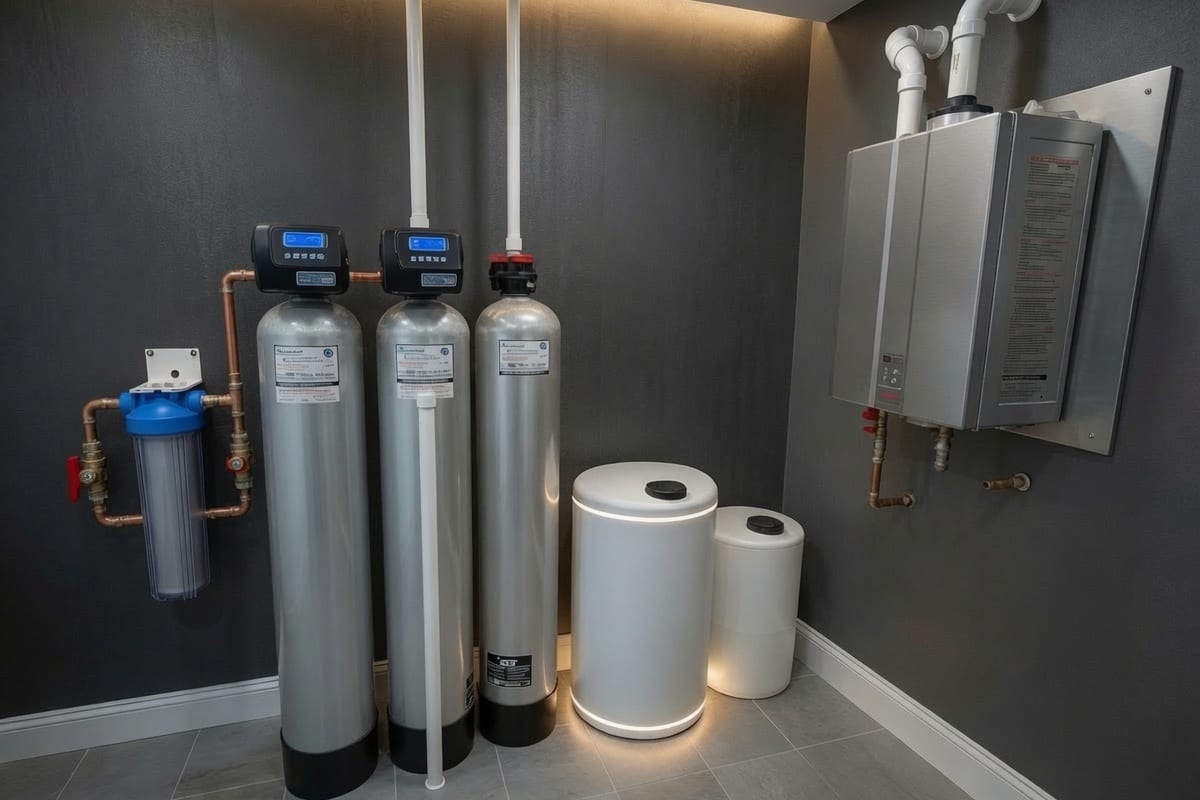
A whole house water filter, sometimes called a whole home or point-of-entry (POE) system, sits where the main water line comes into your house. Every drop that reaches a faucet, shower, or appliance passes through it first. That is different from a pitcher or a single under-sink unit, which only cleans water at one spot.
For most Raleigh homes on city water, the core of the system is a carbon tank. Activated carbon is very good at grabbing chlorine, chloramine, and the taste and odor problems that come with disinfected surface water. It also reduces disinfection byproducts, which form when the disinfectant reacts with natural material in the source water.
Why Raleigh city water tastes and smells the way it does
Raleigh pulls its drinking water from Falls Lake and the Neuse River, then treats it at the E.M. Johnson and Dempsey Benton plants. To keep the water safe on its long trip through the pipes, the city disinfects with chloramine, a longer-lasting cousin of chlorine. That is the number one reason people call us about their city water: a chemical or bleach taste and a smell that gets stronger in a hot shower.
Chloramine at treatment levels is not a health emergency, but it is annoying, and it can dry out skin and hair and leave an off flavor in coffee and iced tea. A carbon-based whole house water filter removes it across the whole house, so your shower, your ice maker, and your kitchen faucet all improve at once.
If you live in Cary, Apex, or Morrisville, your water comes from Jordan Lake instead, in the Cape Fear basin. The disinfection and taste issues are similar, and we handle those towns too. You can read more on our Cary water filtration page.
The PFAS and GenX question
The Cape Fear and Haw River basins that feed much of the Triangle have documented PFAS and GenX contamination. These are man-made compounds that do not break down easily, and they have shown up in the rivers that supply drinking water downstream. Pittsboro, which draws straight from the Haw River, has measured some of the highest levels in the state.
A whole house carbon filter reduces PFAS, which is worth doing, but carbon alone will not take it to non-detect. The honest answer is that the best home defense against PFAS in drinking water is a two-part setup: carbon filtration for the whole house, plus a reverse osmosis system at the kitchen sink for the water you actually drink and cook with. We will tell you if your address is in one of the higher-risk supply areas.
What a whole house system removes and improves
- Chlorine and chloramine taste and odor at every tap, not just the kitchen.
- Disinfection byproducts that form in treated surface water.
- Sediment and fine grit that can come off aging city mains, using a pre-filter stage.
- Some PFAS and organic compounds, reduced by the carbon media.
- Softer feel on skin and hair, since the harsh chemical taste is gone from shower water.
What a carbon filter does not do is remove hardness minerals. If your water is hard, which is common on well supplies and some outlying areas, you also need a softener. That is a separate job, and we will say so plainly after we test.
How we size and install your system
Sizing is the part cheap installs get wrong. A filter that is too small for your home chokes your water pressure, and one that is too large wastes money. We look at how many bathrooms and fixtures you have, your pipe diameter, and your peak flow, then match the tank and media to it. Done right, you will not notice any pressure loss. If a filter you already have is costing you pressure, our guide to a whole house filter causing low water pressure covers the usual causes.
Installation happens at the main line, usually in the garage, crawlspace, or utility area near where the water enters. Our licensed installers handle the plumbing, add the right pre-filtration, and set up a bypass so the system can be serviced without shutting off your whole house. On city water, a well-placed carbon system is a clean, low-maintenance install.
Water Filtration System Maintenance and Repair
Once installed, whole house filtration systems run quietly for years, but media eventually gets spent and cartridges clog. Most carbon filters in this area need media replacement every 3 to 5 years, with sediment pre-filters needing service every 3 to 6 months depending on your water quality and usage. We tell you the actual schedule for your system so you are not guessing. If your filter starts showing low pressure or poor taste improvement, we handle repairs and media swaps, so your water stays clean without the headache of tracking it yourself.
Testing comes first, always
We do not sell you equipment before we know what is in your water. A free in-home water test tells us your chlorine level, hardness, pH, iron, and total dissolved solids in a few minutes. That is what tells us whether you need carbon only, carbon plus a softener, or carbon plus reverse osmosis. If your water genuinely does not need much, we will tell you that too.
Signs your home would benefit from whole home filtration
Not every home needs the same setup, but a few signs point clearly toward whole home, point-of-entry filtration. If you are not sure you need one at all, our guide to whether you need a whole house filter on city water is a good place to start. If you notice these, a test will confirm whether carbon is the right fix:
- A chlorine or bleach smell that gets stronger in a hot shower.
- Coffee, tea, and ice that taste off even from a fresh pot.
- Dry, itchy skin or dull hair that started when you moved into the house.
- A flat or chemical taste at the kitchen tap that a pitcher filter only partly hides.
- Living in a supply area with known PFAS concerns in the Cape Fear or Haw River basins.
A pitcher or a single fridge filter only cleans water at one spot, and it runs out fast. Whole house filtration treats the water before it splits off to every faucet, shower, and appliance, so you are not refilling a pitcher or replacing tiny cartridges every few weeks. The difference shows up most in the shower and the laundry, places a countertop filter never reaches.
How whole house filtration works with well water
Everything above assumes city water, which is where most whole house filtration calls come from in Raleigh proper. If you are on a private well, carbon filtration still helps with taste and certain organics, but it is rarely the whole story. Wells in the Triangle's rural fringe usually bring iron, sulfur, hardness, or low pH that carbon cannot touch.
For those homes, a carbon filter is one stage in a larger setup that may also include iron and sulfur removal, softening, and disinfection. If you are on a well, start with our well water treatment page, because the order and combination of stages matters. Either way, the test tells us the truth about your water before we build anything.
What it costs and what happens next
Whole house filtration pricing depends on your home size, your water, and whether you add a softener or reverse osmosis stage. We give you an up-front quote after the test, with no surprise fees at install. For a full breakdown of ranges in this area, see our water filtration cost guide for Raleigh.
We serve the whole Triangle for whole house filtration, from city-water neighborhoods in Raleigh, Garner, and Knightdale to the outlying towns where supplies and geology change street by street. Because the region is growing so quickly, we never assume your block matches the one next door, and the free consultation is what keeps the recommendation honest.
If you are tired of the chlorine smell in your shower and want cleaner water at every tap, whole house water filtration is the fix, and it starts with knowing exactly what is in your Raleigh water. Call us or request a free consultation, and we will build the right system for your home instead of a one-size box off a shelf.
Frequently Asked Questions
Why does my Raleigh tap water smell like a swimming pool?
That chlorine or bleach smell comes from chloramine, the disinfectant Raleigh uses to keep city water safe from the treatment plant to your tap. It is not harmful at these levels, but many people dislike the taste and odor. A whole house carbon filter strips chloramine out before it reaches your faucets and shower heads.
Does a whole house water filter remove PFAS in the Triangle?
A high-quality carbon filter reduces PFAS and other organic contaminants, though it will not pull them to non-detect on its own. For drinking and cooking water we pair the whole house filter with a reverse osmosis system at the kitchen sink, which handles PFAS and GenX far more thoroughly.
How often do the filters need to be changed?
Most point-of-entry carbon systems in this area run 3 to 5 years before the media needs replacing, depending on your water use and household size. Sediment pre-filters are swapped more often, usually every 3 to 6 months. We tell you the real schedule for your system so you are not guessing.
Will a whole house filter lower my water pressure?
A correctly sized system will not. Pressure drops happen when a filter is too small for the home flow rate. We size the system to your fixture count and pipe size so showers and appliances run normally. If your pressure is already low, we flag that before installing anything.
Do I need a water softener too, or is the filter enough?
It depends on your water. Raleigh city water is moderately soft, so a carbon filter alone often does the job. Well water and some outlying supplies are hard and need a softener as well. We test your water first, then tell you honestly whether one unit or two makes sense.
Can you install a filter if I am on city water in Cary or Apex?
Yes. Cary, Apex, and Morrisville draw from Jordan Lake in the Cape Fear basin, which carries its own taste and contaminant profile. Whole house carbon filtration works the same way there. We serve the full Triangle, and the system is matched to your local supply.
Do you service and repair existing filtration systems?
Yes. We handle maintenance and repair on whole house filtration systems, including ones we did not install. Carbon media typically needs replacing every 3 to 5 years and sediment pre-filters every 3 to 6 months, and we quote any service or repair up front before work starts. If your system shows low pressure or the chlorine taste is back, that is usually a sign the media is spent.
Ready for cleaner, better-tasting water?
Start with a free consultation and an up-front price. Serving Raleigh and the surrounding Triangle.