Reverse Osmosis vs Whole-House Water Filtration
Raleigh Water Pros • July 20, 2026 • 7 min read • Updated September 14, 2026
If you are shopping for better water at home, you have probably run into two very different products: reverse osmosis systems and whole-house filters. They sound like they compete, but they actually solve different problems in different parts of your home. Picking the wrong one, or thinking one replaces the other, is the most common mistake we see.
This guide breaks down what each does, what it costs, and how to figure out which one (or both) your Triangle home actually needs.
What is the difference between point-of-use and point-of-entry?
The whole comparison comes down to two phrases:
- Point-of-use (POU) treats the water at one specific tap, usually the kitchen sink. Reverse osmosis is the classic example. You get highly purified water from one dedicated faucet for drinking and cooking.
- Point-of-entry (POE) treats all the water as it enters your home, so every faucet, shower, and appliance gets filtered water. A whole-house carbon filter is the classic example.
One cleans a single tap to a very high level. The other improves every tap to a good level. Once you see it that way, the “versus” mostly disappears.
What does reverse osmosis do?
Reverse osmosis (RO) pushes water through a very fine membrane that blocks almost everything larger than a water molecule. It is the most thorough drinking-water treatment most homeowners can install.
An under-sink RO system removes or greatly reduces:
- PFAS (“forever chemicals”)
- Lead
- Fluoride
- Nitrates
- Total dissolved solids (TDS), the general mineral content that affects taste
- Chlorine and chloramine taste and odor (handled by the carbon pre-filters)
The tradeoffs of RO:
- It treats one tap. RO is slow, so it fills a small storage tank and feeds a dedicated faucet. It is not meant to supply the whole house.
- Low flow rate. You draw purified water from that one faucet; you would not run a shower off it.
- It wastes some water during the filtering process, though modern systems are much more efficient than older ones.
- It removes minerals, which some people counter with a small remineralization stage for taste.
RO is the right tool when your concern is what you and your family drink and cook with. Explore our reverse osmosis drinking water systems to see how they are set up.
What does whole-house filtration do?
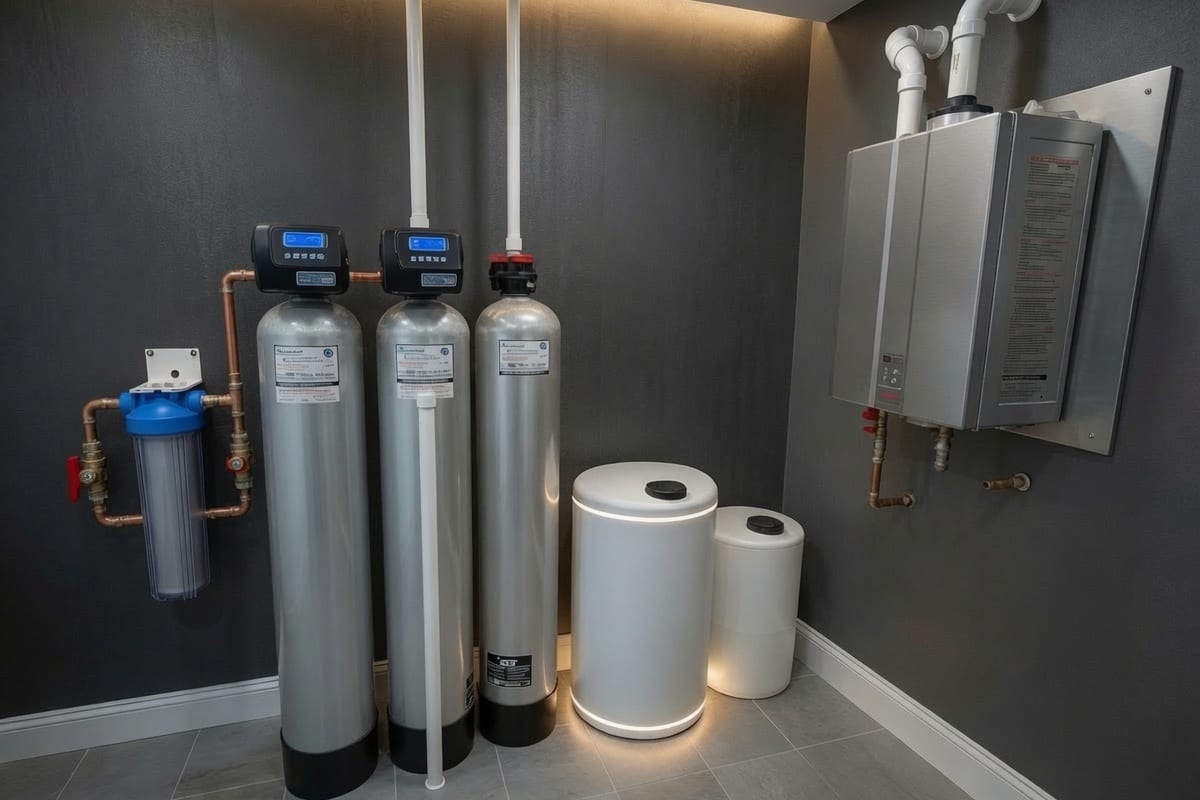
A whole-house carbon filter treats water at the point it enters your home, so protection and better water reach every fixture. For most Triangle homes on city water, the main job is removing the chlorine or chloramine that utilities add to disinfect the supply.
A whole-house carbon system typically:
- Removes chlorine and chloramine, which improves taste and smell and stops that “pool water” note at every tap.
- Reduces sediment so faucets, valves, and appliances last longer (often paired with a sediment pre-filter).
- Makes showers and baths gentler on skin and hair, since you are no longer bathing in chlorinated water.
- Protects your plumbing and appliances from the wear that chlorine and grit cause over years.
What a whole-house carbon filter does not do:
- It does not deionize or purify your drinking water to the level RO does. It will not strip out fluoride, most lead, or dissolved solids. It is a broad quality upgrade, not a precision drinking-water purifier.
If you are on Raleigh city water (Falls Lake and the Neuse River, treated with chloramine and moderately soft), a whole-house carbon filter is the piece that upgrades every tap. See our whole-house water filtration options for details.
Reverse osmosis vs whole-house filtration: side-by-side
| Feature | Reverse Osmosis (point-of-use) | Whole-House Carbon (point-of-entry) |
|---|---|---|
| Where it treats | One tap (usually kitchen) | Every tap in the home |
| Chlorine and chloramine | Yes, at that tap | Yes, whole home |
| PFAS, lead, fluoride, TDS | Yes, removes or greatly reduces | No, not designed for this |
| Sediment | Handled by pre-filters | Yes, whole home |
| Flow rate | Low (fills a small tank) | Full household flow |
| Best for | Drinking and cooking water | Shower, bathing, taste, appliance protection |
| Typical cost range | Lower up-front, single unit | Higher up-front, whole-home unit |
Costs vary based on your water and home, so use this as a rough map, then check real numbers on our water filtration cost guide.
How each system fits into your home
It helps to picture where these units physically go, because that tells you a lot about what they can and cannot do.
A whole-house filter installs on the main water line, usually near where the line enters the house or close to the water heater and pressure tank. Every drop of water in the home passes through it first. That placement is exactly why it can treat showers, laundry, the dishwasher, outdoor spigots, and every faucet at once. It is a larger tank-style unit and needs space and a drain nearby for the models that backwash.
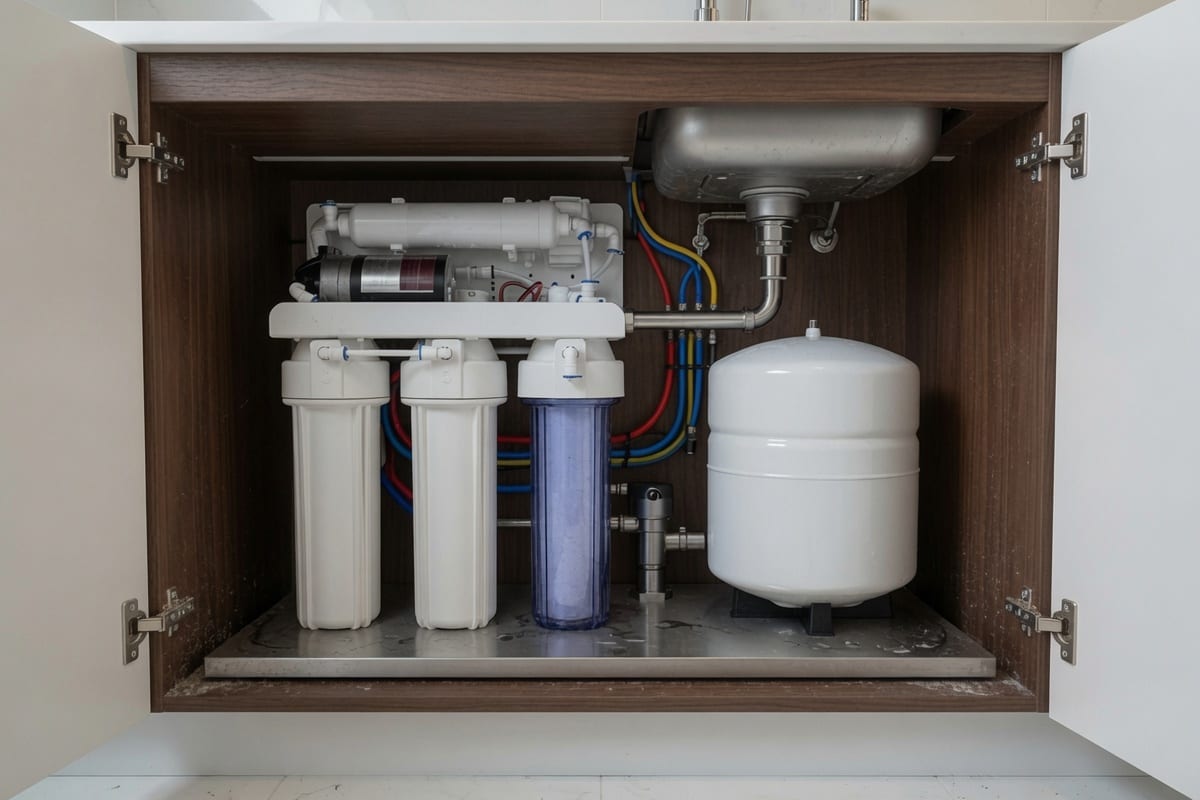
A reverse osmosis system installs under one sink, usually the kitchen. It is compact, tucks into the cabinet, and feeds a small dedicated faucet mounted on the counter or sink deck. Because it works slowly and stores purified water in a little tank, it is built for the volume you use for drinking, cooking, coffee, and filling water bottles, not for high-demand uses like bathing or running appliances.
Understanding the placement makes the “which do I need” question easier. If your concern travels through the whole house (chlorine smell, sediment, appliance wear), you want point-of-entry. If your concern is only what you swallow (PFAS, lead, purity), you want point-of-use.
Do I need reverse osmosis if I have a whole-house filter?
Usually yes, if drinking-water quality is a priority. This is the question we get most, so here is the honest answer.
A whole-house carbon filter makes your water taste and smell much better everywhere, and it protects your home. But it does not remove PFAS, lead, fluoride, or dissolved solids. If you want your drinking and cooking water free of those, you still want an RO system at the kitchen sink.
They are not redundant. They stack. The whole-house filter even helps the RO system by removing chlorine before it reaches the RO membrane, which extends the membrane’s life.
Do I need a whole-house filter if I have reverse osmosis?
It depends on what bothers you. If your only concern is drinking water, an under-sink RO alone may be enough. But RO does nothing for the water you shower in, wash clothes in, or run through your dishwasher. If you dislike chlorine smell in the shower, want to protect your plumbing, or want better water at every tap, the whole-house filter is what delivers that.
Why most Triangle homes benefit from both
For a lot of homes here, the best setup is a whole-house carbon filter for chlorine, taste, and shower quality, plus an RO system at the kitchen for pure drinking water. Each handles what the other cannot:
- The whole-house unit upgrades every tap and protects the home.
- The RO unit gives you bottled-quality water for drinking and cooking, including protection against PFAS, which is a real concern for parts of the Triangle drawing from Jordan Lake in the Cape Fear basin, like Cary and Apex.
You do not have to buy both at once. Many homeowners start with the piece that solves their biggest complaint and add the other later.
A quick note: softeners solve a different problem
People often lump water softeners into this conversation, but a softener does something neither of these filters does. A softener removes hardness, meaning the calcium and magnesium that cause scale buildup, spotty dishes, and dry skin. It is not a filter for chemicals or a drinking-water purifier.
- Hard water (scale, film, crusty faucets) points to a softener.
- Chlorine, taste, whole-home quality points to whole-house carbon.
- Pure drinking water points to RO.
Some homes need all three, especially well homes with hard water. City-water homes in Raleigh, where the supply is moderately soft, often skip the softener. A water test tells you which of these you actually need instead of guessing. Learn more about water softener installation if hardness is your issue.
How to decide (the short version)
- You mainly care about drinking water: start with reverse osmosis.
- You mainly care about chlorine smell, showers, and every-tap quality: start with whole-house carbon.
- You want the complete upgrade: do both, whole-house carbon plus kitchen RO.
- Your dishes are spotty and your skin is dry: you likely have a hardness problem and want a softener, separate from either filter above.
The cleanest way to get this right is to test your water first. Raleigh Water Pros offers a free in-home consultation across Raleigh and the Triangle, with up-front pricing and licensed installers, so you only buy the equipment your water actually calls for.
Not sure which setup fits your home? Contact us for a free consultation and we will show you exactly what your water needs, no guesswork and no pressure.