Iron Staining from Well Water | Raleigh Treatment Cost 2026
Raleigh Water Pros • August 29, 2026 • 8 min read
Your Bathroom Fixtures Are Turning Orange. Here’s Why and What It Costs to Fix.
You wake up, brush your teeth, and notice something unsettling. The sink basin has rust-colored stains that won’t scrub away. Your daughter’s white shirt came out of the washing machine with mysterious orange blotches. The grout around the shower is discolored. And that stainless steel fixture you installed last year? Already showing deep red streaks.
If you’re on a well in Raleigh, you likely know what’s happening before you finish reading this. Iron in your well water isn’t just cosmetic. It’s attacking your plumbing system, staining everything it touches, and accumulating damage that costs thousands to repair if left untreated.
The good news: iron staining is one of the most straightforward water quality problems to diagnose and fix. You’re looking at a free in-home consultation to start, $1,800 to $3,500 installed for a properly sized iron and sulfur filter, and permanent relief. Here’s exactly what you need to know.
The Staining Problem: It’s Not Just About Looks
Iron staining shows up in three distinct ways once it hits your well water system.
On fixtures and surfaces: Orange or rust-colored stains accumulate inside sink bowls, on toilet tanks, and around faucet aerators. These aren’t permanent in the sense of permanent damage, but they’re persistent. Bleach and vinegar scrubbing gives maybe temporary relief. The stains return because the iron-rich water keeps delivering more iron.
In laundry: White and light-colored fabrics develop rust-colored spots or an overall dingy appearance. Cotton towels and bed linens are hit hardest. Industrial laundromats in Raleigh that serve well-water customers report customer complaints about staining within weeks of new equipment if iron levels aren’t addressed.
In plumbing: This is where the real cost hides. Iron bacteria colonize your pipes and form a slimy coating. This buildup reduces water flow, clogs aerators, and eventually narrows pipes enough that water pressure drops noticeably. Homeowners in Raleigh’s northeast neighborhoods (Wake Forest, Creedmoor areas) report low-pressure issues 5-7 years into untreated iron problems.
The staining itself is a marker. It tells you iron is present and active. The invisible part, the bacterial biofilm inside your pipes, is what becomes expensive if ignored.
How Much Iron Is in Your Water? Start With a Test.
Before we talk treatment, you need data. Iron in well water shows up in two forms: ferrous (dissolved) and ferric (suspended particles). Your water might have one, both, or neither in meaningful quantities. A yellow or tea-colored tint is not always iron, either, and our guide to tannins in NC well water explains how to tell the two apart.
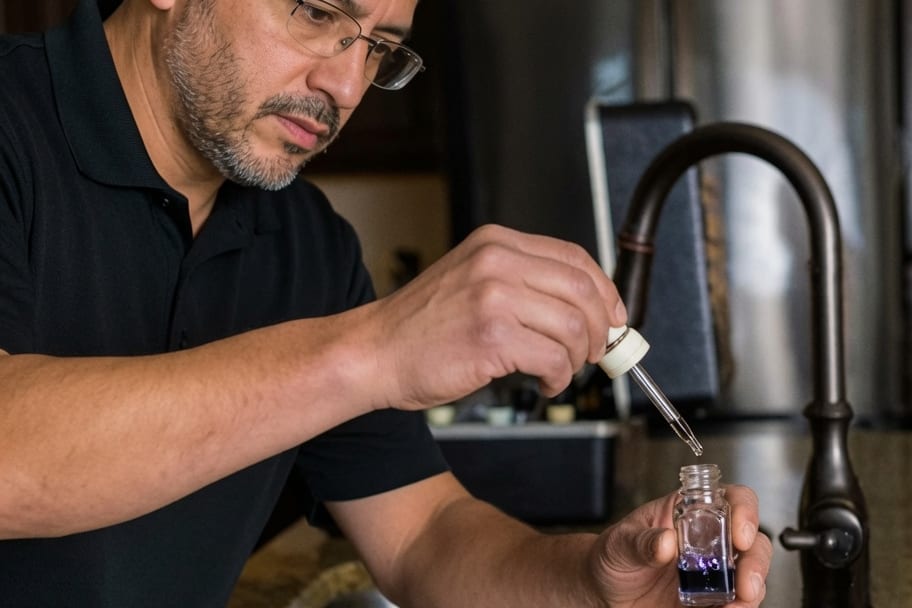
The test process:
Our free in-home water test reads iron on the spot, and a basic iron test through a certified local lab costs $40 to $75 with a report in 3-5 days. Results show iron in PPM (parts per million). Here’s what the numbers mean:
- 0-0.3 PPM: Typically not visible; no treatment needed
- 0.3-1 PPM: Staining may appear, especially in light fixtures and laundry
- 1-3 PPM: Definite staining, noticeable within weeks, iron bacteria likely present
- 3+ PPM: Aggressive staining, plumbing risk, treatment essential
Most Raleigh wells with visible staining problems fall into the 0.8 to 2.5 PPM range. That’s high enough to act on, low enough that a standard iron filter solves it completely.
You can also get a more comprehensive water analysis ($100-$150) that tests for iron, manganese, hardness, bacteria, and pH at the same time. If you’re building a treatment plan, that broader view saves money down the line because it prevents installing filters that conflict with other issues.
Treatment Methods: Your Options and Real Installed Costs
Once you know your iron levels, you have three realistic paths.
Option 1: Whole-House Iron Filter ($1,800-$3,500 Installed)
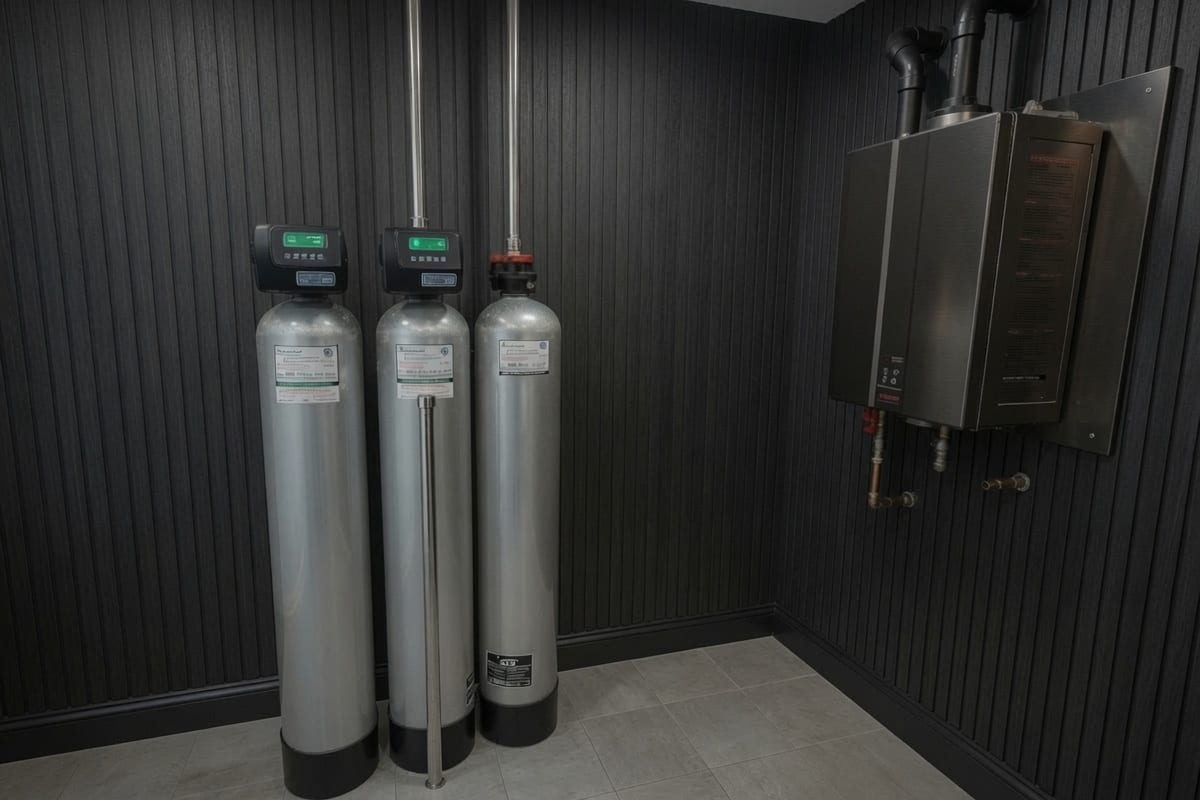
This is the most common fix for moderate iron levels (0.5-3 PPM). An iron filter oxidizes dissolved iron into particles, then traps them in a media bed. Every few years, you backflush the system to clean the media.
What you’re paying:
- Filter tank and media: $1,200-$2,500
- Installation labor: $400-$700
- Misc. plumbing, permit, inspection: $200-$300
- Total: $1,800-$3,500
Raleigh homeowners in Garner and Holly Springs report closer to the higher end because well-to-main-line distances tend to be longer, requiring additional piping.
Maintenance: Annual backflush (manual or automatic timer), media replacement every 5-7 years ($150-$300). The filter needs space; plan for a tank about 4-5 feet tall and 1.5 feet wide in your utility room or outdoor enclosure.
Performance: Removes ferrous iron very well (90-95%). Ferric iron and iron bacteria, less so if they’re already established in your pipes. If staining is new and iron levels are moderate, this works perfectly.
Option 2: Water Softener with Iron Removal ($1,600-$2,500 Installed)
If you also have hard water (which many Raleigh well owners do), a softener equipped with iron removal handles both problems. The softener resin doesn’t just remove hardness minerals; it can be pre-loaded to grab ferrous iron as well.
What you’re paying:
- Softener unit (capacity for 3-4 person household): $1,000-$1,500
- Installation with brine tank: $300-$600
- Plumbing and permits: $150-$300
- Salt and setup: $100-$200
- Total: $1,550-$2,600
Maintenance: Salt refills ($8-$15 per 50-lb bag, roughly one bag every 4-8 weeks depending on household size and usage). Annual inspection ($75-$150). Brine tank cleaning every 2-3 years ($100-$200).
Performance: Excellent for ferrous iron and hardness. Doesn’t remove ferric particles or address iron bacteria if your pipes are already contaminated. But if you’re starting fresh after a treatment upgrade, this is comprehensive.
Option 3: Combination Iron Filter + Softener ($3,300-$7,000)
For high iron and hard water together, or if your pipes already have bacterial buildup, a two-stage system gives you the best insurance. Iron filter first (removes particles and biofilm), then softener (handles hardness and dissolved iron).
What you’re paying:
- Iron filter: $1,800-$3,500 installed
- Softener: $1,500-$3,500 installed
- Total: $3,300-$7,000 (bundling both in one visit shares the labor cost; a full multi-stage well system with UV and pH correction runs $4,000-$8,000)
Maintenance: Both systems require regular attention (backflush the filter, refill salt in the softener). But this approach solves multiple water quality problems at once.
Maintenance Costs and the Timeline for ROI
Here’s where transparency matters.
An iron filter running for 5 years will cost you:
- Annual backflush chemical or manual service: $50-$150
- Media replacement at year 5: $150-$300
- Minor repairs (valve seals, etc.): $100-$200 over 5 years
- Total ongoing: $500-$850 over 5 years
A softener running for 5 years will cost you:
- Salt refills (5 bags per month on average): $400-$800
- Annual inspections and service: $150-$300
- Brine tank cleaning: $100-$200 over 5 years
- Minor repairs: $50-$150
- Total ongoing: $700-$1,450 over 5 years
Return on investment: Most Raleigh homeowners see the value within 18-24 months. Here’s the math:
- Untreated iron staining forces replacement of fixtures (faucets, showerheads, fixtures: $1,500-$3,000 over 5 years)
- Laundry damage and staining treatments: $300-$800 over 5 years
- Plumbing repairs from biofilm buildup (partial pipe replacement, fixture work): $1,000-$4,000 if you wait 7+ years
- Water pressure loss requiring diagnostic/repair work: $500-$1,500
The cost of doing nothing is higher. An iron filter installed today saves you $3,000-$6,000 in fixture replacement and plumbing repairs over 5 years. The ROI is real, and it compounds if you plan to stay in the home beyond 5 years.
FAQ: Questions Raleigh Homeowners Ask
Q: Can I just use a point-of-use filter on my kitchen sink? A: No. Orange staining affects your entire home, your whole plumbing system, and your laundry. Point-of-use filters only protect that one faucet. You need a whole-house system to actually solve the problem.
Q: What if I get a water pitcher filter like Brita? A: Same issue. Those filter maybe 2 gallons at a time. Your shower alone uses 25+ gallons. The iron staining continues.
Q: Is iron in well water dangerous to drink? A: Not at the levels typically found in Raleigh wells (under 3 PPM). The EPA doesn’t classify iron as a health hazard. It’s a nuisance contaminant. That said, very high iron levels can encourage bacterial growth, so testing is smart.
Q: Can I treat this myself with hydrogen peroxide or other chemicals? A: Adding peroxide or chlorine yourself is risky. You need precise dosing, ventilation, and follow-up testing. A miscalculated dose can create different problems (excess chlorine, corrosion). It’s not a DIY area. Hire it out.
Q: How long does an iron filter installation take? A: Most installations are 2-4 hours for a single-stage filter. You’ll be without water for 1-2 hours during the work. Schedule it midday if possible.
Q: Do I need a permit? A: In Raleigh, yes. Anything touching your main water line requires a plumbing permit ($50-$150). A licensed plumber pulls it and coordinates inspection. It’s not optional; it protects you and your home’s resale value.
Q: What’s the lifespan of an iron filter? A: The tank itself, 10-15 years. The media inside, 5-7 years before performance drops. Plan for one media replacement during the life of the tank.
How to Move Forward
Step 1: Test your water. Schedule a free in-home consultation, or call a certified lab for a basic iron test ($40-$75). Get numbers.
Step 2: Get 2-3 quotes. Don’t rely on one contractor’s recommendation. Multiple quotes clarify what’s standard pricing in your area and reveal contractors who overcharge for unnecessary upgrades.
Step 3: Ask about warranties. Tank warranty (5-10 years typical), media warranty (1-2 years), and labor warranty (1 year). Get it in writing.
Step 4: Plan for maintenance. Budget $100-$200 per year for service, salt refills, or filter chemicals. It’s small money that prevents bigger problems.
Iron staining from well water is solvable, predictable, and cost-effective to treat. The earlier you act, the less you’ll spend on fixture replacement and plumbing damage. If your water is turning your fixtures orange and your laundry rust-colored, you’re not looking at a complex problem, just one that needs the right equipment and professional installation.
Ready to stop the orange staining? Contact us for a free consultation and quote. We’ll pull a sample, analyze it, and show you exactly which treatment fits your situation and budget.