UV Water Purification System Cost in NC (2026)
Raleigh Water Pros • September 20, 2026 • 11 min read
The lab result came back positive, the county told you to disinfect, and now there are two quotes in your inbox with a UV system on them. You want one number: what does UV water purification cost in North Carolina, installed, on a well outside Clayton or Fuquay-Varina.
The chamber is the easy part. Two quotes can name the same equipment and mean two different jobs, because ultraviolet light only disinfects water that is already clear, and everything that has to happen upstream of the lamp is where the totals separate.
Below: the installed range, the four things that move it, the pre-filtration question that has to be settled before anyone prices a chamber, what the system costs to run, and what a UV quote has to itemise before you sign it.
How much does a UV water purification system cost in NC?
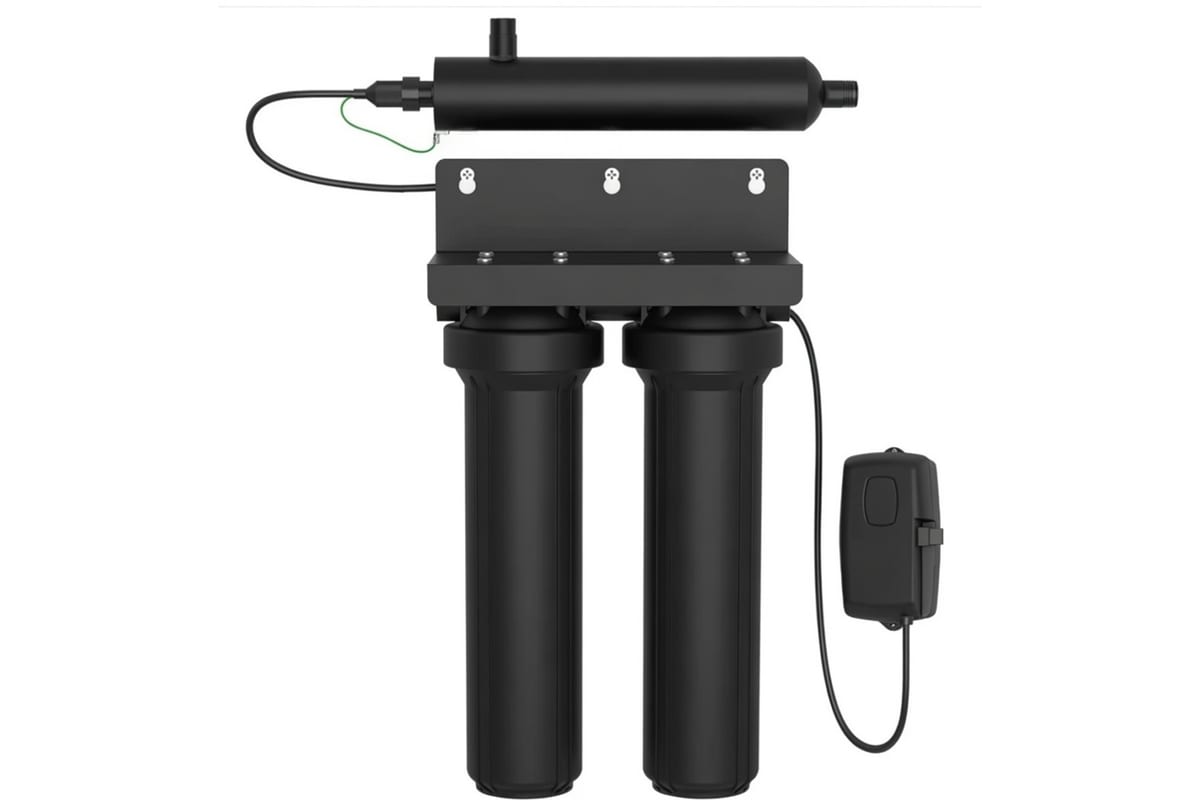
UV disinfection runs $700 to $1,500 installed on a North Carolina well in 2026. That buys the stainless chamber, the germicidal lamp and quartz sleeve inside it, mounting, and the plumbing to tie it into the line where it sits. That is our own planning range, published in the Raleigh water filtration cost guide and dated September 2026. It is not a quote, and it is not a survey of what other people paid. It also assumes the water arriving at the chamber is already clear.
| What you are buying | Where it lands | Why |
|---|---|---|
| Single lamp chamber, clear water, simple tie-in near the pressure tank | Low end of the range | Small lamp, short pipe run, nothing to work around |
| A chamber sized for a higher peak flow | Middle | Bigger reactor, bigger lamp and ballast |
| A unit certified to NSF/ANSI 55 Class A, with sensor and alarm | Upper end | The fail-safe hardware is part of the certification |
| An awkward install point: tight mechanical room, long tie-in, no outlet nearby | Upper end | Labour and materials, not equipment |
| Water that has to be treated before it reaches the lamp | Priced as its own stage | Covered further down, and it is the big one |
Want the number for your own well rather than a range? Request a free consultation and we test your water first, then quote in writing.
What drives the price of a UV system?
Four things: the flow rate the chamber has to cover, whether the unit is certified Class A or Class B, whether it carries a monitor, and what the plumbing looks like where it goes.
Flow rate and lamp size
UV dose is intensity multiplied by exposure time, so the faster water moves through the chamber, the smaller the dose it receives. A unit sized against a brochure figure underdelivers the moment two showers and a dishwasher run together.
EPA’s guidance for public water system installations makes the same point in engineering language: the design flow rate “must fall within the flow rate envelope validated for the reactor.” Household equipment is smaller and the arithmetic is identical. Sizing is a peak flow question, and a bigger chamber with a longer lamp costs more.
Class A or Class B certification
This separates two units that look the same on a shelf. Writing in the trade journal Water Conditioning and Purification, NSF’s Rick Andrew sets out what each class is for: a Class B system is for “supplemental bactericidal treatment of disinfected public drinking water or other drinking water that has been tested and deemed acceptable for human consumption,” while a Class A system is “intended to inactivate microorganisms, including bacteria, viruses, Cryptosporidium oocysts and Giardia cysts in contaminated water.”
If you are buying UV because a well test came back positive, Class A is the one the situation describes, and it carries a hardware requirement Class B does not: those systems “must also include a UV sensor and alarm to act as a fail-safe in case the system is not functioning in a manner to provide safe drinking water.” That sensor is part of why a Class A unit costs more.
The monitor and what it does on failure
A UV system fails silently. No taste change, no smell and no pressure drop when output falls below the germicidal dose, so the only thing between a weak lamp and a year of unnoticed exposure is an indicator. Ask what the alarm actually does: some light the controller, some sound, and some shut the water off.
Plumbing at the install point
Where the chamber goes decides a real share of the labour. Room beside the pressure tank, an outlet nearby for the ballast and short pipe runs is the cheap version. A crawl space, a long tie-in, a new circuit, or a bank of equipment that has to be re-plumbed to get the lamp last in line is the expensive one. Our guide to what order well water systems go in explains why UV always sits at the end of the train.
The pre-filtration line most quotes leave vague
UV needs clear water, so on a well that carries sediment or iron the honest quote has a filtration stage in front of the lamp, and that stage changes the total more than the lamp ever will.
University of Georgia Extension states the mechanism plainly: “Suspended solid particles (turbidity) in the water can shield organisms from exposure to light,” and “to facilitate exposure between the bacteria and light, a sediment filter should free the untreated water entering the unit from turbidity as much as possible.” The same bulletin adds what hardness and metals do: “Hard water salts of calcium and magnesium may coat the quartz sleeve with scale,” and “iron and manganese can impart color to the water and reduce the UV light output.”
EPA watches the same short list before any UV facility is designed: calcium, alkalinity, hardness, iron, manganese, pH and ORP. Its pilot work found standard cleaning kept up at sites with “total hardness levels less than 140 mg/L and iron less than 0.1 mg/L.” Past those readings, cleaning stops being occasional and a stage upstream starts paying for itself.
What that means on a quote, in plain money:
- Sediment filtration. We publish no price band for this, because our cost page carries none and a figure lifted off a national blog would be a guess wearing a citation. It is quoted as a line on the job, in writing, before any work starts.
- Iron or hydrogen sulfide. That is a tank, not a cartridge. Iron and sulfur removal runs $1,800 to $3,500 installed in this market.
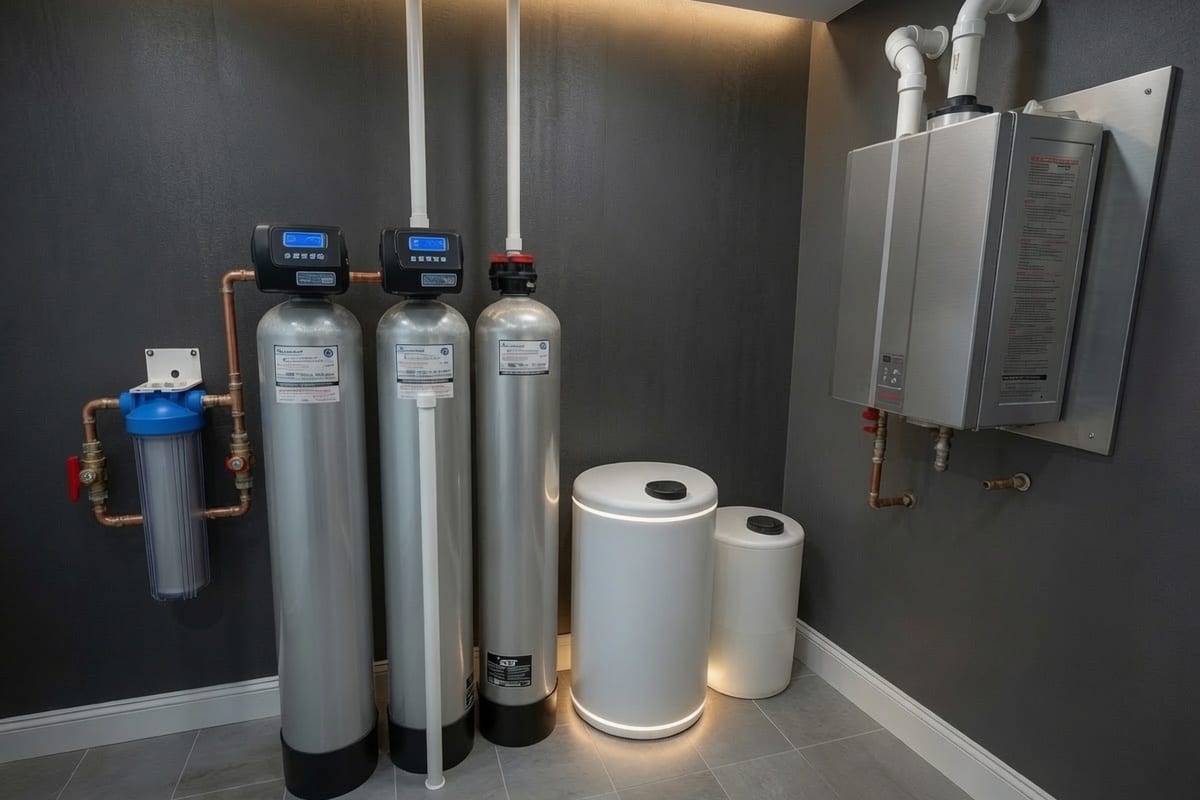
- Several problems at once. A well needing sediment, iron, pH correction and hardness handled before the lamp is a complete build, and a full well water treatment train runs $4,000 to $8,000+ installed. Our well water treatment cost guide breaks that down.
Hardness is the reading people guess at, and the one nobody can hand you. We do not have a representative local dataset that would predict your well’s hardness, so test your own water rather than working from anyone’s regional figure, ours included. There is a structural reason the number is hard to find: General Statute 87-97(h) lists what a newly constructed private well must be tested for, and hardness is not on it. The panel covers iron, manganese, magnesium, nitrate, pH and bacterial indicators, so a new well file tells you about the iron and nothing about the scale. Measure it before anyone sizes a chamber.
Pro tip: ask for a sample port between the pre-filtration and the UV chamber at install. It costs almost nothing while the pipe is open, and it is the only way to prove later that the water reaching the lamp is as clear as the design assumed. Without one, a repeat positive turns into an argument about which stage failed.
What does a UV system cost to run?
A lamp on a yearly schedule, a quartz sleeve every few years, prefilter cartridges and one bacteria sample. UGA Extension puts lamp life at “every 9,000 hours (approximately 1 year) of continuous lit-up usage,” and a household unit runs continuously because water can be drawn at any moment.
We are not printing part prices here, for the same reason as the sediment line: lamps and sleeves vary by chamber length and lamp type, and there is no published band to stand behind. Our post on UV bulb and sleeve replacement covers the intervals, why a glowing lamp still needs changing, and what to get in writing on day one.
What a UV quote must itemise
A quote with a model number and a total is not enough to compare against another one. Ask for these six lines:
- The chamber’s rated flow, in gallons per minute, and the peak household flow it was sized against.
- Class A or Class B, stated plainly, with the certification named.
- Whether a sensor and alarm are included, and exactly what happens when the lamp fails.
- The pre-filtration in front of it: housing size, micron rating and flow rating, or a written statement that the water needs none and why.
- Lamp and sleeve part numbers, so you can price replacements without being tied to one supplier.
- The plumbing scope: isolation valves, a bypass, sample ports and the electrical supply.
Two red flags worth naming. A quote that prices a chamber on a well nobody has tested is guessing at the flow, the clarity and the problem. And a quote offering UV as the answer to a well that has failed twice is treating the water instead of the well: a repeat positive is a reason to have the casing, cap, seal and grout inspected before more equipment is added, which is a county health department and well contractor question rather than ours. Our comparison of UV and shock chlorination sets out that sequence.
Frequently Asked Questions
How much does a UV water purification system cost installed in NC?
$700 to $1,500 installed is the typical range on a private well in 2026, covering the chamber, lamp, sleeve and tie-in. The spread comes from flow rate, whether the unit is Class A with a sensor, and the plumbing at the install point. Pre-filtration is priced on top, and the Raleigh water filtration cost guide shows how the stages stack.
Does a UV system need a sediment filter in front of it?
Almost always on a well. UGA Extension is explicit that suspended particles shield organisms from the light and that a sediment filter should clear the incoming water of turbidity as far as possible. On the red clay wells around Clayton and Johnston County, storm runoff is what puts fines in the line.
Is UV cheaper than shocking the well?
Cheaper is the wrong comparison, because they do different jobs: chlorination disinfects the well and plumbing once, and UV treats every gallon from then on. The two are often used in sequence rather than chosen between, and which applies depends on what the result and the well inspection actually show. Our well disinfection comparison walks through it.
What size UV system do I need for my house?
The one rated for your peak flow rather than your average use, because dose falls as flow rises. Fixture count, simultaneous demand and the transmittance of your water all feed into it, which is why water testing comes before sizing.
Does UV cost much to run each year?
The recurring items are a lamp about once a year, a quartz sleeve every few years, prefilter cartridges and a yearly bacteria sample. We publish no band for the parts because none exists that we would stand behind, so get those prices in writing before you buy the unit.
Will UV fix a well that keeps failing its bacteria test?
Not on its own. UV disinfects the water passing through the chamber and does nothing to the well itself, so a well that keeps failing is a reason to review the sampling and inspect the well construction rather than to add treatment again. Homeowners in Fuquay-Varina and Pittsboro should start with the county health department. We install the treatment once the wellhead is sound.
Sources
Read in September 2026. Manufacturer instructions for your specific unit take precedence over general guidance.
- UGA Extension Bulletin 1487, Water Disinfection Methods and Devices (Saha, Hawkins and Mickler, 12 May 2026): turbidity shielding organisms, the sediment filter requirement, scale on the quartz sleeve, iron and manganese, and the 9,000 hour lamp life.
- EPA Ultraviolet Treatment Toolkit: the validated flow rate envelope, the fouling parameter list, and the 140 mg/L hardness and 0.1 mg/L iron pilot findings. Written for public water systems rather than household equipment.
- NSF/ANSI 55 Class A Versus Class B UV Systems, Rick Andrew, Water Conditioning and Purification, 7 May 2015: the two class definitions and the Class A sensor and alarm requirement.
- NC General Statute 87-97, subsection (h): the required new well analyte list, which does not include hardness.
UV water purification pricing across Raleigh and the Triangle
A UV quote is only as good as the water it was written against. Get the well tested, settle the pre-filtration question first, and the chamber becomes the straightforward part of the job rather than the line everyone argues about afterwards.
We size and install UV water purification and complete well water treatment for homes in Raleigh, Clayton, Fuquay-Varina and Wake Forest. Call (984) 384-6991 or book a free consultation for an up-front written price with the flow rating, the certification class, the alarm and the pre-filtration all spelled out.