Arsenic in NC Well Water: Where and What to Do
Raleigh Water Pros • September 26, 2026 • 9 min read
Arsenic is the well contaminant that gives no warning. It does not stain, it does not smell, and it does not change the taste. A well can look and taste perfect and still carry it, which is why it sits on North Carolina’s required test for every newly built well.
Arsenic in well water in North Carolina is almost always natural, released from rock rather than dumped by anyone, and it is not spread evenly. A band of old volcanic rock through the central Piedmont, known as the Slate Belt, produces far more of it than anywhere else in the state, while most Triangle counties sit well below the state average.
This guide covers where arsenic occurs, with the state’s own county numbers, what the 10 microgram per litre standard means and does not mean, how you find out whether your well has it, and what the state lists as the options if it does.
Where Is Arsenic Found in North Carolina Well Water?
Mostly in the Slate Belt of the central Piedmont, though low levels turn up statewide. NC DEQ’s arsenic fact sheet explains the geology: “Rocks that were formed during periods of volcanic activity tend to have a greater abundance of minerals that contain arsenic,” and areas “underlain by metamorphosed volcanic and sedimentary rocks, commonly referred to as the ‘Slate Belt,’ have a greater number of wells with detectable and elevated levels of arsenic than in other regions. However, low levels of arsenic are found in groundwater throughout North Carolina” (NC DEQ, Arsenic in Groundwater).
The same sheet says investigations show arsenic in the state’s groundwater “is most often naturally occurring,” released as water moves through rock fractures, with agriculture and industry as occasional additional sources.
The county numbers show how uneven it is. North Carolina’s Division of Public Health publishes summaries of private well samples tested by the State Laboratory of Public Health from 1998 to 2010. Here is the share of tested wells above the 10 microgram per litre standard.
| County | Wells tested for arsenic | Above 10 ug/L | Highest result (ug/L) |
|---|---|---|---|
| Stanly | 933 | 20.15% (188 wells) | 806 |
| Union | 3,478 | 19.70% (685 wells) | 303 |
| Montgomery | 391 | 8.70% (34 wells) | 88 |
| Randolph | 1,793 | 4.91% (88 wells) | 106 |
| Davidson | 572 | 4.20% (24 wells) | 100 |
| Chatham | 1,547 | 2.20% (34 wells) | 127 |
| Catawba | 512 | 1.95% (10 wells) | 133 |
| Orange | 4,676 | 0.98% (46 wells) | 86 |
| Johnston | 1,460 | 0.68% (10 wells) | 35 |
| Durham | 473 | 0.63% (3 wells) | 12 |
| Wake | 2,591 | 0.62% (16 wells) | 237 |
| Pitt | 138 | 0.00% (0 wells) | 5 |
Source: NC DPH county well water reports, for example Union, Stanly and Wake.
For a statewide comparison, NC DEQ reports that 233 of 10,289 private well samples analysed in 2018 and 2019, or 2.26 percent, exceeded the 10 ppb standard (NC DEQ, private well information).
Two caveats matter. NC DPH says its county averages “may not reflect the quality of groundwater in a single well,” and the fact sheet makes the same point from the other side: “there are many instances where one well contains dissolved arsenic and another well nearby is arsenic free.” A low county share does not clear your well, and a high one does not condemn it. And the county data runs to 2010.
Want to know what your own numbers mean? Request a free consultation and we read the lab report with you, then put any price in writing.
What Does the 10 ug/L Arsenic Standard Mean?
It is the federal limit for public water systems, which North Carolina also uses as its groundwater standard, and water below it is not automatically risk-free. NC DEQ’s fact sheet sets it out: EPA’s maximum contaminant level for arsenic is 10 micrograms per litre (also written 10 parts per billion), North Carolina “has established the same regulatory level for groundwater quality,” and EPA’s non-regulatory goal is zero.
The fact sheet adds a sentence worth reading twice: “the MCL assumes a specified risk of cancer and may take other factors into account. Thus, arsenic levels below the MCL are not necessarily free from health risks.” It encourages well owners to “consider protective measures if test results show detectable levels of arsenic.”
On health, the state’s wording is that “long-term exposure to arsenic can cause skin damage, problems with the circulatory system and significantly increase the risk of developing cancer,” and that the greatest exposure is from drinking and cooking, with skin contact from bathing “considered to be much less of a risk for most people.” A question about your own exposure goes to your health care provider, which is where the fact sheet sends it too.
Private wells are not regulated by the 10 ug/L limit. The fact sheet is plain: “Private well water users are responsible for protection and maintenance of their drinking water supplies.”
How Do You Know if Your Well Has Arsenic?
Only a lab test can tell you, because arsenic “is colorless, odorless and tasteless.” Nothing about the water will give it away.
If your well was built on or after 1 July 2008, arsenic is already on file. G.S. 87-97(h) requires the county to test every newly constructed well within 30 days of its certificate of completion for a panel that begins with arsenic (NCGS 87-97). Ask your county environmental health office for that report.
Older wells, and wells that have never been sampled, need a test ordered. Your county health department or a state-certified lab can run it, and our NC well water testing guide explains what the state panel includes and leaves out. If you are buying a home on a well, arsenic belongs on the pre-closing list covered in buying a house with well water in NC.
Pro tip: if your well sits in a high-arsenic county and has a result from years ago, retest before you buy treatment. The fact sheet notes that installing and using a well “can cause geochemical changes that can affect the amount of arsenic that dissolves,” and a treatment system is sized on today’s number, not an old one.
What Are the Options if Your Well Has Arsenic?
NC DEQ lists four: bottled water, treatment, connecting to a public water system, or a new well, and it names treatment as the most common. Each has a trade-off the fact sheet spells out.
| Option | What the state says | Practical note |
|---|---|---|
| Bottled water | ”Viable,” but “may not be a good permanent solution due to the cost and inconvenience” | A stopgap while you decide |
| Connect to public water | ”Cost effective … provided that water supply lines are in the area,” since public systems must meet EPA standards | The utility or a contractor handles hookups, not us |
| Drill a new well | Possible, but “there is a risk that a new well could also contain arsenic” | A well contractor’s decision |
| Treat the water | ”The most common solution” | Needs regular maintenance to keep working |
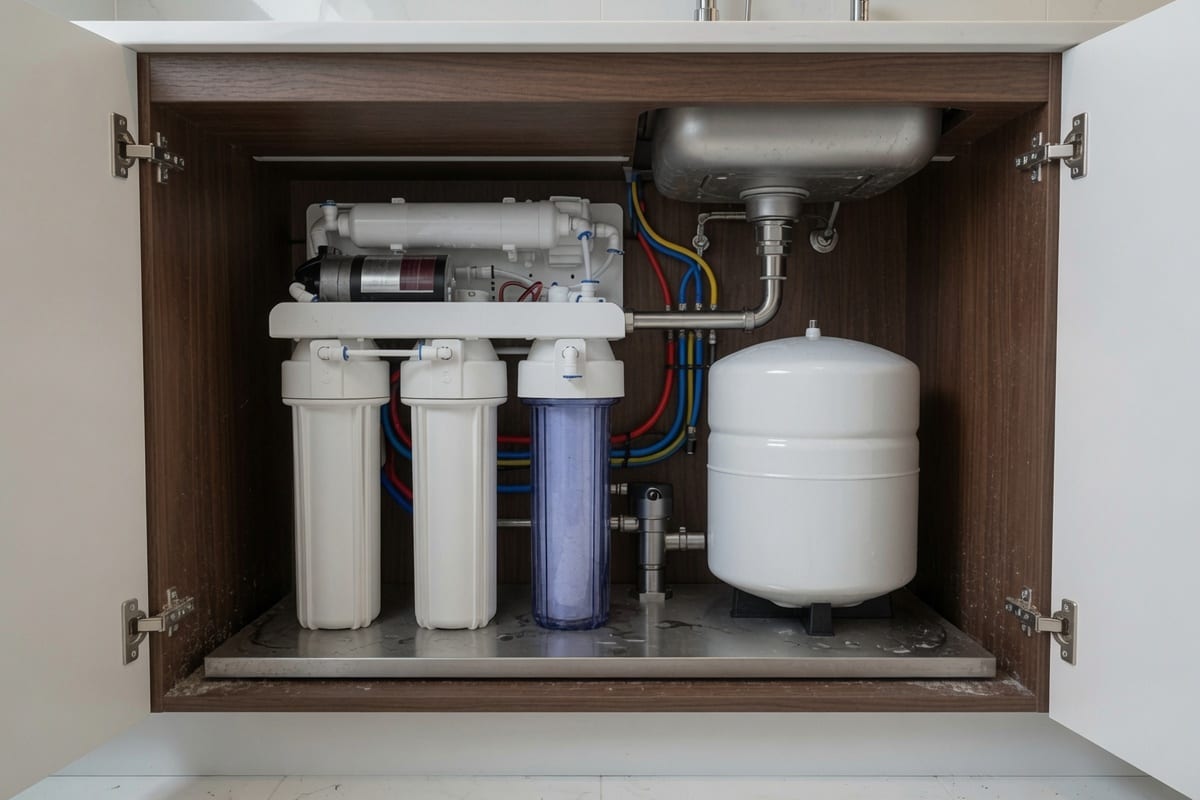
For treatment, the fact sheet names two groups suited to homes. Reverse osmosis is “a membrane filtration process commonly used by households to remove arsenic,” with the limitations that membranes can foul early and that a pre-treatment step may be needed to remove arsenic effectively. Adsorptive media, such as granular ferric oxide, can be installed at a single tap or, “at a higher cost,” for the whole house.
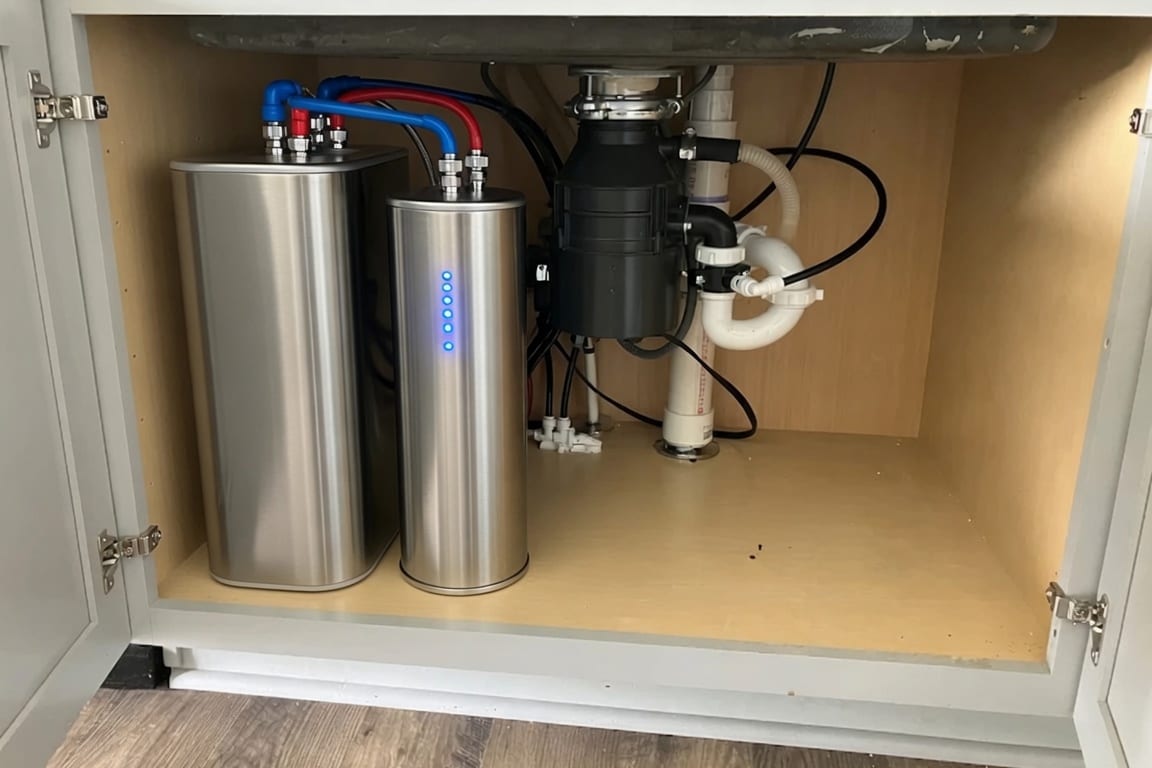
Because drinking and cooking are the main exposure route, a point-of-use system at the kitchen tap is the usual starting point. An under-sink reverse osmosis system runs $350 to $900 installed on the band in our Raleigh water filtration cost guide. That is a planning range, not a quote. We do not publish a price for whole-house arsenic media, because the sizing depends entirely on the lab result and the rest of the water chemistry.
Two cautions apply to any arsenic treatment. Choose a unit certified for arsenic reduction, since not every RO or filter carries that claim, and our comparison of under-sink RO, fridge filters and pitchers explains what the certifications cover. And retest after installation and on a schedule, because the fact sheet warns that “failure to properly maintain a water treatment system may result in exposure to elevated levels of arsenic.” Our reverse osmosis drinking water page covers installation and upkeep.
Frequently Asked Questions
Is arsenic in well water common in North Carolina?
Statewide, NC DEQ found 2.26 percent of private well samples above 10 ug/L in 2018 and 2019. It is far more common in parts of the central Piedmont: about one in five tested wells in Stanly and Union counties exceeded the standard in the state’s 1998 to 2010 data.
Is there arsenic in Triangle well water?
Less than most of the state. In NC DPH’s 1998 to 2010 data, 0.62 percent of tested Wake wells, 0.63 percent in Durham County and 0.98 percent in Orange exceeded 10 ug/L, with Chatham at 2.20 percent. Individual wells vary, so homeowners near Durham and Chapel Hill still need their own result.
Can you taste or smell arsenic in water?
No. NC DEQ describes arsenic as colorless, odorless and tasteless, so the only way to know is a lab test.
Does a water softener or whole house filter remove arsenic?
Not reliably, and neither is sold for it. The state names reverse osmosis and adsorptive media such as granular ferric oxide as the household options. Our well water treatment page covers how arsenic treatment fits alongside other equipment on a well.
What does it cost to treat arsenic in well water?
An under-sink reverse osmosis system for drinking and cooking water runs $350 to $900 installed on our cost band. Whole-house media is priced only after a lab result. Book a free consultation to go over your numbers.
Sources
- NC DEQ (Division of Water Quality, Aquifer Protection Section), Arsenic in Groundwater fact sheet, undated, observed 26 September 2026: geology, the Slate Belt, health wording, the 10 ug/L standard, and the four options.
- NC DPH county well water reports, State Laboratory of Public Health private well samples, 1998 to 2010: every county figure in the table.
- NC DEQ, private well information, observed 26 September 2026: 233 of 10,289 samples above 10 ppb in 2018 to 2019.
- NCGS 87-97: arsenic on the required test for newly constructed wells.
Getting Arsenic Out of Your Well Water
Arsenic in North Carolina well water is a geology question with a lab-test answer. Know your county’s pattern, get your own number, and if it is elevated, treat the water you drink and cook with first and keep the system maintained.
We test, size and install reverse osmosis and well water treatment across Raleigh, Durham, Chapel Hill, Pittsboro and Clayton, and we read the water before quoting anything. Well replacement and public water hookups stay with a well contractor or the utility.
Call (984) 384-6991 or schedule a free consultation for an up-front written price on treating arsenic in your well water.