Buying a House With Well Water in NC: The Checklist
Raleigh Water Pros • September 20, 2026 • 11 min read
The listing says private well. The pre-approval letter says nothing about it at all. Between those two facts sits a due diligence window that is often shorter than the laboratory’s turnaround.
Buying a house with well water around Raleigh, Wake County and the rest of the Triangle is not harder than buying on city water. It is differently timed. A city buyer inherits a utility that samples its own water hundreds of times a year and publishes the results. A well buyer inherits equipment in the yard, a hole in the ground, and whatever the last owner did or did not do about either. Our guide to city water vs well water in NC sets out the difference in full.
Here is the checklist: the paperwork to ask for before you sign, what to test and when, what your lender’s rule turns on, what a failed result does to a deal, what the treatment equipment in the basement is telling you, and what to budget once the keys are yours.
If you are standing on the other side of this deal, our guide to selling a home with well water in Raleigh covers disclosure and pre-listing prep.
What should you ask for before you make an offer?
Ask for four things: the well’s permit and certificate of completion, the county’s file of past test results, the depth and age of the well, and the service history of any treatment equipment on site.
Most buyers ask the seller. Ask the county first. North Carolina General Statute 87-97(k) requires that “each local health department shall maintain a registry of all private drinking water wells” and that the department “retain a record of the results of all tests of water from a private drinking water well until the well is properly closed.” The same statute puts the local health department, not the seller, in charge of testing a newly constructed well and giving the owner the results.
That matters because a file you request is a file nobody has to negotiate with you about. What exists varies with the age of the well and the county that permitted it, and older wells may have almost nothing on record. The office that issued the permit is the only one that can tell you what it holds.
| What to ask for | Who holds it | What it tells you |
|---|---|---|
| Well permit and certificate of completion | The county health department, under G.S. 87-97 | Whether the well was permitted, and when |
| Construction record | Same office | Total depth, casing depth, grouting, yield on the day it was drilled |
| Past water test results | Same office, which must keep them until the well is closed | Whether anything has ever failed, and what |
| Treatment equipment records | The seller | What problem somebody was already paying to treat |
| The wellhead | Your own eyes, on the first walkthrough | Cap condition, whether it sits above grade, what drains toward it |
Pro tip: ask the county before you ask the seller. Because G.S. 87-97(k) makes the local health department keep every test result until the well is closed, the history is a records question rather than a point of negotiation, and you can start it the day you go under contract.
What should you test for, and when?
Test for what North Carolina requires on a new well, add the things that list leaves out, and start the clock the day you go under contract rather than the week before closing.
The state’s required panel for a newly constructed well is written into G.S. 87-97(h): arsenic, barium, cadmium, chromium, copper, fluoride, lead, iron, magnesium, manganese, mercury, nitrates, nitrites, selenium, silver, sodium, zinc, pH, and bacterial indicators. It is a sensible floor for a resale sample too.
Note what is not on it. No hardness. No radon or uranium. No PFAS. Our post on what the NC well water testing panel misses covers the additions worth paying for by region, and water testing is the part of this job we do.
Then there is the clock, which is the part that wrecks schedules. Wake County publishes its own turnaround, and its advice to people buying and selling homes is blunt.
| Step | Wake County’s published timing |
|---|---|
| Bacteria results | usually ready in about 48 hours |
| Other tests (inorganics, volatile organics, pesticides, radiological) | 2 to 4 weeks |
| Buying or selling a home | ”Allow 4-5 weeks minimum for testing” |
Wake County’s own packages, observed on its well water testing page on 20 September 2026: the First Timer’s Package at $175 (coliform bacteria, inorganics, volatile organic compounds and pesticides), the Rads Package at $140 (uranium, radon in water, gross alpha activity and a radon in air kit), plus a $50 trip fee any time county staff collect the sample. County fees differ and change, so confirm with the county holding your parcel rather than with a blog post, this one included. A private certified laboratory can sometimes turn results faster, and Wake says so itself.
Not sure which panel your purchase needs? Request a free consultation and we will read the lab sheet with you before anyone talks about equipment.
What will your lender require?
That depends on the loan program and on your lender’s own overlay, and it is the lender rather than North Carolina that decides. Get the requirement in writing from your loan officer in the first week, because it sets both the panel and the deadline.
HUD’s Homeownership Center reference guide on individual water systems, observed 20 September 2026, describes wells as “subject to compliance with all requirements of the local and/or State Health Authority having jurisdiction,” and adds that where the local authority has no specific requirement, “the maximum contaminant levels established by the Environmental Protection Agency (EPA) will apply.” It also notes that the lender “has the option to require testing” even where nothing else mandates it.
Two practical consequences. First, the standard your sample is judged against is a local or state one, so the answer can differ between Wake, Johnston and Chatham counties. Second, some programs put an expiry on the certification, so ask how fresh the sample has to be before you book it. The current Single Family Housing Policy Handbook 4000.1 and the VA and USDA program rules each read differently, and none of this is legal advice: your lender, the county office and a licensed attorney make the determination for your file.
What happens if the result comes back bad?
Most failures are bacteriological, and most bacteriological failures clear after disinfection and a clean retest, so the usual outcome is a repair-or-credit negotiation rather than a dead deal.
The sequence is disinfection, then a retest, and the retest is the one that matters. A second positive after the well has been chlorinated is not a bacteria problem any more. It points at the casing, cap, seal or grout, and no amount of chlorine closes a failed seal. We walk that through in what to do when a well water inspection fails, and a coliform positive well test covers the first 24 hours in detail.
Who pays is set by your purchase contract, not by statute. That is a conversation for your agent and the closing attorney.
What does the treatment equipment in the basement tell you?
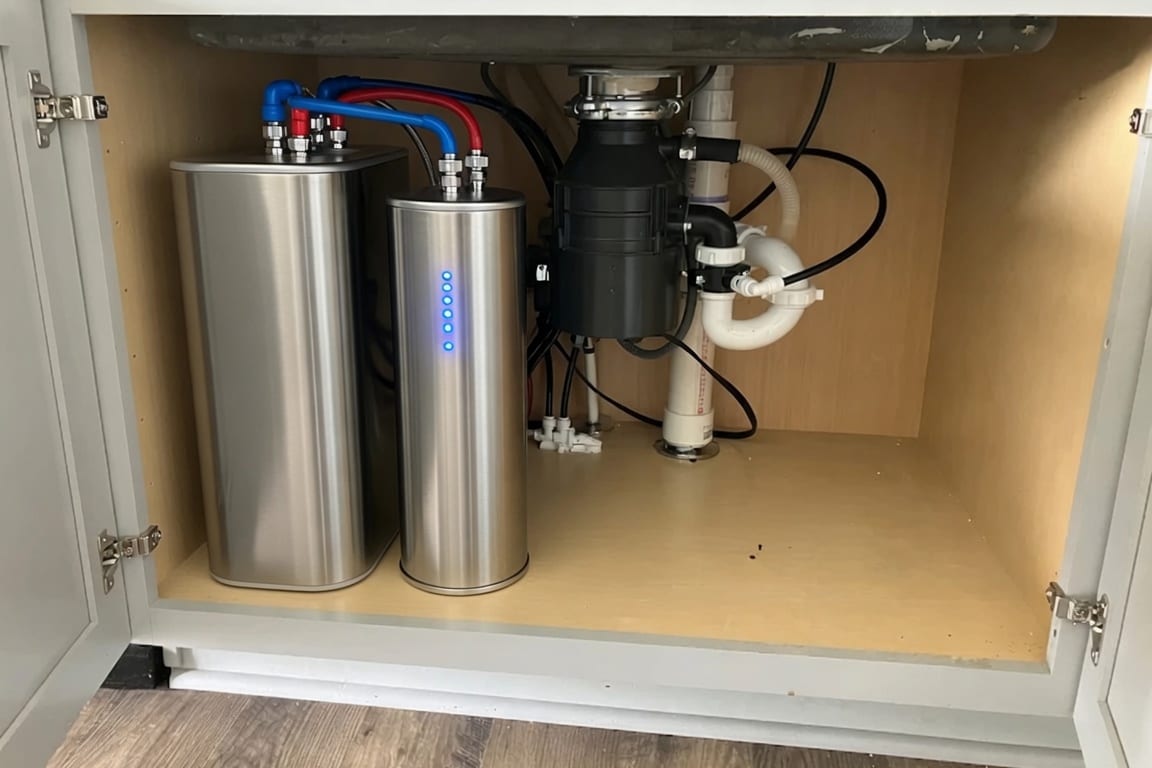
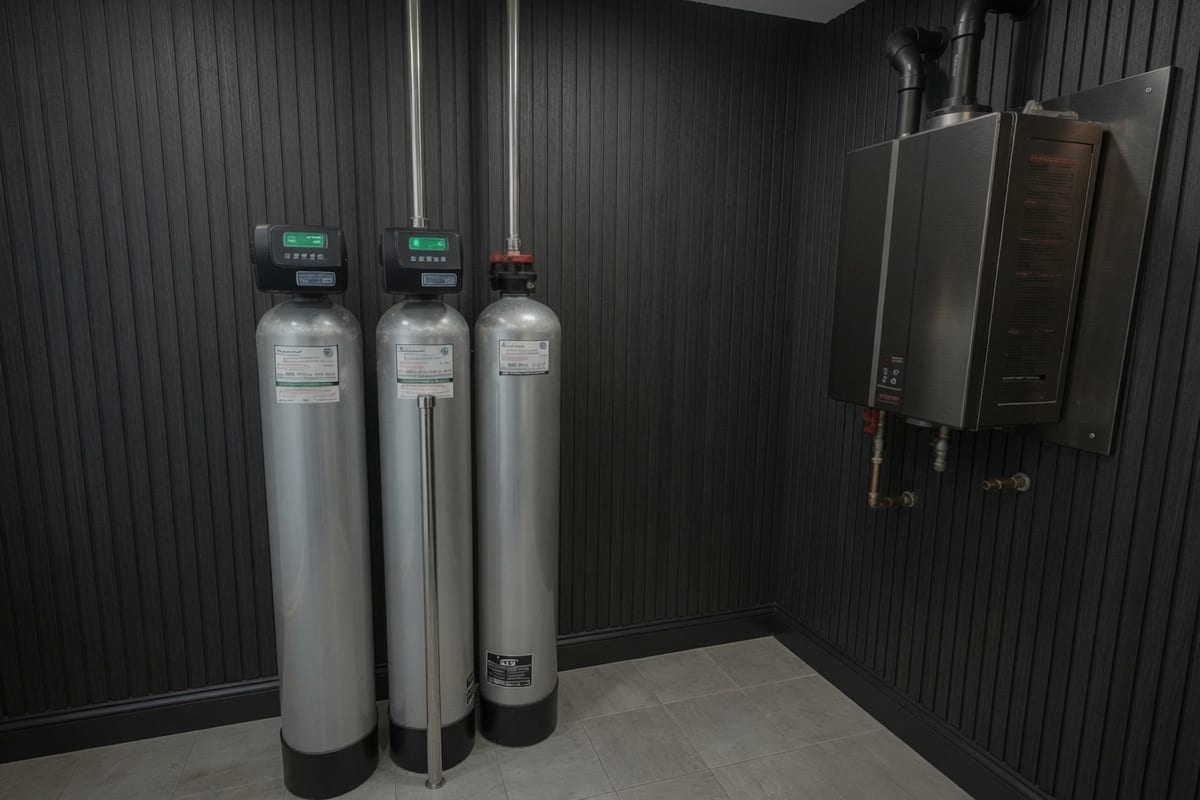
That somebody already had a problem. A tank in the utility room is not a bonus feature. It is a receipt.
- A water softener suggests the hardness was bad enough that a previous owner spent money on it.
- An iron or sulfur filter suggests staining on fixtures, laundry or an odour at the tap.
- An acid neutralizer suggests the pH tested low, which is the stage that protects copper plumbing. Our post on pinhole leaks in copper pipes explains what that damage looks like.
- A UV lamp points at a bacteria result at some stage, though not always: some owners fit one as a precaution, and some come as part of a package deal rather than in response to a test.
Read all of that as a prompt to ask questions, not as a diagnosis. Equipment tells you what somebody once decided to buy, which is not the same as what the water measured, and none of it substitutes for your own test. None of it is a reason to walk either. It is a reason to ask what the original result was, when the media was last changed, when the UV lamp was last replaced and whether anyone has tested since. Unmaintained equipment is a liability wearing the costume of an asset, and a treatment train sized for water nobody has retested in eight years is a guess.
On hardness specifically, be careful with any number you are quoted. North Carolina’s required new-well panel does not include hardness at all, so a new well’s own file will not carry it. Private wells around the Triangle commonly run far harder than city water, though we have no representative dataset to check that against and yours could land anywhere. Measure it. Our well water treatment work starts with the lab sheet for exactly that reason.
What should you budget after closing?
Budget nothing until the results are in, then budget by the problem. These are the planning ranges we use in the Triangle, never a quote, and the Raleigh water filtration cost guide breaks down what moves each one.
| What the result shows | Typical installed range |
|---|---|
| Bacteria that keeps coming back after the well is sound | UV disinfection, $700 to $1,500 |
| Low pH | Acid neutralizer, $1,200 to $2,200 |
| Hardness | Water softener, $1,500 to $3,500 |
| Iron staining or a rotten egg smell | Iron and sulfur filter, $1,800 to $3,500 |
| Nitrate or another drinking-water-only problem | Under-sink reverse osmosis, $350 to $900 |
| Several of the above at once | Full well water system, $4,000 to $8,000+ |
Add the recurring line nobody budgets: softener salt at $50 to $150 a year, plus media and filter changes. Our well water treatment cost guide carries the rest of the maintenance picture.
Frequently Asked Questions
Does North Carolina require a water test when a house on a well is sold?
The state’s mandatory test attaches to newly constructed wells, not to resales. G.S. 87-97(h) puts the test on the local health department within 30 days of issuing a certificate of completion. Whether your purchase needs a test comes from your contract and your lender, and requirements vary by parcel, scope and jurisdiction, so the county office, the lender or a licensed attorney makes that determination.
How long does well water testing take before closing?
Bacteria results are usually ready in about 48 hours, and Wake County puts other tests at 2 to 4 weeks. For a home purchase the county’s own instruction is to “Allow 4-5 weeks minimum for testing,” observed 20 September 2026. Book the sample the week you go under contract, not the week you plan to close.
Can I rely on the seller’s old water test?
Ask your lender, because some programs set a maximum age for the certification. Beyond the paperwork, a sample is a snapshot: wells around Clayton and Johnston County can flip positive after a wet week and clear again on their own, which is why a current sample is worth more than a clean one from two springs ago.
Is a water softener on the property a good sign or a bad one?
Both. It tells you the water needed treating, and it tells you somebody dealt with it. A whole-home softener runs $1,500 to $3,500 installed here, so an existing unit in good order has real value, while one that has not seen salt in two years is a replacement you have not priced yet.
Who do I call if the problem is the well itself?
A certified well contractor, with your county health department inspecting first. We do not drill wells, work on pumps or pressure tanks, or touch casings, caps or grout. We test water and install treatment, and around Wake Forest and Fuquay-Varina that split comes up most weeks.
What is the cheapest mistake to avoid as a well buyer?
Waiting. The testing clock is the only part of this that cannot be shortened by spending more, and a sample booked late is the most common reason a well deal misses its closing date. Everything else on this page is a phone call or a records request, and our guide to water testing cost in NC shows what the panels run before you book one.
Sources
Fees, forms and agency guidance change. Check the current version before you rely on any of it.
- G.S. 87-97, North Carolina General Assembly, read 20 September 2026: subsection (h) for the required analyte list and the 30-day test on a newly constructed well, (j) for results going to the owner, (k) for the well registry and the retention of test results.
- Wake County, well water testing, observed 20 September 2026: the $175 First Timer’s Package, the $140 Rads Package, the $50 trip fee, the 48-hour and 2-to-4-week turnarounds, and the “Allow 4-5 weeks minimum” instruction for home sales.
- Wake County, well permits, fees and approvals, observed 20 September 2026: permit fees and five-year validity.
- HUD, Homeownership Center Reference Guide, Individual Water Systems, observed 20 September 2026. This is HUD’s archived reference guide; the Single Family Housing Policy Handbook 4000.1 is the current authority and your lender applies it, so confirm the requirement with the loan officer.
Buying a house with well water in the Triangle
Run it in this order: request the county file, book the sample the week you go under contract, get the lender’s requirement in writing, and read the equipment on site as evidence rather than as a feature list. That sequence turns a well from an unknown into a line item.
We test water and install treatment across Raleigh, Wake Forest, Clayton, Fuquay-Varina and Chapel Hill, and we say plainly when the next call belongs to a well contractor or the county instead of to us. Call (984) 384-6991 or book a free consultation for an up-front written price based on your results, not on a guess about your address.