Reverse Osmosis Not Working? Causes and Fixes
Raleigh Water Pros • September 26, 2026 • 10 min read
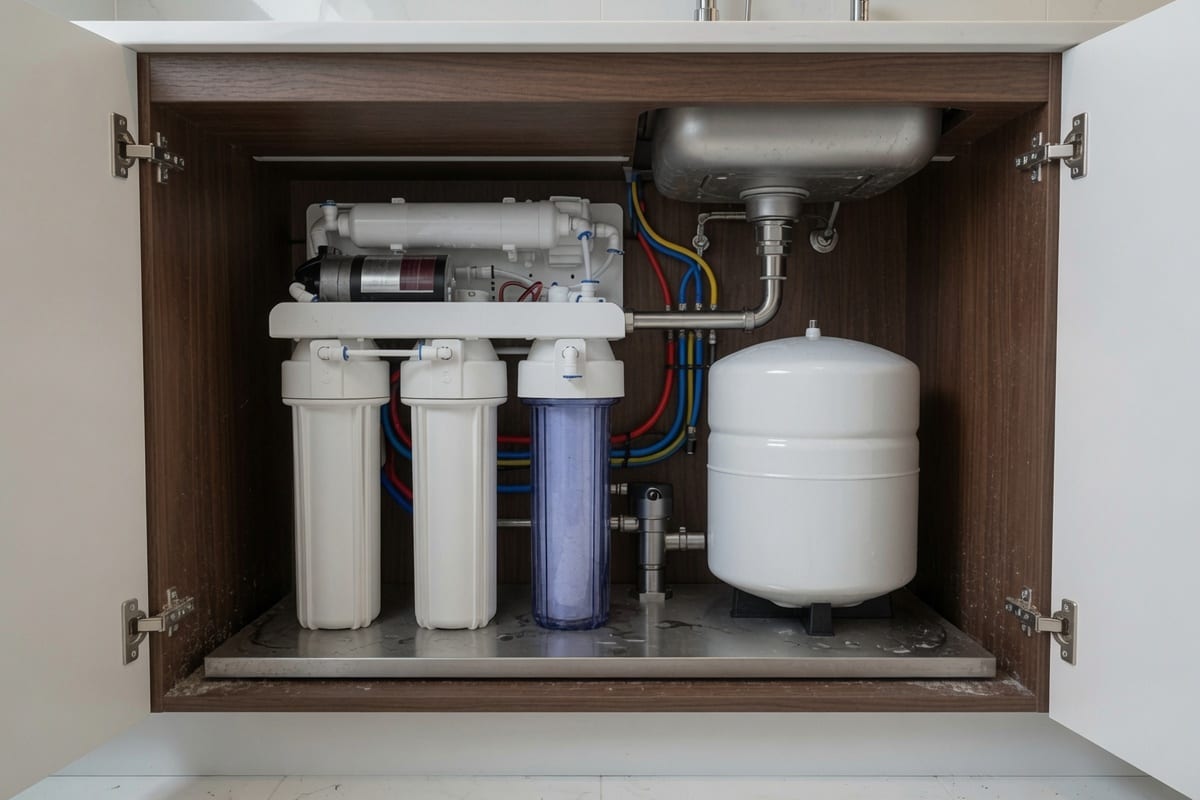
The RO faucet used to fill a glass in a few seconds. Now it dribbles, or fills half a glass and quits. Or the water tastes the way the kitchen tap does, or you can hear the drain line running at two in the morning.
A reverse osmosis system not working is rarely a dead membrane. Under-sink RO is a pressure machine: water is pushed through a membrane against the pressure of the storage tank, and most failures are that balance going wrong. The membrane is the last thing to suspect, not the first.
This guide covers the symptoms homeowners in Cary, Apex and the rest of the Triangle report, what causes each, what you can check yourself, and when a new system beats another repair. Dollar figures are planning ranges, not quotes.
Why is my reverse osmosis system not working?
Most reverse osmosis problems come from one of three places: not enough pressure reaching the membrane, a storage tank that has lost its air charge, or prefilters that have clogged. A fouled or worn membrane is real but less common, and it is the expensive answer, so rule out the cheap ones first.
The Water Quality Association’s sizing guide gives the arithmetic behind all of it. The pressure actually driving water through the membrane is the feed pressure minus two things pushing back: the osmotic pressure of the dissolved solids in your water (roughly 1 psi for every 100 mg/L), and the back pressure of the storage tank, “roughly equal to the air pre-charge on the tank.” When that difference gets small, production slows and quality drops. WQA puts it bluntly: “Storage tank back pressure is a key factor when troubleshooting RO performance.”
| Symptom | Most likely cause | What to check first |
|---|---|---|
| Faucet trickles, tank never seems full | Low feed pressure or clogged prefilters | Feed valve fully open; prefilter age |
| Strong flow for a few seconds, then nothing | Tank air charge too low or bladder failed | Empty-tank air pressure |
| Stopped working right after a filter change | Closed valve, trapped air, unseated cartridge | Valves, housings, a full flush |
| Tastes like tap water, or worse | Membrane fouled or worn, or low pressure | Tap versus RO reading on a TDS meter |
| First glass of the morning tastes off | Normal TDS creep after sitting | Run the faucet briefly first |
| Drain runs constantly | Automatic shut-off or check valve not closing | Listen with the tank full |
| Gurgling at the faucet or the sink | Drain line or air gap partly blocked | Drain saddle and air gap |
| Drip or puddle under the sink | Fitting, housing O-ring or tank connection | Dry every joint, then look again |
The pressure checks you can do yourself
Three checks cover most failures, with nothing more than a bucket and a tire gauge.
Feed pressure. Confirm the feed valve on the cold line is fully open; it is often a small saddle or angle valve that gets bumped. WQA notes that “the pressure from a municipal source should be sufficient,” while “pressure in private wells can be problematic.” A well that cycles low to moderate pressure may not push an under-sink system hard enough, and WQA says a booster pump on the RO itself may be needed. That is a small RO accessory, not the well pump; a well contractor handles the well side.
Tank air charge. WQA says tank air pressure is “typically … set between 5 and 10 psi.” The charge is read with the tank empty, so close the feed valve, open the RO faucet until it stops, and put a tire gauge on the valve on the side of the tank. Near zero means it needs air or the bladder has failed. Too high and the tank holds very little water.
Temperature. Membranes are rated at 77°F and 60 psi, and WQA says production falls about 3 percent for every 1°C the water is colder. A slower tank in February, on a well or a cold kitchen line, can be normal rather than a fault.
Pro tip: If a tank feels heavy but the faucet quits after a few seconds, the water is there and the air is not. Lifting an empty tank and finding it heavy is the fastest bladder test there is. A tank with a failed bladder is a replacement, not a recharge.
Want the pressure, the tank and the water read in one visit? Request a free consultation and we test first, then quote in writing.
Reverse osmosis not working after changing filters?
When RO stops working right after a filter change, the cause is almost always the change itself, not a coincidence. Work through these before assuming a bad part.
- A valve left closed. The feed valve and the tank valve both get shut for a filter change. Check both are fully open.
- Trapped air. New cartridges hold air, and the first tank or two after a change can sputter and run slow. Drain and refill the tank per the manual before judging it.
- A cartridge not seated, or an O-ring pinched. A housing that was hard to close, or a slow drip at the housing, points here. Unscrew, reseat, lubricate the O-ring as the manual says, and close it again.
- The wrong cartridge. A finer micron rating or a different length can starve the membrane or bypass it altogether.
- Carbon fines in the first water. Black specks or a cloudy first tank after new carbon is common and should rinse out. The manual’s flush step exists for this.
How often each stage is due, and why the carbon stage protects the membrane, is covered in our guide on how often to change a whole house filter, which has a section on RO.
Why does my RO water taste bad?
RO water that tastes like tap water usually means the membrane is passing more than it should, either because it is worn or fouled or because pressure is too low for it to work properly. A handheld TDS meter tells you which direction to look; it measures dissolved solids, not safety.
Read the kitchen tap, then the RO faucet, and compare. WQA gives the formula: percent rejection equals the tap reading minus the RO reading, divided by the tap reading, times 100. Its nominal table puts a thin film composite membrane at 90 to 98 percent rejection for sodium and 93 to 99 percent for calcium and magnesium, at 60 psi net and 77°F. A membrane well below its manufacturer’s rating, with feed pressure and tank charge confirmed good, is due.
Two cases are not faults. WQA describes TDS creep: when the system sits, dissolved solids slowly cross the membrane, so the first draw of the morning reads higher, and “water quality should improve after 5-10 minutes of use.” And RO removes the chloramine taste only because of its carbon stages; on Raleigh or Cary city water, a chemical taste coming back usually means the carbon cartridge, not the membrane. Our carbon filtration page covers why chloramine needs catalytic carbon.
On a well, fouling is the bigger risk. WQA notes that iron and manganese “can easily foul” the membrane “even at low concentrations,” and “generally … should be removed by other water treatment methods prior to RO treatment.” A membrane that fails early on a well outside Apex or Holly Springs is telling you about the water ahead of it. The well water treatment page covers that pre-treatment.
Why does my RO drain run all the time?
A drain that keeps running when the tank is full means the system is not shutting off, and it is usually the automatic shut-off valve or the check valve. WQA “strongly recommends that all residential RO systems use a functioning auto shut-off mechanism to reduce wasted water,” because without one the system keeps sending water to the drain.
To check, let the tank fill with no faucet open, wait an hour, then listen at the drain line or the air gap faucet. Steady trickling means the shut-off is not closing.
Gurgling is different. The drain line runs from the system to a saddle on the sink drain, and many RO faucets carry an air gap. A kink, a clog at the saddle, or debris in the air gap makes noise and sometimes spills water at the faucet base. Clearing it is usually straightforward.
Repair it, or replace the system?
Repair usually makes sense when one part has failed on an otherwise sound system; replacement makes sense when the tank bladder, the membrane and the housings are all due at once. An installed under-sink system runs $350 to $900 in the Triangle, per our Raleigh cost guide, and a string of parts on an old unit can approach that.
The reverse osmosis cost guide sets out what goes into an installed price. If you are unsure whether RO is even the right tool, the under-sink RO versus fridge filter versus pitcher comparison matches each option to the problem it solves.
One boundary worth knowing: WQA warns that small home RO systems “should never be used as a primary means of removing biological contamination.” If a well tests positive for bacteria, RO at the kitchen sink is not the fix; disinfection of the whole supply is.
Frequently Asked Questions
Why is my reverse osmosis faucet so slow?
Usually low feed pressure, clogged prefilters or a tank that has lost its air charge. Check that the feed valve is fully open, note the prefilter age, and read the empty-tank air pressure with a tire gauge. WQA puts the typical setting at 5 to 10 psi.
Why did my reverse osmosis stop working after I changed the filters?
Most often a valve was left closed, air is trapped in the new cartridges, or a housing is not seated. Open the feed and tank valves fully, reseat each housing, then drain and refill the tank before judging the result.
How do I know if my RO membrane is bad?
Compare a TDS reading from the tap with one from the RO faucet. If rejection has fallen well below the manufacturer’s rating and pressure and tank charge are fine, the membrane is worn or fouled. On a well in Garner or Apex, iron ahead of the RO is a common culprit.
Is it normal for an RO system to run water to the drain?
Yes while it is making water, no once the tank is full. A drain that runs around the clock means the automatic shut-off or check valve is not closing.
How much does a new under-sink reverse osmosis system cost?
Most Triangle homes pay $350 to $900 installed. Our reverse osmosis drinking water page explains how we size one.
Does cold well water slow down reverse osmosis?
Yes. Membranes are rated at 77°F and WQA says production drops about 3 percent per 1°C colder, so winter well water fills the tank noticeably slower. That is normal, not a fault.
Sources
Read or checked 26 September 2026.
- Water Quality Association, POU Reverse Osmosis Performance and Sizing (Education Kit Volume X, Article 4): differential pressure, osmotic pressure, tank precharge and back pressure, temperature, TDS creep, percent rejection, iron and manganese fouling, the auto shut-off recommendation and the biological contamination warning.
- Raleigh Water reports and the Town of Cary water report, 2025: chloramine as the disinfectant residual.
Get Reverse Osmosis Fixed in Cary, Apex and the Triangle
When reverse osmosis is not working, check the feed valve, the tank charge and the prefilters before anyone talks about a new membrane. Most of the time the fix is on that short list.
We install and service under-sink RO across Raleigh, Cary, Apex, Holly Springs and Garner, and on a well we read the iron and hardness first, because that decides how long a membrane lasts. Book a free consultation and get an up-front written price for only what your water needs.
Call (984) 384-6991 or book your free consultation.