How to Choose a Water Treatment Company in Raleigh
Raleigh Water Pros • September 26, 2026 • 10 min read
Search for water treatment companies in Raleigh and you get a map full of pins, a column of ads and a dozen websites that say roughly the same thing. None of that tells you which one will measure your water, size the equipment from the reading and still answer the phone in year three.
This guide is about how to choose a water treatment company on evidence you can check yourself, whether you are on Raleigh Water in North Hills, on Cary’s system in Morrisville, or on a private well outside Garner or Clayton, and whatever the system.
Below: what to have in hand before anyone visits, ten questions to ask, what a written quote should show, the red flags, and how to compare two quotes. Prices are planning ranges, never quotes.
How do you choose a water treatment company?
Choose the company that measures your water before it recommends anything, sizes the equipment from that reading, puts every cost in writing, and passes a licence check you run yourself. Brand, showroom and ad budget tell you very little. Those four habits tell you most of what matters.
NC State Extension’s buyer checklist (AG 473-3, revised December 2024) ends on the rule under all of it: get every promise in writing, and know how to reach the company that sold you the equipment.
Start with your water, not with the company
The most useful thing you can bring to a sales visit is a number. It makes a bad recommendation obvious.
On city water the number is already published. Raleigh Water’s 2025 report puts hardness at about 1.49 grains per gallon at the E.M. Johnson plant and labels it “Soft”, and the city disinfects with chloramine most of the year. Cary’s system, which also serves Morrisville, reports about 1.8 grains and prints “moderately soft”. A company that recommends a whole-home softener on either supply on hardness grounds has not read the report. Our guide to finding out what is in your water shows where each report lives.
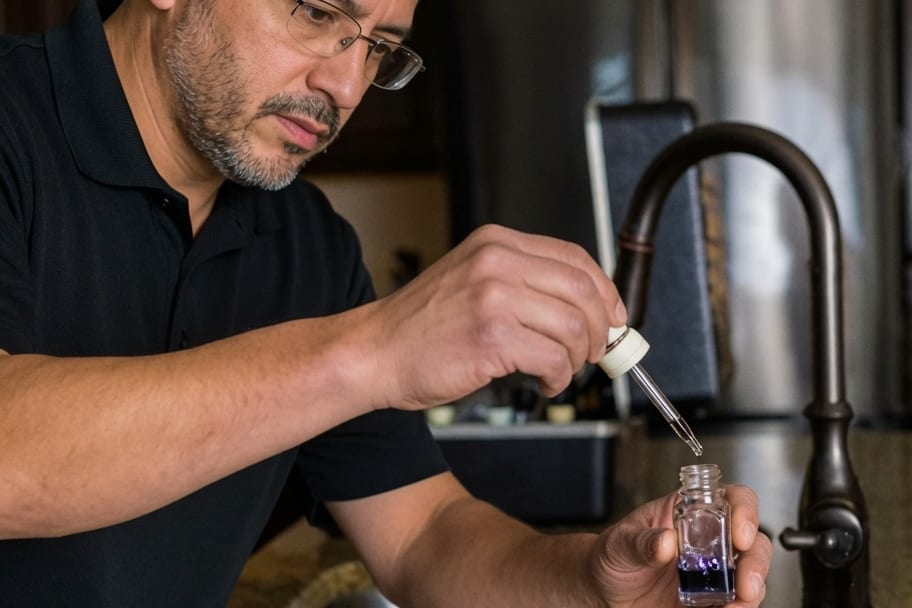
On a private well nothing is published for you, so the reading has to happen first. NC State’s advice on in-home readings is specific: “Be wary of any in-home test which claims to determine more than basic water quality parameters such as pH, hardness, iron, and sulfur.” A kitchen-table reading of those four is a fair starting point for sizing. Anything with a health limit (bacteria, nitrate, arsenic, lead) belongs to a certified laboratory, which is what our water testing and analysis page explains.
Ten questions to ask every water treatment company
Ask every company the same ten, and write the answers down.
| Question | A good answer sounds like | A warning sign |
|---|---|---|
| What did you measure, and what were the numbers? | Hardness, iron, pH and the reading, written on the proposal | ”Your water is bad” with no numbers |
| Why this system and not a smaller one? | Tied to a reading, your household size and your peak flow | ”This is what everyone in Raleigh gets” |
| Is the equipment certified for the claim you made? | A named NSF/ANSI standard you can look up | ”Our own lab tested it” |
| What will it not remove? | A specific list | ”It removes everything” |
| What does it cost to run each year? | Salt, media, cartridges, lamps and power, itemized | ”Almost nothing” |
| Who does the maintenance, and how often? | A schedule, and whether you can do it yourself | Maintenance only through a paid plan |
| Who physically installs it? | A named company and its licence number on the proposal | ”A guy we use” |
| What happens if it does not fix the problem? | A written remedy for that specific problem | A verbal promise |
| Who carries the labour warranty, for how long? | A named entity and a term, in writing | ”The manufacturer handles that” |
| Can I have this price in writing to compare? | Yes, today, with no expiry by tonight | A discount that dies if you wait |
Items seven through nine are where NC law and NC State Extension overlap. North Carolina puts whole-house treatment installation inside its plumbing contracting statute, and our guide to who can legally install water treatment in NC walks through the law and the free state licence search. Run that search yourself on every company whose quote you hold.
Want the reading done before anyone talks equipment? Request a free consultation and we test first, then quote in writing.
What should a written water treatment quote include?
A written quote should name the water reading it was built from, the exact equipment and its size, the installed price, and the yearly running cost, because those four lines let you compare one company against another.
NC State lists the costs people forget: “hidden costs such as installation fees, regular maintenance fees, equipment rental fees, or costs associated with disposal of reject water or spent cartridges.” Each system also has details that decide whether it works:
| System | Planning range, installed | What the quote should state for this system |
|---|---|---|
| Water softener | $1,500 to $3,500 | Hardness and iron used for sizing, grain capacity, the hardness setting it will be programmed to |
| Whole house carbon filter | $1,500 to $3,500 | Standard or catalytic carbon (chloramine needs catalytic), tank size, rated flow |
| Under-sink reverse osmosis | $350 to $900 | NSF/ANSI 58 certification, storage tank size, the faucet and drain connection |
| Iron and sulfur filter (well) | $1,800 to $3,500 | Iron level, pH and the backwash flow the well must supply |
| Acid neutralizer (well) | $1,200 to $2,200 | Starting pH, media type, how often media is topped up |
| UV disinfection (well) | $700 to $1,500 | Rated flow, the prefilter ahead of it, lamp change interval |
| Full well water system | $4,000 to $8,000+ | Every stage in order, and what each one is there to fix |
Those ranges come from our Raleigh water filtration cost guide, which breaks each one down further. A number far outside a range like this deserves a question, not an assumption.
The quote should also say who pulls a permit if your jurisdiction needs one. Permit requirements vary by parcel, scope and jurisdiction, and the city or county inspections office decides, not the installer. For softeners specifically, the big box versus local installer comparison has a line-by-line installation checklist.
Pro tip: Hand every company the same sheet before they quote: your utility report or well reading, household size, number of bathrooms, and the distance from the main line to the nearest drain and outlet. Two quotes built from the same facts can be compared. Two quotes built from two different guesses cannot.
What are the red flags when hiring a water treatment company?
Most red flags are about pressure and vagueness, not equipment. Any one is a reason to slow down.
- A scare before a number. Colour-changing drops or talk of what is “in your water” with no lab result behind it.
- A price that expires tonight. Good equipment is still good equipment on Thursday.
- A softener for a Raleigh or Cary taste complaint. Chloramine taste is a carbon question.
- “Removes everything.” CDC’s guidance says to “check the product’s label for the specific substances the filter can remove.”
- No certification you can look up in NSF’s public database.
- A rental or finance contract you have not read at home. Our rent versus buy breakdown covers who owns the equipment at the end.
- No licence number on the proposal. G.S. 87-21(e) requires the number on proposals and contracts for licensed plumbing work, which in North Carolina includes whole-house treatment.
If you do sign at your kitchen table, know the federal Cooling-Off Rule. The FTC says it covers sales of $25 or more made at your home, and your right to cancel for a full refund “lasts until midnight of the third business day after the sale.” The seller must give you two copies of a cancellation form.
How many quotes should you get, and how do you compare them?
Two written quotes built from the same water reading is usually enough; three helps for a full well train.
Compare them in this order: the diagnosis (if one says iron and the other says hardness, settle the water question first), the sizing numbers, the work included (bypass, drain, old equipment removal, startup), and five years of running cost. A softener on a soft city supply is the classic cheap-to-buy, costly-to-run mistake, burning $50 to $150 a year in salt for no benefit.
On a well in Garner or Clayton, quotes differ more, because iron, pH and hydrogen sulfide change the stage order. On city water in Cary or Wake Forest, two quotes for the same carbon or RO system usually land close together.
Frequently Asked Questions
What questions should I ask a water treatment company before I buy?
Ask what they measured and what the numbers were, why they chose this size, which NSF/ANSI standard the equipment is certified to, what it will not remove, what it costs to run each year, and who installs and warranties it. Get the answers in writing. NC State Extension’s AG 473-3 checklist is the best free starting point.
Is it better to use a local company or a national brand?
Either can be right; the process matters more than the badge. Did they measure, size from the reading, and name the installer and labour warranty in writing? Our whole house water filtration page shows how sizing from a reading works.
Should a water treatment company test my water before quoting?
Yes, for anything beyond a simple drinking water filter. On Raleigh or Cary city water the utility report covers most of it; on a private well the hardness, iron and pH reading decides the system.
How much should water treatment cost in Raleigh?
Most whole-home systems in the Triangle fall between $1,500 and $3,500 installed, with under-sink RO at $350 to $900 and a full well water system at $4,000 to $8,000+. Those are planning ranges from our cost guide, not quotes.
What should I do if a salesperson pressures me to sign today?
Ask for the price in writing and say you will call back. If you have already signed at home, the FTC Cooling-Off Rule gives you until midnight of the third business day to cancel for a full refund.
Do I need a water treatment company at all on city water?
Often not for hardness, since Raleigh and Cary both publish soft water. Many homeowners on those systems want chloramine taste or specific contaminants handled, and that is a carbon or RO question. Our well water treatment page covers the very different picture on a private well in Wake Forest or Clayton.
Sources
Read or checked 26 September 2026.
- NC State Extension, Questions to Ask When Purchasing Water Treatment Equipment (AG 473-3), Jennings and Sneed, revised 11 December 2024: the twelve buyer questions, the in-home test warning, hidden costs, and getting promises in writing.
- CDC, About Choosing Home Water Filters, last reviewed 10 April 2024: certification and checking the label for specific substances.
- NSF certified drinking water treatment units, the public listing for checking a certification claim.
- FTC, Buyer’s Remorse: The FTC’s Cooling-Off Rule, updated September 2025: the three business day cancellation right for in-home sales of $25 or more.
- Raleigh Water reports (2025 hardness and chloramine) and the Town of Cary water report (2025 hardness).
Choosing a Water Treatment Company in Raleigh and the Triangle
The right water treatment company is the one whose recommendation you could have predicted from your own water numbers. Measure first, ask the ten questions, and check the licence yourself.
We install and size softeners, carbon, reverse osmosis and well treatment across Raleigh, Cary, Garner, Clayton and Wake Forest, and every job starts with a reading at your tap. If you want a water treatment company that puts the numbers on the page, book a free consultation and get an up-front written price. You can see every system we handle on our services page.
Call (984) 384-6991 or request your free consultation.