How to Find Out What Is in Your Water in NC
Raleigh Water Pros • September 20, 2026 • 10 min read
You want to know what is in your water. Maybe the ice tastes like a swimming pool, maybe the guest bathroom sink has gone orange, maybe you read a PFAS headline and your toddler drinks from the kitchen tap. So you searched, and every result wanted to sell you a test.
Most of what is in your water has already been measured and published. On a city supply in Raleigh, Cary or Garner, a utility sampled it thousands of times last year and printed the results. On a well, the state required a named list of analytes when it was drilled.
So finding out what is in your water starts with reading what exists. It costs nothing, takes twenty minutes, and tells you whether you need a laboratory. This guide runs the free steps in order and puts lab work last, for the three things nothing else answers.
How do I find out what is in my water for free?
Work through four free sources in order and stop when one answers your question: your utility’s annual report, the databases that republish it, your own eyes and nose, and a hardware store strip. A certified laboratory is step five, not step one.
| Step | Cost | What it answers | What it misses |
|---|---|---|---|
| 1. Your utility’s annual report | Nothing | Source, disinfectant, every regulated contaminant detected last year, any violation | Your own plumbing, often hardness |
| 2. EPA and EWG databases | Nothing | Which system serves you, and its violation record | Anything the utility did not publish |
| 3. Your own eyes and nose | Nothing | Staining, smell, cloudiness, which taps, what changed | Any number, anything invisible |
| 4. Hardness or pH strip | $10 to $20 | Rough hardness, rough pH, any disinfectant residual | Bacteria, lead, nitrate, metals, PFAS |
| 5. Certified laboratory | Varies by panel | Bacteria, lead at your tap, PFAS, nitrate, metals | Nothing, but you pay per line |
Well owners skip step one: no report exists for a private well.
Want those numbers read at your own tap rather than guessed at? Request a free consultation and we measure first, then quote in writing.
Step one: read your utility’s annual report
Every community water system has to hand you one, formally a Consumer Confidence Report, and EPA is blunt about the deadline: “Reports must be sent by your water supplier each year by July 1.” It must name the lake, river or aquifer the water comes from, summarise the risk to that source, and list every regulated contaminant found.
Raleigh Water’s 2025 report covers more addresses than people expect: Raleigh, Garner, Wake Forest, Rolesville, Knightdale, Wendell and Zebulon all sit inside one system, PWSID NC0392010. From it: the source is Falls Lake and Lake Benson, the disinfectant is chloramine at 2.80 ppm against a limit of 4, trihalomethanes ran 34.2 ppb against an MCL of 80, hardness was 25.2 mg/L (about 1.47 grains per gallon) printed “Soft”, and the violation column reads “No” throughout.
Read a line left to right: amount detected, range, legal limit, health goal, violation yes or no. A number under the limit with “No” beside it means the utility met the standard, not that the substance is absent.
Pro tip: hardness is not a regulated contaminant, so no rule requires it on the report, and it is missing from North Carolina’s required well panel too. Cary prints its hardness (30 mg/L, about 1.8 grains per gallon, “moderately soft”) in the plant’s testing summary rather than the report, and Clayton, Fuquay-Varina and Holly Springs publish none anywhere. Nobody can tell you your hardness over the phone, on either supply.
The report describes the system, not your house. Lead and copper figures come from a set of selected homes, so a 1962 ranch in Garner with original fixtures is not in them. Our line-by-line read of that report is in is Raleigh tap water safe to drink.
Step two: what the EPA and EWG databases really tell you
EPA’s “Find Your Consumer Confidence Report” tool confirms which system serves your address, and that matters more than it sounds. A Fuquay-Varina home buys from three utilities on two river basins; a Holly Springs home is on Harnett Regional water; a Cary home is on Jordan Lake. Guess, and you read the wrong report.
The EWG Tap Water Database is the other name people land on. It republishes utility test data against EWG’s own health guidelines, and EWG is clear those are not legal limits: they are set on health grounds alone, without regard to treatment cost or feasibility, and several cover contaminants with no federal limit at all. So a result flagged as hundreds of times above an EWG guideline can sit far below the enforceable limit, with no violation of anything. Read the measured number and the legal limit beside it, not the multiplier.
Neither database measures anything. Both republish what a utility reported, a year or two back.
Step three: what a $10 test strip can and cannot tell you
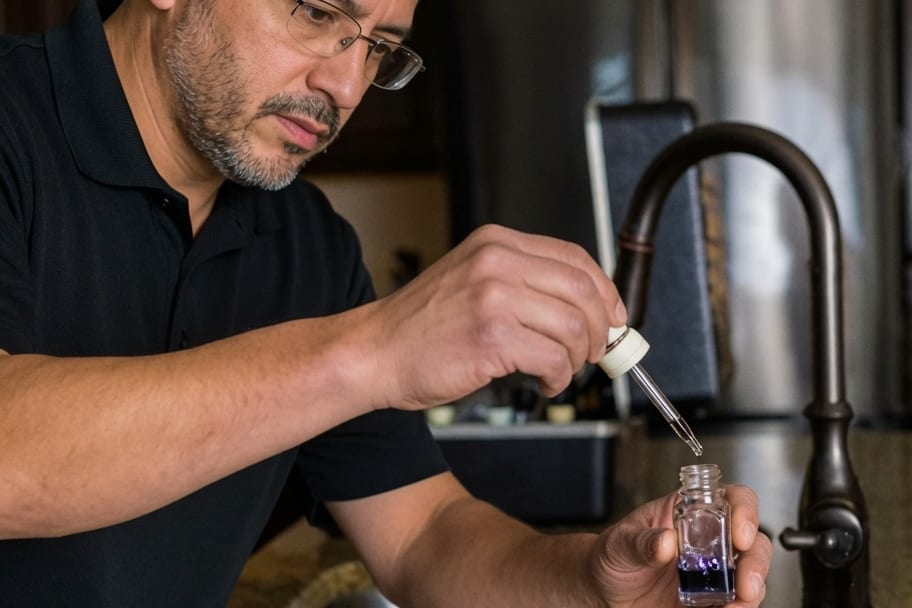
A strip measures a very short list: usually total hardness, pH and free chlorine, sometimes iron, nitrate and alkalinity. It matches a colour block, so it gives a band, not a figure. That is enough for three questions: whether your water is hard enough to be worth softening, whether your pH is clearly acidic (common in Piedmont well water, and the reason blue-green stains show up in sinks), and whether a disinfectant residual is present at that tap.
It cannot tell you about bacteria, lead, arsenic, PFAS, or nitrate at the 10 mg/L line that matters for infants, and no lender or health department accepts one.
Sample properly or the number is fiction. Run the cold tap, sample ahead of any treatment already fitted, and use a threadless tap if you have one, which is what the state’s rule specifies for new wells. Testing after a filter tells you how the filter is doing, not what is in the water.
What does North Carolina’s required well test cover?
Within 30 days of issuing a certificate of completion for a new private well, the local health department must have the water sampled and tested by a certified laboratory. North Carolina General Statute 87-97(h) names the analytes: 18 chemical and physical parameters plus bacterial indicators.
| On the required panel | Not on it |
|---|---|
| Bacterial indicators (coliform, then E. coli) | PFAS |
| Arsenic, barium, cadmium, chromium, mercury, selenium, silver | Radon, uranium |
| Lead, copper, zinc | Gross alpha and beta |
| Iron, magnesium, manganese, sodium | Hardness |
| Fluoride, nitrate, nitrite | VOCs and pesticides |
| pH | Hydrogen sulfide |
Note the left column. Lead is on the required panel, and plenty of vendor copy tells well owners it is not. What the panel cannot say is whether lead is coming from your plumbing, because that sample is drawn ahead of everything, which measures the well, not the house.
Wake County sells the additions. Its First Timer’s Package covers coliform bacteria, a full inorganic panel, volatile organic compounds and pesticides for $175; its Rads Package covers gross alpha and beta activity, radon in water, uranium and a radon air kit for $140. Add a $50 trip fee when the county collects, though Wake accepts bacteria and inorganic samples collected by the resident. Fees read from wake.gov on 20 September 2026; county fees change, so confirm yours. Wake states plainly it does not offer PFAS testing. What the panel misses by region is in our guide to NC well water testing.
When is a certified laboratory the only answer?
Three things: bacteria, lead at your own tap, and PFAS. Nothing free and nothing on a strip answers any of them.
Bacteria needs incubation under laboratory conditions, and a well can go from clean to positive after one wet week and back, so retest after heavy rain, after work on the well, and once a year regardless. A confirmed positive usually ends in UV disinfection once the entry point is sealed, which is a well contractor’s job before it is ours.
Lead has to be sampled at your tap, because it comes from service lines, solder and fixtures rather than the source. PFAS needs a method run at a lab equipped for it. In North Carolina, drinking water analyses must be performed by a laboratory certified by the NC State Laboratory of Public Health, which publishes a searchable list.
Our lane is narrower on purpose. A water testing visit reads the treatment parameters at your tap, hardness, iron, pH, chlorine and TDS, because those decide equipment. It is no substitute for a certified lab, and we say so when a lab is needed. Pricing by panel is in our water testing cost guide.
What to write down before you call anyone
Five minutes with a notepad stops anyone selling you a panel you do not need.
- Your source: utility name and PWSID, or private well with depth and year
- The date of the most recent report or test, and where it lives
- Four numbers off it if present: hardness, pH, disinfectant residual, iron
- What you see and smell, at which taps, and whether it is hot, cold or both
- When it started, and what changed then: a wet week, a new well next door, a new heater
- Any treatment already fitted, its age, and when the media was last changed
- Whether anyone in the house is pregnant, an infant, or immune compromised
Hot water only points at the heater. Both sides point upstream.
Frequently Asked Questions
How do I find my water quality report?
Use EPA’s “Find Your Consumer Confidence Report” tool or your utility’s own site, and expect the current one by July 1 each year. If your address is in Garner, Wake Forest, Knightdale, Rolesville, Wendell or Zebulon, the report you want is Raleigh Water’s: all seven sit inside PWSID NC0392010.
Does a water quality report tell me if my water is hard?
Often not, because hardness is not a regulated contaminant. Raleigh publishes it anyway at 25.2 mg/L, about 1.47 grains per gallon, printed “Soft”, while Clayton, Fuquay-Varina and Holly Springs publish no figure at all. Our hardness read for NC cities collects the ones that do.
Do private wells get a water quality report?
No. Nobody tests, treats or reports on a private well except the owner. Owners around Wake Forest and rural Chatham County carry that themselves, and a well water treatment plan starts with whatever the last panel said.
Can I test my own water for bacteria?
No. Coliform and E. coli need incubation at a certified laboratory. You can usually collect the sample yourself in a county-supplied sterile bottle, but for a sale or a dispute have it collected professionally.
What do I do if I find something I do not like?
Match the finding to a fix rather than buying a package. Treatment ranges sit in our Raleigh water filtration cost guide, and a city water treatment plan on a chloramine supply looks nothing like a well plan. Every figure is a planning range, not a quote.
Find out what is in your water, then decide
You can get most of the way to an answer in Raleigh, Cary, Garner or Fuquay-Varina without spending a dollar. Read your report, confirm the right system, look and smell, buy the strip. Pay a certified laboratory for bacteria, lead and PFAS.
If the numbers point at treatment, we read them at your tap and give you an up-front written price for only what the results support. Call (984) 384-6991 or book a free consultation.
Sources and reporting dates
- EPA, Consumer Confidence Reports: the July 1 deadline and required contents.
- EWG Tap Water Database methodology: health guidelines against legal limits.
- NC General Statute 87-97, subsection (h): the new-well analyte list.
- Wake County well water tests and fees and its PFAS page, read 20 September 2026.
- NC State Laboratory of Public Health certified laboratory list.
- Raleigh and Cary figures: each utility’s 2025 annual report.