Water Testing Cost in NC: What Labs and Pros Charge (2026)
Raleigh Water Pros • August 16, 2026 • 8 min read
Maybe your well water started smelling different after a wet spring, your toddler drinks from the tap all day and the PFAS headlines have you uneasy, or you are buying a house on a well in Johnston County and the inspector said “get the water tested” without saying where or for how much. Water testing pricing is genuinely confusing because a “water test” can mean anything from a $30 bacteria check to a $650 full-panel lab workup. This guide breaks down what testing actually costs in North Carolina in 2026, panel by panel, and which one your situation calls for.
These are typical NC lab and market ranges for planning, and individual labs set their own fees.
How Much Does Water Testing Cost in NC?
Water testing in North Carolina costs roughly $30 to $650 in 2026, depending on how much you test for. A basic bacteria test sits at the bottom of the range, a standard well panel lands in the middle at $75 to $250, and specialty panels for PFAS or a full real-estate workup push toward the top.
Here is what the common test types run:
| Test type | What it covers | Typical NC cost (2026) |
|---|---|---|
| Basic bacteria test | Total coliform and E. coli | $30 to $75 |
| County health department well panel | Bacteria plus common inorganics | $50 to $150 |
| Standard private lab well panel | Bacteria, iron, hardness, pH, manganese, nitrates | $75 to $250 |
| Real estate / mortgage panel | Lender-required list, often FHA/VA specific | $150 to $400 |
| PFAS / GenX panel | Per- and polyfluoroalkyl substances | $250 to $500 |
| Comprehensive panel | Metals, VOCs, bacteria, pesticides, radon in water | $400 to $650 |
| In-home professional test | Hardness, iron, pH, TDS, chlorine measured on site | Often free with a treatment consult |
Which one you need depends mostly on whether you are on city water or a well. City-water homes in Raleigh, Cary, and Durham already get utility-tested water, so testing there is usually about taste, hardness, or PFAS curiosity. Well homes around Clayton, Wake Forest, and rural Chatham County carry the full testing responsibility themselves, because nobody else is checking a private well.
What Factors Affect Water Testing Cost in NC?
City water vs well water
This is the fork that decides everything. Raleigh’s Falls Lake supply and the Jordan Lake water serving Cary and Apex are tested constantly by the utilities, and the annual water quality reports are public. If you are on city water, you rarely need a big panel; hardness, chlorine, and PFAS are the usual questions. Private wells are unregulated, so North Carolina recommends well owners test at least yearly for bacteria and common contaminants. That recurring responsibility is why well owners should know these prices cold.
How many analytes you test for
Labs price per analyte or per bundled panel. Bacteria alone is cheap. Add metals, nitrates, VOCs, and pesticides and each group adds $25 to $150. The comprehensive panels near $650 exist mainly for real estate closings, new wells, and situations where something specific is suspected.
Certified lab vs in-home testing
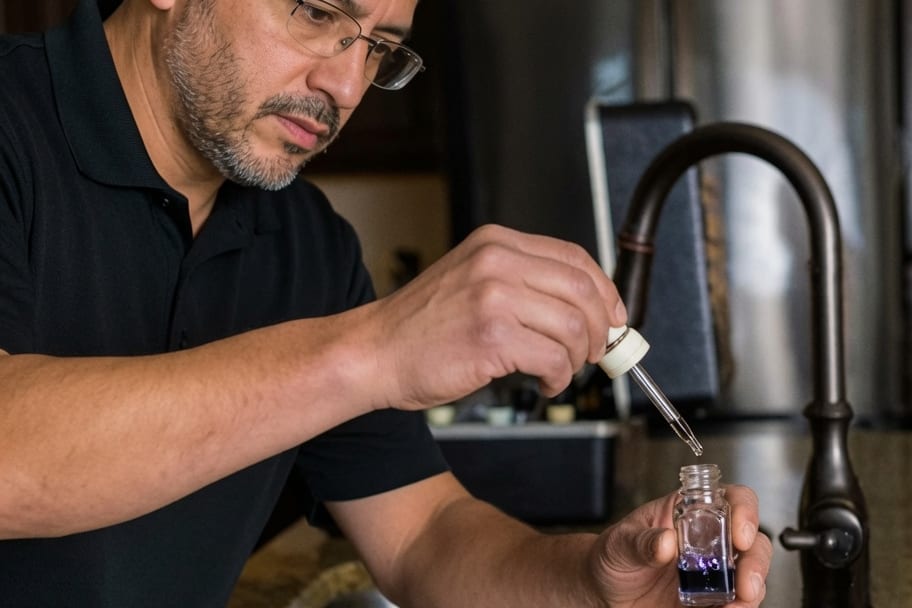
A state-certified lab gives you defensible numbers, which matter for mortgages, new wells, and health concerns like bacteria or lead. In-home professional testing measures the treatment-relevant basics (hardness in gpg, iron, pH, TDS, chlorine) on the spot, and reputable water treatment companies, ours included, do it free as part of a water testing visit. The honest rule: use certified labs for health and legal questions, use in-home testing for equipment sizing.
PFAS and specialty contaminants
PFAS panels are the expensive outlier at $250 to $500 because the lab methods are demanding. In NC this testing has real relevance: GenX contamination in the Cape Fear basin put our state at the center of the national PFAS story, and Triangle utilities now report detectable levels too. Our PFAS and GenX Triangle water guide covers who should actually spend that money and who can rely on utility data.
Sampling and shipping logistics
Bacteria samples have short hold times and often need same-day delivery to the lab on ice. Some labs charge $25 to $75 for courier pickup or professional sample collection, and real-estate tests usually require a neutral third party to pull the sample.
Here is a quick decision table by situation:
| Your situation | Test to get | Expected cost |
|---|---|---|
| City water, bad taste or scale | In-home basics, hardness and chlorine | Free to $75 |
| City water, PFAS concern | PFAS panel, or check utility reports first | $0 to $500 |
| Well, annual checkup | Bacteria plus standard panel | $75 to $250 |
| Well, buying a home | Real estate panel per lender | $150 to $400 |
| Well, stains or odor | Standard panel plus iron, manganese, sulfur | $100 to $250 |
| New well or suspected contamination | Comprehensive panel | $400 to $650 |
How Can You Save Money on Water Testing?
- Use your county first. Wake, Johnston, and Chatham county health departments offer well testing at subsidized rates, often $50 to $150 for panels a private lab charges more for. Processing is slower, but the chemistry is the same.
- Read the utility report before paying for city-water tests. Raleigh and Cary publish annual water quality data, including PFAS results, for free. Test what the report cannot tell you, like hardness at your tap or your home’s plumbing contribution.
- Match the panel to the question. Do not buy a $650 comprehensive panel to diagnose orange stains; a $100 to $250 standard panel answers that. Save big panels for closings and new wells.
- Take the free in-home consultation for treatment sizing. If your end goal is equipment, hardness and iron measured at your tap is exactly what sizing needs, and it costs nothing.
- Bundle annual well testing with system maintenance visits if you have treatment equipment; combined trips cost less than separate appointments.
What’s Included in a Water Test (and What to Watch For)
A legitimate test, lab or in-home, gives you numbers: hardness in grains per gallon, iron in mg/L, pH, TDS, bacteria presence or absence. You should get a written report you can hand to any company for a competing quote.
Red flags in the water testing world:
- “Free water tests” that are sales demos. The classic precipitation demonstration turns your water cloudy in front of you and proves only that water contains minerals. It is theater designed to alarm, not measurement. If there are no numbers, it was not a test.
- Tests that always find an emergency. If every house tested somehow needs the presenter’s $8,000 system that night, the test is a prop.
- Refusing to leave the results. Your water data belongs to you. A company that will not put numbers in writing expects you not to comparison shop.
- Diagnosing bacteria or lead from an in-home kit. Health calls need certified labs. An honest pro says so and points you to one.
- Pressure to skip testing entirely. Anyone sizing a system without measuring your water is guessing with your money. Test results are what turn a sales pitch into an engineering decision, which is exactly how we approach well water treatment.
Frequently Asked Questions
How much does a water test cost in NC?
$30 to $650 in 2026, depending on the panel. Basic bacteria tests run $30 to $75, standard well panels $75 to $250, and comprehensive or PFAS panels $250 to $650.
How much does well water testing cost per year?
Plan on $75 to $250 annually for the recommended yearly checkup: bacteria plus the standard chemistry panel. County health department options can bring that down to $50 to $150.
Is a free in-home consultation legitimate?
It can be, with one distinction. A legitimate in-home test reports measured numbers (hardness in gpg, iron, pH, TDS) you keep in writing, and it is the right tool for sizing treatment equipment. A “test” that is a cloudy-water demonstration with a same-night contract is a sales show. Numbers on paper are the difference.
How much does PFAS testing cost?
$250 to $500 for a certified lab panel. City-water customers can often skip it and read their utility’s published PFAS results for free, then put the savings toward treatment: an under-sink RO handles PFAS for $400 to $1,200 installed, detailed in our reverse osmosis cost guide.
What should I test for when buying a house with a well?
Your lender’s required panel, typically $150 to $400, at minimum covering bacteria, nitrates, and often lead. Beyond the lender list, a standard chemistry panel tells you what treatment the house will need, which belongs in your budget math before closing. Our well water treatment cost guide shows what those results translate to in equipment dollars.
What happens after the test?
The results map directly to fixes: hardness points to a softener, iron and sulfur to oxidizing filtration, bacteria to UV, and taste or PFAS to carbon or RO. For the full budget picture across all of those, see our whole house water filtration cost guide.
Get Your Water Tested Without the Sales Show
Testing should give you information, not pressure. Raleigh Water Pros offers free in-home consultations with written results across Raleigh, Cary, Apex, Wake Forest, Holly Springs, Clayton, Durham, and the surrounding Triangle, and we will tell you plainly when a certified lab is the right next step instead. Call (984) 384-6991 or schedule your free consultation today.