Big Box vs Local Water Softener Installation in NC
Raleigh Water Pros • September 20, 2026 • 10 min read
Search for big box water softener installation and two of the ten suggestions Google offers come back with “reddit” stuck on the end. People append “reddit” when the pages already ranking have not answered them, and here the retail pages mostly cannot, because what sits on a retail shelf is a box and what you are actually buying is a plumbing job in your house.
We are a local installer in Wake County, so we are one of the two categories on this page and you should treat our opinion accordingly. What saves it is that most of what follows is checkable without us: a state statute, an administrative rule, and a public license database anyone can open.
This post names no companies and compares no brands, because the choice is not between two logos. It is between two ways of buying the same work. Below: who does the install, who sized the unit and from what measurement, what the quote covers, and who you call in two years.
Are you buying a box or an install?
A shelf price tags the equipment; an installed price tags the equipment plus the labor, the fittings, the drain, the disposal and the warranty position, and that second list is where the money and nearly all of the risk sit. Comparing a box price against an installed price is not a comparison at all.
A whole-home softener in North Carolina runs $1,500 to $3,500 installed on either route, broken down on the Raleigh cost page. Every figure here is a planning range, not a quote. The useful question is not which route is cheaper on the day, since they often land close, but what each price includes and who carries the work afterwards.
Does North Carolina require a license to install a water softener?
The statute says water treatment installation is licensed plumbing work. NCGS 87-21(c), as amended by House Bill 911 (Session Law 2022-75, 2022), applies the plumbing, heating and fire sprinkler contracting article to work “which includes the installation or replacement of condensing units, air handlers, gas furnaces, package units, boilers, water heaters, heat exchangers, or whole-house water purification or treatment systems, as well as the connection, repair, or alteration to the plumbing drainage, waste, or venting system or the potable water system.”
The obvious next question is whether a softener swap counts as a minor repair, which would sit outside that. The Board’s own rule closes it. 21 NCAC 50 .0506(c) reads: “The installation of a water purification system which interrupts the potable water supply does not constitute a minor repair or replacement within the meaning of G.S. 87-21(c).” Subsection (d) of the same rule adds that any work requiring interruption of the potable water supply which, if poorly performed, creates a risk of contaminating it is not a minor repair either.
Now the part that costs us nothing to tell you. The State Board of Examiners of Plumbing, Heating and Fire Sprinkler Contractors runs a free public search at public.nclicensing.org. Search by company name, license number or person; it takes about two minutes. Run it on whoever you are about to hire, whichever route you take, and run it on us too. A claim printed on a company’s own website is not verification. The database is.
Permits are a separate question from licensing, and the answer is local. Requirements vary by jurisdiction and by the scope of the work, and your city or county inspections office makes the determination, not the person holding the wrench. Ask whether one is needed for your scope and who is pulling it, and get that answer before work starts rather than after.
Want this priced for your house rather than for a category? Request a free consultation, and we measure the water first, then put an up-front written price on the softener installation.
Who sized the unit, and from what measurement?
Sizing is a calculation from your hardness in grains per gallon, your household size, your iron level and your peak flow, and if nobody measured before the unit was chosen, the size is a guess dressed up as a recommendation. This is the difference that shows up in performance rather than on the invoice.
Sizing charts usually run off household size alone, because a shelf cannot know your water. That works if your water is average and fails both ways if it is not: undersized, the unit regenerates constantly and burns salt; oversized, the resin bed channels because it never sees enough flow.
The Triangle splits cleanly here. On city water the numbers are published: Raleigh Water’s annual report puts total hardness at about 1.5 grains per gallon and classifies the water “Soft”, and the Cary and Apex plant publishes about 1.8 grains, printed “moderately soft”. At those readings the correct recommendation is usually no softener at all, and a chart that starts from household size will never tell you that. We collected the published hardness figures for NC cities with each utility’s own source.
Wells are the other half of the map. Private wells around the Triangle commonly run far harder than city water, though we have no representative dataset that would predict yours and yours could land anywhere, which is why the state’s required new-well panel under NCGS 87-97(h) lists eighteen analytes without hardness among them. On a well, iron and pH matter as much as hardness, because iron above roughly a part per million fouls resin that was sized on hardness alone. Either route should have the hardness measured at your tap before a model number is written down.
What should the installation quote include?
| Line item | What to confirm before you sign |
|---|---|
| Bypass valve | Fitted and labelled, so the house keeps water while the unit is serviced |
| Drain line and air gap | Where it runs, how it is secured, and that it discharges legally |
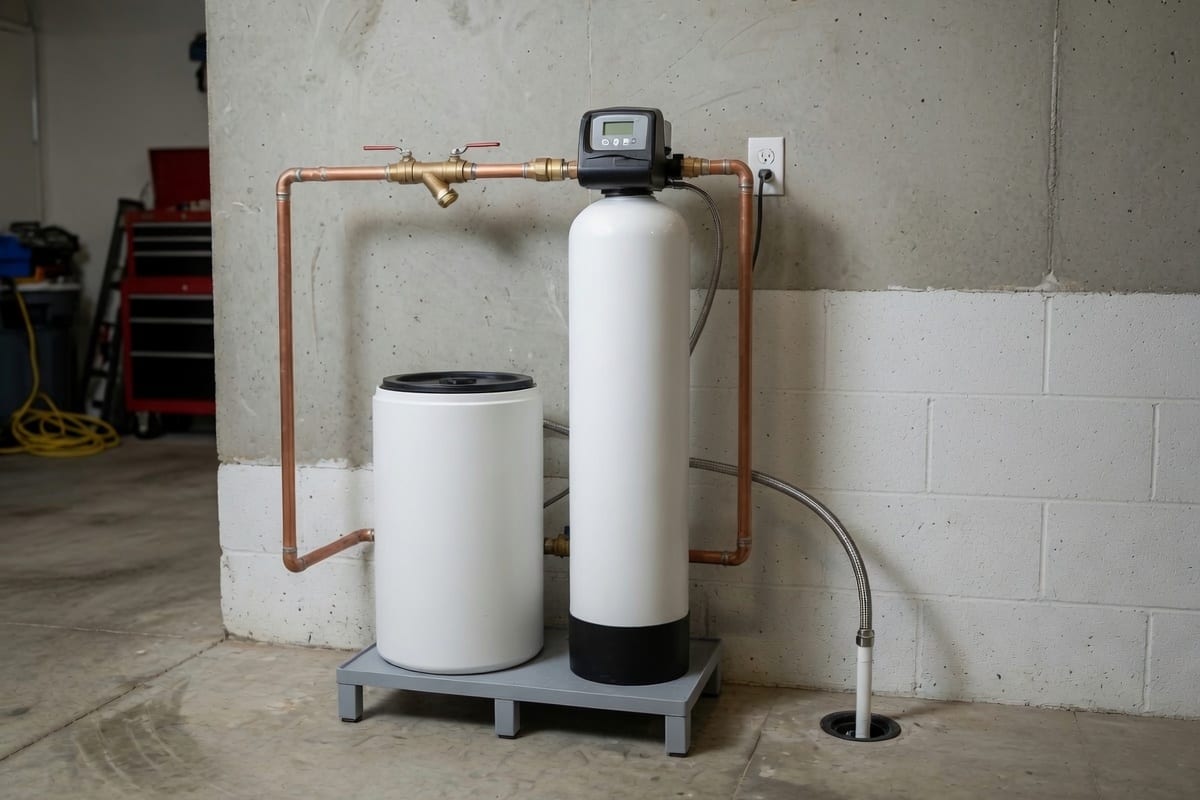
| Brine tank position | Clearance to lift the lid and swing a salt bag in |
| Plumbing transitions | Copper, CPVC or PEX fittings, and who supplies them |
| Old unit removal | Hauled away, or billed separately, or left in your garage |
| Permit and inspection | Whether your jurisdiction requires one, and who pulls it |
| Electrical supply | A grounded outlet within reach of the valve head |
| Startup and settings | Hardness entered, regeneration set, and a reading taken after |
A quote listing the model and one number is not wrong, it is incomplete, and the gaps are where change orders come from. In Cary and newer Apex builds there is often a pre-plumbed loop and a drain waiting, so the labor is short. In a 1970s house with copper, no nearby drain and no outlet it is not, and the same box costs more to fit. Our breakdown of what an installed price covers explains why.
What happens on a service call two years later?
Two warranties exist and they are rarely held by the same party: the manufacturer covers the tank, control valve and media for a stated term, and the labor to diagnose and fit the part belongs to whoever installed it. Ask, in writing, which entity carries the labor side and for how long.
The follow-on questions are the same for both routes, so use them on both. Who physically performs the work, and are they the license holder or working under one? If a third party installs it, which company do I call when it stops regenerating? Is the warranty registered in my name? Are parts for this valve stocked locally, or ordered?
Pro tip: Before anyone quotes, write down your hardness reading, your iron result if you are on a well, and the distance from the proposed location to the nearest drain and grounded outlet. Those three facts decide most of the difference between one quote and another, and handing them over up front is what makes two quotes genuinely comparable.
None of this makes retail the wrong answer. A big box program that sends a licensed contractor who measures your water, sizes from the reading and names the entity carrying the labor warranty has done a good job. You simply cannot tell that from the shelf, so ask, and check the license yourself either way. Our guide to choosing a water treatment company in Raleigh lists the rest of the questions worth asking.
Frequently Asked Questions
Do I need a licensed plumber to install a water softener in North Carolina?
The statute treats it as licensed work. NCGS 87-21(c), as amended in 2022, brings “whole-house water purification or treatment systems” inside the plumbing, heating and fire sprinkler contracting article, and 21 NCAC 50 .0506(c) says installing a purification system that interrupts the potable water supply is not a minor repair. Verify any installer, including us, at the state board’s public search before work starts.
Does a water softener installation need a permit in NC?
That depends on your jurisdiction and the scope of the work, and the city or county inspections office decides it, not the installer. A straight like-for-like swap and a new install cutting into the main are treated differently in many places. Ask who is pulling the permit if one is required, and get the answer in writing.
Is the unit on a retail shelf the same one a local installer sells?
Sometimes similar, rarely identical. Retail and dealer channels usually carry different model lines with different valve heads, warranty terms and parts availability, so compare the valve and the warranty rather than the badge on the tank. The more useful comparison is whether the unit was chosen from a measurement of your water or from a chart.
How do I check whether a water softener installer is licensed?
Use the State Board of Examiners of Plumbing, Heating and Fire Sprinkler Contractors public search and enter the company name or license number. It is free and open to anyone, and it takes a couple of minutes. Do it for every quote you are holding, in Holly Springs or anywhere else in the Triangle.
What should a water softener installation quote include?
Equipment, labor, bypass valve, drain line, brine tank placement, plumbing transitions, removal of the old unit, permit where one is required, and startup with your hardness programd in. Expect the whole package to land in the $1,500 to $3,500 range, and see what a service visit includes for what happens after.
Do I even need a softener on Raleigh or Cary city water?
Usually not. Raleigh Water classifies its own supply “Soft” at about 1.5 grains per gallon and the Cary and Apex plant publishes about 1.8, and neither number gives a softener much to do. If city water bothers you here, the complaint is nearly always taste, which is a whole house water filtration question rather than a hardness one.
Sources
- NCGS 87-21, subsection (c), as amended by House Bill 911, Session Law 2022-75 (2022). The quoted scope language is the statute’s own.
- 21 NCAC 50 .0506, “Minor Repairs and Alterations”, subsections (c) and (d), published by the State Board of Examiners of Plumbing, Heating and Fire Sprinkler Contractors.
- The public license search: public.nclicensing.org.
- Raleigh hardness and the “Soft” classification are from Raleigh Water’s 2025 annual water quality report; the Cary and Apex figure is from the Cary/Apex Water Treatment Facility’s published report.
- The analyte list for new private wells is NCGS 87-97(h). Hardness is not on it, which is why no state well hardness dataset exists.
Getting a local water softener installation quote
If you are choosing between a retail installation program and a local installer anywhere in Raleigh, Cary, Apex or Knightdale, the two things that will tell you most are a hardness reading taken before anyone names a model, and a license check you run yourself.
We test the water at your tap, size to the reading, and give an up-front written price covering the bypass, the drain, the removal and the startup, so you can set it line for line against any other quote. Call (984) 384-6991 or book a free consultation.