Is Clayton NC Tap Water Safe to Drink? (2026)
Raleigh Water Pros • September 26, 2026 • 9 min read
A lot of the people asking whether Clayton water is safe moved here from somewhere with a different utility, a different taste and a different set of headlines. Fair question. The answer sits in three public documents that almost nobody opens together.
Is Clayton NC tap water safe to drink? Yes, and its recent federal compliance record is the cleanest of the neighbouring systems we have compared. But Clayton does not make its own water, so reading the Town’s report alone leaves out half the story.
Below: who actually treats Clayton’s water, what the 2025 reports say, why the water smells different every late winter, the one lead reading worth understanding, and what PFAS testing shows on the Neuse side of the Triangle.
Is Clayton NC tap water safe to drink?
Yes. The Town of Clayton’s 2025 report states that it received no drinking water violations and met every state and federal requirement, and EPA’s compliance database shows zero violations of any kind for Clayton in the last three years.
That three-year zero is the cleanest recent record among the Cary, Johnston County, Fuquay-Varina and Holly Springs systems we have compared. The only health-based item on Clayton’s entire EPA file is a treatment technique record from 2005, returned to compliance on 6 December 2005, more than twenty years ago. Everything else on the file is paperwork: late report and public notice items between 1992 and 2021.
Bacteria testing tells the same story. Clayton reported E. coli in 0 of 360 samples in 2025, and Clayton North in 0 of 60.
Where does Clayton’s water come from?
The Neuse River, treated by Johnston County at its intake and treatment facility half a mile east of Wilson’s Mills. Clayton owns no intake and no plant; its own report says it “purchases water from Johnston County West.”
The county’s plant pulls river water into two on-site reservoirs of 35 million gallons each, then runs it through presedimentation, coagulation, clarification, multimedia filtration and disinfection. Clayton’s water system is the pipes, tanks and meters that carry that finished water to homes. The Town runs two systems of its own: Clayton (NC0351020) and the smaller Clayton North (NC4051019).
The county also buys bulk water from Smithfield, the City of Raleigh and Harnett County to supplement its West service area, and says that purchased water “mixes with water produced by the County in the distribution system.” So a Clayton tap is Neuse water, blended in varying proportion. Next door in Garner and Knightdale the picture is different again: those towns are on Raleigh Water, a separate utility with its own report.
Want readings from your own tap instead of a system average? Request a free consultation and we test first, then give you the numbers in writing.
Johnston County West and East: two different waters
Johnston County runs two service areas off the same river, and they disinfect differently. This is the part of the story most Clayton pages miss, and it explains a lot about taste.
The county describes Johnston West as generally the area north of I-95, with exceptions in the Little River, Buffalo and O’Neals water districts. Clayton buys from the West. Here is how the two areas compare in their 2025 reports:
| 2025 reporting year | Johnston County West (supplies Clayton) | Johnston County East |
|---|---|---|
| Disinfectant residual | chloramine, 2.31 ppm average | free chlorine, 1.03 ppm average; no chloramine line published |
| Total trihalomethanes (limit 80 ppb) | 57 ppb | 69 ppb |
| Haloacetic acids (limit 60 ppb) | 41 ppb | 39 ppb |
| pH | 7.3 | 7.0 |
| Violations in 2025 | one reporting item, since resolved | none |
West’s report says so in words: its water “has chloramines, (a combination of chlorine and ammonia) as a secondary disinfectant.” East’s report does not name a disinfectant; it simply shows a chlorine residual and no chloramine residual.
The byproduct numbers move exactly as chemistry predicts. Free chlorine forms more trihalomethanes than chloramine, and the East’s 69 ppb is 86 percent of the federal limit, the highest byproduct figure we have seen in any of these four systems’ reports. It is still a pass. For a Clayton home the relevant column is the West’s, and Clayton’s own distribution sampling came in lower again, at 47 ppb trihalomethanes and 37 ppb haloacetic acids.
That West reporting item is worth a line. In January 2025 the county collected all 90 required coliform samples, every one negative, but reported only 84 of them to the state on time, and filed the rest on 4 April 2025. It is a paperwork miss, and the county said so itself: “public health was not impacted.”
Why does Clayton water smell like chlorine in late winter?
Because for about six weeks every year, Johnston County switches the Clayton area from chloramine to chlorine alone.
The Town’s drinking water page puts it plainly: in the Clayton area, “water is normally treated with a combination of chlorine and ammonia. However, for 6 weeks in late February and March, only chlorine will be used.” It adds that “the water is safe to drink and use but there may be a slight odor or discoloration.” The page covers Town of Clayton customers and some private utility customers in the area.
Free chlorine smells sharper than chloramine, so late February into March is when most “why does my water smell like a pool” questions in Clayton start. The Town does not publish exact start and end dates on that page, so check its drinking water page each winter rather than relying on last year’s timing.
For filters, the switch matters in one direction. Standard activated carbon handles free chlorine well and chloramine poorly, so a standard filter that seems fine in March may do little the rest of the year. Catalytic carbon handles both. Our explainer on catalytic carbon for chloramine covers why.
Pro tip: if your Clayton water suddenly smells stronger in late February, look at the calendar before you look at your plumbing. A sharper chlorine note during the Town’s six-week chlorine-only window is expected, and it fades when the ammonia goes back in.
What about lead in Clayton water?
Clayton’s lead numbers are clean: a 90th percentile of 0 ppb in its 2023 round, with the highest single home at 6 ppb, and Clayton North at 0 ppb with no site over the 15 ppb action level.
One reading upstream deserves a careful sentence. In Johnston County West’s own spring 2024 sampling, one tap came back at 89 ppb, one site over the action level. The 90th percentile for that round was still 0 ppb, which is the compliance figure, and the county’s autumn 2024 round came back 0 to 0.
What that tells you: the supply is not carrying lead, and one house somewhere had fittings or solder that were. That is exactly what tap sampling is designed to catch. If your home has older brass fixtures or pre-1988 solder, your own tap is the only place that question gets answered.
Is there PFAS in Clayton water?
Clayton publishes no PFAS results of its own, so the numbers that describe its water are Johnston County West’s. Recent testing found PFOS at 7.9 parts per trillion and PFOA at 4.0 parts per trillion. EPA set a maximum contaminant level of 4 parts per trillion for each in 2024, with a compliance deadline still in the future, and the system reports no violation. Treatment upgrades to meet the standard are in planning: NC DEQ has funded a PFAS treatment study at the county’s plant.
1,4-dioxane is not a Clayton issue on the evidence. Neither Clayton nor the county reports it, and NC DEQ’s Neuse basin monitoring from 2017 to 2021 logged one detection in 383 results. Our North Carolina PFAS guide sets Johnston County beside other utilities in the state.
What is worth filtering on Clayton water?
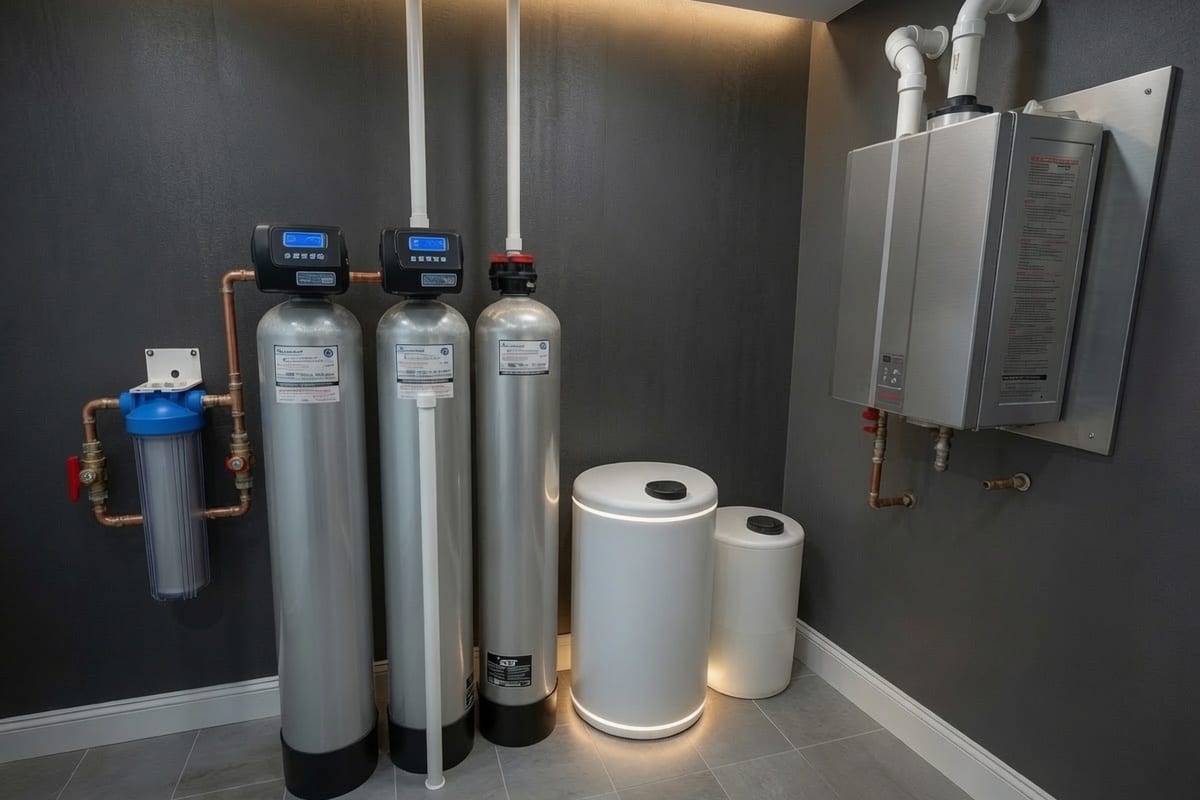
For most Clayton homes, two things at most. A whole house carbon system with catalytic media, for the chloramine taste at every tap. And, if the PFAS numbers bother you, an under-sink reverse osmosis unit at the kitchen sink. Prices and sizing for both are in our Clayton water filtration cost guide, so we will not repeat them here.
A softener is a different question. Neither Clayton nor Johnston County publishes a hardness figure, so nobody can tell you from a document whether your water is hard. Measure it before buying anything.
Frequently Asked Questions
Is Clayton NC water safe to drink?
Yes. Clayton’s 2025 report says it received no violations and met every state and federal requirement, and EPA’s compliance database shows no violations for the Town in the last three years. E. coli was absent in all 360 of the Town’s 2025 samples.
Where is the Clayton NC water treatment plant?
Clayton does not have one. Its water is treated by Johnston County at an intake and treatment facility on the Neuse River about half a mile east of Wilson’s Mills, and Clayton buys it from the county’s West service area.
Why does Clayton water taste different in March?
The Town switches to chlorine only for about six weeks in late February and March each year, instead of the usual chlorine and ammonia. The Town says the water stays safe but may carry a slight odor or discoloration during that window.
Is Clayton water chlorine or chloramine?
Chloramine for most of the year: Clayton reported a 1.95 ppm chloramine average in 2025, plus the spring chlorine-only weeks. That is why catalytic carbon, not standard carbon, is the right choice for city water treatment in Clayton.
Does Clayton water have PFAS?
At low levels. Johnston County West, which supplies Clayton, reported PFOS at 7.9 and PFOA at 4.0 parts per trillion in 2025. The federal limit of 4 parts per trillion has a compliance deadline still in the future, and the county reports no violation.
How do I test my own Clayton tap?
Read the Town’s report and Johnston County West’s together, then measure what they cannot tell you. We check hardness and the residual at your house during a free consultation in Clayton; lead at your fixtures goes to a certified lab.
Sources and reporting dates
- Town of Clayton and Clayton North 2025 annual water quality reports, on the Town’s water quality reports page.
- Town of Clayton Drinking Water page, for the annual six-week chlorine-only period, read 26 September 2026.
- Johnston County West and East 2025 annual water quality reports.
- EPA’s Safe Drinking Water Information System and ECHO records for NC0351020, NC4051019, NC0351070 and NC4051018, read September 2026.
- NC DEQ’s 1,4-dioxane annual progress report of January 2023, for Neuse basin monitoring. Its figures are untreated river water, not tap water.
A system average does not describe every address on every day. Check the current report before acting on any number here.
Clayton tap water, answered
Clayton water is safe, compliant and cleanly reported. What changes from house to house is taste, the plumbing inside the walls and whether anyone has ever measured hardness at the tap. Our Clayton water filtration page covers Clayton, Garner, Knightdale and the Johnston County edge.
Every visit starts with a free consultation: we test at your tap, compare it with what Clayton and Johnston County publish, and give you an up-front written price for only what the readings support. Call (984) 384-6991 or book your free consultation.