Is Holly Springs NC Tap Water Safe to Drink? (2026)
Raleigh Water Pros • September 26, 2026 • 8 min read
Holly Springs sits in an odd spot. Its water has the highest published PFAS numbers of any town in southern Wake that we have read, and at the same time its federal compliance file has never recorded a single health-based violation. Pages that mention only one of those facts are either selling a filter or selling reassurance.
Is Holly Springs tap water safe to drink? Yes, by every standard in force today. The PFAS numbers are real, they sit above a federal limit whose deadline has not arrived, and the fix is already funded and scheduled.
Below: where Holly Springs water comes from, what the Town’s 2025 report shows, why the report carries a chemical most Triangle reports do not, what the PFAS and 1,4-dioxane numbers mean, and what is worth doing at home.
Is Holly Springs tap water safe to drink?
Yes. EPA’s record for the Town lists fifteen violations between 1993 and 2024, and every one is marked not health based. EPA’s compliance database shows no current and no serious violations.
None of the fifteen is health based; the recent ones are monitoring and reporting items, samples filed late or incomplete, then corrected. None is a contaminant over a limit. Disinfection byproducts, lead, copper, fluoride and radium all came in under their limits in the Town’s most recent report.
One caveat on sourcing. The Town’s 2025 report has no “violations received” section at all, so the clean record here rests on EPA’s file rather than on a statement from the Town.
Where does Holly Springs water come from?
The Cape Fear River, treated by Harnett Regional Water at its plant at 310 West Duncan Street in Lillington. Holly Springs runs no intake and no treatment plant; its own report says it “purchases water from Harnett Regional Water.”
NC DEQ’s 2025 water supply plan shows one regular supplier: Harnett, averaging about 3.78 million gallons a day through a 36-inch main, on a contract that runs to 2048. A connection with Cary exists for emergencies only. The Cape Fear itself forms where the Deep and Haw rivers meet on the Chatham and Lee county line, upstream of Lillington.
There is a geographic twist. About two thirds of the people Holly Springs serves live in the Neuse basin, so the state records the system as a surface water transfer: Cape Fear water, mostly drunk on the Neuse side of the line. Next door, Fuquay-Varina buys more than half its water from Harnett too, and Apex draws on Jordan Lake through the Cary/Apex plant.
What does the 2025 Holly Springs water report show?
Byproducts, lead and copper all under their limits, a chloramine residual, and one line you will not find in Cary’s or Raleigh’s report: chlorite.
| 2025 report (lead and copper sampled 2023) | Holly Springs result | Limit |
|---|---|---|
| Total trihalomethanes | 40.0 ppb (15 to 43) | 80 ppb |
| Haloacetic acids | 24.0 ppb (0 to 24) | 60 ppb |
| Chloramine, running annual average | 2.16 ppm | 4.0 ppm |
| Chlorite (from Harnett’s treatment) | 0.42 ppm (0.06 to 0.64) | 1 ppm |
| Lead, 90th percentile | not detected, no site over the action level | action level 15 ppb |
| Copper, 90th percentile | 0.03 ppm | action level 1.3 ppm |
| Fluoride | 0.66 ppm | 4 ppm |
| Combined radium (sampled October 2021) | 1.1 pCi/L | 5 pCi/L |
Want the readings from your own tap rather than the town average? Request a free consultation and we test first, then put the numbers in writing.
Chlorite is the fingerprint of chlorine dioxide. Harnett’s report lists chlorine dioxide alongside its chlorine and chloramine residuals, and chlorite is the byproduct that treatment leaves behind. At 0.42 ppm it sits well under the 1 ppm limit. It shows up on Holly Springs’ report because of Harnett’s process, not because of anything in the town’s pipes.
Chloramine needs a small footnote. The report publishes a chloramine average of 2.16 ppm and a chlorine average of 1.33 ppm without saying in words which disinfectant it uses, so reading chloramine as the working residual is our inference from the numbers, supported by Harnett’s own chloramine average of 2.57 ppm. Individual samples reached 4.6 ppm, and that is not a violation: the 4.0 ppm limit applies to the running annual average, which was 2.16.
Hardness is simply not published. Neither the Town nor Harnett prints a hardness figure, so no honest source can tell you whether Holly Springs water is hard. Our softener guide for Fuquay-Varina and Holly Springs covers what to do about that.
Is there PFAS in Holly Springs water?
Yes, at levels above the future federal limit, with no violation and a treatment fix already funded.
Recent testing found PFOS at 8.7 parts per trillion and PFOA at 5.3 parts per trillion. EPA set a maximum contaminant level of 4 parts per trillion for each in 2024, with a compliance deadline still in the future, and the system reports no violation. Treatment upgrades to meet the standard are in planning and funded.
A few details give that context. The 2024 round read PFOS at 9.6 and PFOA at 5.3, so the numbers are steady rather than climbing. The Town’s printed 2025 PFOA range starts slightly above its own average, a quirk of the published table, so we quote the average as printed. GenX was not detected in the 2024 round, which surprises people who know the Cape Fear story: GenX is a problem downstream of Fayetteville, not at Lillington.
The fix is not at Harnett. Holly Springs and Fuquay-Varina are jointly paying for granular activated carbon at the City of Sanford’s water filtration facility, and Holly Springs says that PFAS treatment begins in 2028. NC DEQ awarded Holly Springs about $7.02 million toward it in July 2024. Harnett, in the meantime, uses powdered activated carbon to reduce PFAS and is running a pilot study on its own long-term options. Our North Carolina PFAS guide compares these numbers with other utilities.
What about 1,4-dioxane?
Holly Springs reported 1,4-dioxane at 0.255 parts per billion in 2025, below both EPA’s 35 ppb health advisory and North Carolina’s stricter 0.35 ppb surface-water value; it was a non-detect the year before.
There is no federal limit for 1,4-dioxane. The two benchmarks are the same EPA risk estimate read at two levels of caution, and 0.255 sits under the stricter one. The upstream context is real: NC DEQ notifies downstream systems, Harnett Regional Water among them, when the Asheboro wastewater plant discharges high levels into the Deep River, most recently in July 2026. Those DEQ figures describe wastewater and untreated river water, not finished tap water.
Pro tip: Holly Springs publishes its PFAS in both parts per billion and parts per trillion, side by side. Read the ppt column. A figure like 0.0087 looks tiny until you notice it is 8.7 in the unit the federal limit uses, and a quote built on the wrong column is a quote built on the wrong number.
What is worth filtering on Holly Springs water?
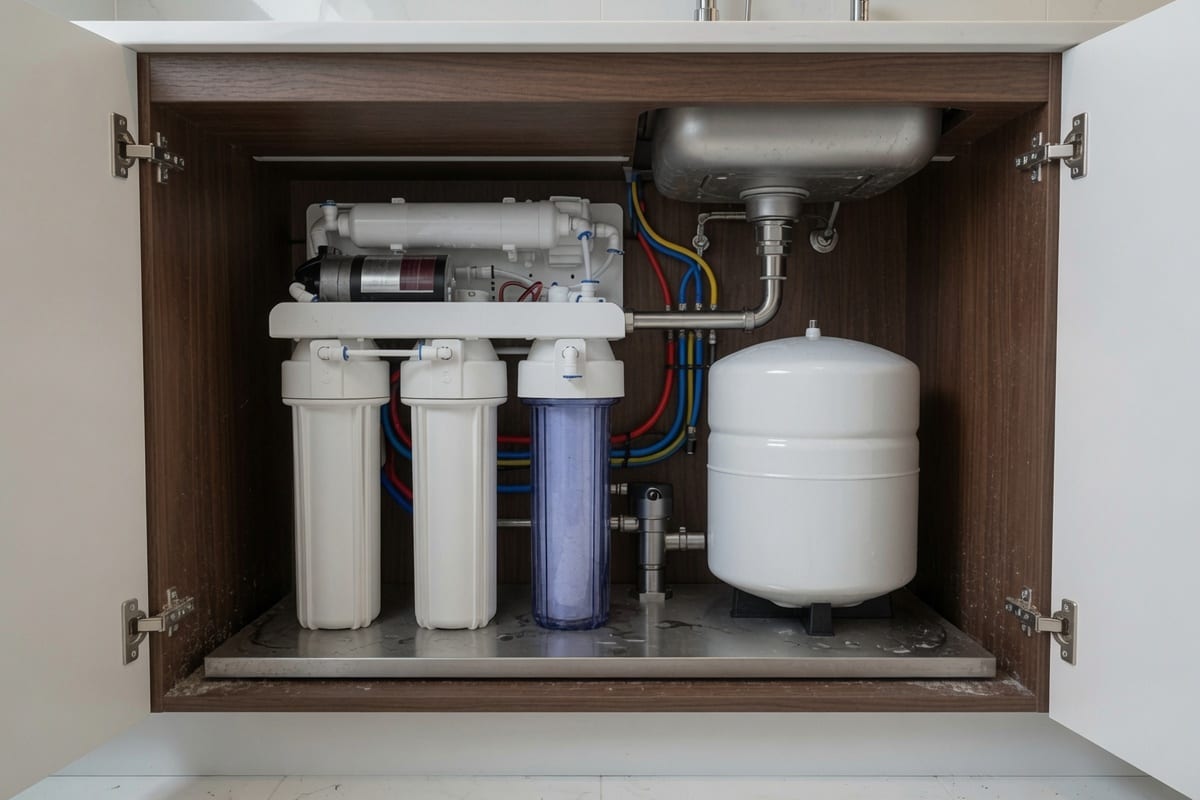
If PFAS is your concern, the targeted answer is an under-sink reverse osmosis unit at the kitchen sink, at $350 to $900 installed. It treats the water you drink and cook with, which is where PFAS exposure comes from, and it bridges the gap until the Sanford carbon plant comes online. Our reverse osmosis drinking water page covers the install, and our comparison of under-sink RO, fridge filters and pitchers explains why a pitcher is not the same thing.
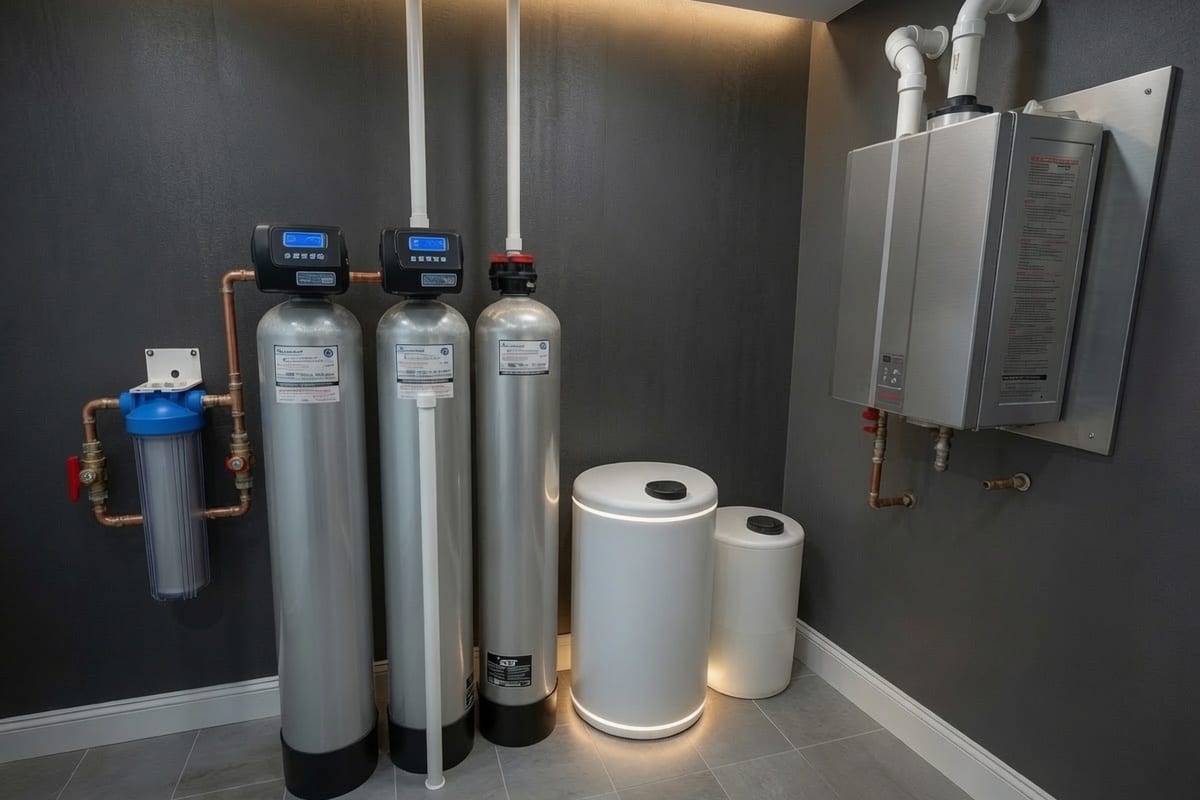
For chloramine taste at every tap, catalytic carbon is the right media. See carbon filtration for how it is sized, and our water filtration cost page for every planning range. Figures are planning ranges, never quotes.
Frequently Asked Questions
Is Holly Springs NC water safe to drink?
Yes. EPA’s file for the Town has never recorded a health-based violation, and its current record shows no open or serious violations. Byproducts, lead and copper were all under their limits in the latest report.
Where does Holly Springs get its water?
From Harnett Regional Water, which treats Cape Fear River water in Lillington. Holly Springs has no plant of its own and buys all of its regular supply from Harnett.
Does Holly Springs have a PFAS problem?
Its 2025 report shows PFOS at 8.7 and PFOA at 5.3 parts per trillion, above the 4 parts per trillion federal limit whose compliance deadline has not arrived. The Town reports no violation, and carbon treatment at Sanford’s plant is funded to begin in 2028.
Is Holly Springs water hard?
Nobody publishes the number. Neither Holly Springs nor Harnett prints a hardness figure, so the only way to know is to measure it at your tap during a free consultation in Holly Springs.
What is chlorite in Holly Springs water?
A byproduct of chlorine dioxide, which Harnett uses in treatment. Holly Springs reported 0.42 ppm in 2025 against a 1 ppm limit, and it is the reason this report has a line most Triangle reports lack.
Will a filter remove PFAS in Holly Springs?
An under-sink reverse osmosis unit is the most reliable household option, at $350 to $900 installed, covering drinking and cooking water. We check the tap before recommending anything, and the full ranges sit on our Raleigh price guide.
Sources and reporting dates
- Town of Holly Springs 2025 annual drinking water quality report and its emerging contaminants page.
- Harnett Regional Water 2025 water quality report.
- NC DEQ Local Water Supply Plan for Holly Springs, 2025.
- NC DEQ State Water Infrastructure Authority funding list of 16 July 2024, and DEQ’s July 2026 Asheboro 1,4-dioxane release.
- EPA’s Safe Drinking Water Information System and ECHO records for NC0392050, read September 2026.
A system average does not describe every address on every day. Check the current report before acting on any number here.
Holly Springs tap water, answered
Holly Springs water meets every standard in force, has a spotless health-based record and carries PFAS, and the Town is adding a carbon-treated supply from Sanford’s plant from 2028. Whether to add a drinking water filter before then is a reasonable personal choice, not an emergency.
We work across Holly Springs, Fuquay-Varina, Apex and southern Wake. Every visit starts with a free consultation: we test at your tap and give you an up-front written price for only what the readings support. Call (984) 384-6991 or request your free consultation.