Water Softeners in Fuquay-Varina and Holly Springs (2026)
Raleigh Water Pros • September 20, 2026 • 10 min read
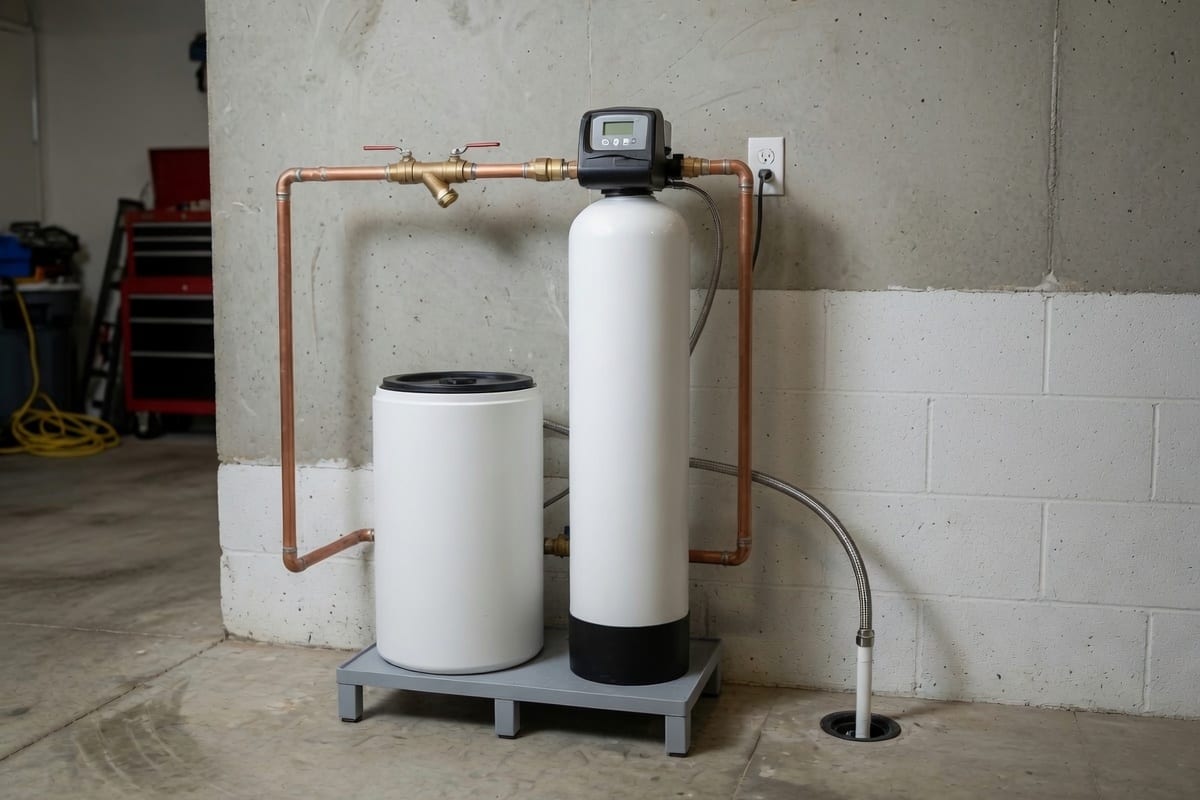
Water softener installation in Fuquay-Varina and Holly Springs splits cleanly in two, and which half you are in changes the answer. On a private well, a softener is often the right buy and the number to size it comes off your own test. On town water the case is far weaker than the sales pitch suggests, for a reason nobody advertises: neither town publishes a hardness figure at all.
We read both utilities’ latest reports and their suppliers’ reports, and there is no hardness row anywhere in the chain. Anyone quoting you a grains-per-gallon number for either town is estimating, and you should ask where it came from.
Below: what installation costs in 2026, where each town’s water comes from, why the town water case stays unproven until somebody measures it, and why the genuine softener market here sits on the well fringes.
What does water softener installation cost in Fuquay-Varina and Holly Springs?
A whole home water softener runs $1,500 to $3,500 installed, with salt adding $50 to $150 a year after that. A salt-free conditioner, which changes how scale behaves rather than removing hardness, runs $1,200 to $2,500. The harder question in both towns is whether you need one at all.
| Situation | What we fit | Installed, typical |
|---|---|---|
| Private well, hardness confirmed by test | Whole home softener | $1,500 to $3,500 |
| Private well, hardness plus iron or sulfur | Iron and sulfur filter ahead of the softener | $1,800 to $3,500 |
| Private well, several problems at once | Staged well treatment build | $4,000 to $8,000+ |
| Town water, no hardness figure published | Test first, then decide | Test-led |
| Scale control without a drain or salt | Salt-free conditioner | $1,200 to $2,500 |
Every figure is a planning range, never a quote. Installed price moves with where the main enters the house, whether a drain is within reach, and whether anything has to go in ahead of the softener. The breakdown is in our Raleigh price guide and our water softener installation cost guide.
Not sure which half you are in? Request a free consultation and we test first, then quote in writing.
Where does Fuquay-Varina’s water come from?
From three different utilities, on two river basins, and the town runs no plant of its own. The Town says so plainly: “The Town of Fuquay-Varina is a Purchase Water System. The water that is used by this system is purchased from the City of Raleigh, Johnston County, and Harnett County.”
NC DEQ’s Local Water Supply Plan for 2024 gives the volumes: Harnett County 1.9217 million gallons a day, City of Raleigh 1.1900, Johnston County 0.3438. That is roughly 56 percent Harnett, 34 percent Raleigh and 10 percent Johnston County, percentages that are our arithmetic on DEQ’s published figures rather than the Town’s statement. Harnett’s water comes off the Cape Fear at Lillington; Raleigh’s and Johnston County’s come off the Neuse. Two basins, one distribution system.
Raleigh Water is a wholesale supplier to Fuquay-Varina, not its retail utility, so the Raleigh numbers describe about a third of what reaches your tap. Our guide to whether Fuquay-Varina tap water is safe to drink covers the rest of the report.
Two things about the reports. The most recent one the Town has published is the 2024 report, so every Fuquay-Varina figure here is a 2024 figure. And its residuals table shows a chloramine running annual average of 2.24 ppm against a chlorine average of 0.17 ppm. The report never names a disinfectant in words, so chloramine here is inferred from the published residuals, not stated by the Town.
Pro tip: Fuquay-Varina reports disinfection byproducts at four separate sites, and the spread is real: trihalomethanes averaged 33.5 and 35.3 ppb at two of them and 14.3 and 16.3 ppb at the other two, against an 80 ppb limit. In a town blending three suppliers, one end genuinely drinks different water from the other. That is the best argument there is for testing at your own address.
Fuquay-Varina also carries two open monitoring violations on EPA’s record, for the second quarter of 2026, under the Stage 2 disinfection byproduct rule. Read that accurately: they are late or missed sample submissions, not contaminant exceedances, and the Town’s reported byproduct levels passed at every location.
Where does Holly Springs’ water come from?
From one supplier, Harnett Regional Water, on the Cape Fear River. The Town’s 2025 report states it directly: “The water that is used by this system is surface water from the Cape Fear River”, purchased from Harnett Regional Water at 310 West Duncan Street, Lillington. NC DEQ’s plan confirms a single regular supplier under contract to 2048. Like Fuquay-Varina, Holly Springs runs no intake and no plant. Our guide to whether Holly Springs tap water is safe to drink goes through its report in full.
Its residuals table shows a chloramine running annual average of 2.16 ppm, and as in Fuquay-Varina the report names no disinfectant in words, so that reading is inferred from the published numbers. Harnett also runs chlorine dioxide, which is why Holly Springs’ report carries a chlorite line that Raleigh’s and Cary’s do not.
On PFAS the numbers deserve care in both directions. Holly Springs’ 2025 report shows PFOS at 8.7 parts per trillion and PFOA at 5.3 parts per trillion in the Town’s own published conversion. EPA set a maximum contaminant level of 4 parts per trillion for each in 2024, and the compliance deadline has not yet arrived. The Town reports no violation and none appears on its EPA record. Treatment is funded: Holly Springs and Fuquay-Varina are jointly paying for granular activated carbon at the City of Sanford’s water filtration facility, which Holly Springs says begins in 2028.
The other half matters as much. Holly Springs has never had a health-based drinking water violation, across fifteen records on EPA’s register going back to 1993, and its lead 90th percentile was a non-detect in 2023. Both things are true at once, and a page giving you only one of them is selling something.
Does town water in either town need a softener?
Nobody can honestly say, because neither utility publishes a hardness figure and neither do their suppliers. Fuquay-Varina’s 2024 report has no hardness, calcium, magnesium or alkalinity row anywhere. Holly Springs prints three miscellaneous characteristics, pH 7.4, sodium 22.0 ppm and sulfate 60.6 ppm, and no hardness. Harnett Regional Water publishes none, and Johnston County West publishes none. Only Raleigh Water publishes hardness, and Raleigh is about a third of Fuquay-Varina’s blend and none of Holly Springs’ supply, so averaging it into an estimate would not produce a number worth having.
What we can say is what the wider state data shows. We read the annual report for 21 North Carolina city systems, and the hardest published municipal figure anywhere was 4.2 grains per gallon, most of the Triangle under 2. Softening usually starts making sense around 7 grains per gallon, and no city system we have read gets near that line. The city-by-city reading is in our North Carolina hard water guide.
So the honest position on town water here: the case for a softener is weak and unproven, and stays unproven until somebody measures hardness at your own tap. That is a test, not a purchase. Our guide on whether a softener is worth it in NC works through the arithmetic.
The real softener market here is the private wells
Both towns have grown outward into countryside that was never on a municipal main, and homes past the mains draw from private wells. That is where softeners genuinely earn their price in this part of Wake County, and where most of our softener work around Apex, Fuquay-Varina and Holly Springs happens.
Well hardness needs the same honesty as town hardness. we have no representative dataset that would predict yours. The required panel for a newly constructed private well under NCGS 87-97(h) names 19 items, including iron, manganese, lead and bacterial indicators, and hardness is not among them, which is why no statewide figure exists. The nearest official number, from the USGS Ground Water Atlas, calls Piedmont crystalline-rock aquifer water soft at about 63 mg/L, roughly 3.7 grains per gallon, but that is a multi-state regional average, not a Wake County measurement. Private wells around the Triangle commonly run far harder than city water, though we have no representative dataset behind that, and yours could land anywhere.
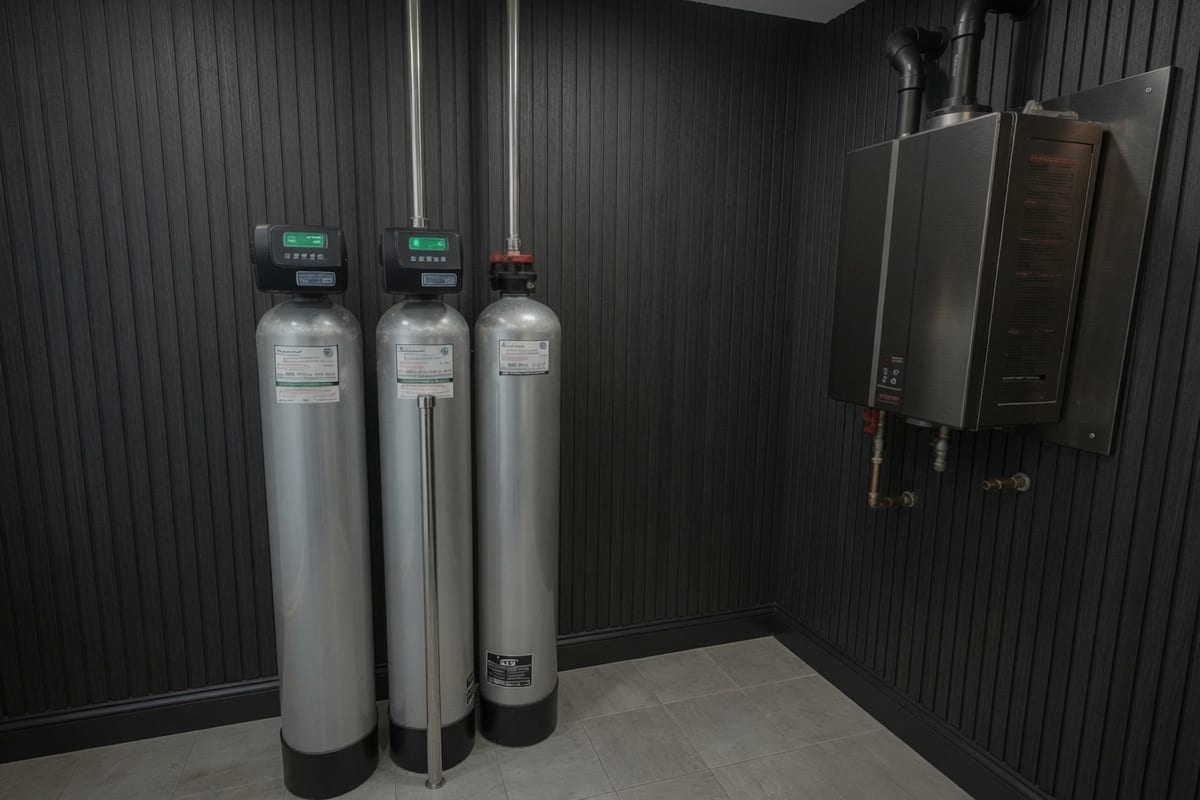
So the answer on a well is always the same: measure, then size. A softener matched to a real grains-per-gallon result runs $1,500 to $3,500 installed. If iron or hydrogen sulfide shows up in the same test, that goes in ahead of the softener, because resin fouls on iron. A staged well water treatment build handling iron, sulfur, pH and disinfection runs $4,000 to $8,000+. Drilling, pumps and pressure tanks are a well contractor’s work.
What should a softener quote include here?
A grains-per-gallon number measured at your house, and the sizing that follows from it. A quote naming a brand and a price without those is a price tag, not a specification. Ask for:
- The measured hardness, in grains per gallon, and where the sample was drawn.
- Iron and pH results on a well, and what goes in ahead of the softener.
- The resin volume and grain capacity, matched to your daily use.
- Where the backwash drains, and salt use per regeneration.
Water testing is the first step on both sides: on town water it tells you whether to buy at all, and on a well it tells us how to size.
Frequently Asked Questions
Is Fuquay-Varina water hard?
The Town publishes no hardness figure, and neither do two of its three suppliers. Anyone giving you a grains-per-gallon number for Fuquay-Varina is estimating, so ask for a measurement at your own tap before buying a water softener.
Is Holly Springs water hard?
Holly Springs publishes no hardness figure, and neither does Harnett Regional Water, which supplies all of the town’s water. The 2025 report gives pH 7.4, sodium 22.0 ppm and sulfate 60.6 ppm instead. With no number in the chain, the decision here starts with a test.
Does Holly Springs have a PFAS problem?
Its 2025 report shows PFOS at 8.7 parts per trillion and PFOA at 5.3. EPA set a limit of 4 parts per trillion for each in 2024 and the compliance deadline has not yet arrived, so the town is not in violation and reports none. Treatment is funded: granular activated carbon at the City of Sanford’s plant, which Holly Springs says begins in 2028.
Are Fuquay-Varina’s open violations a health risk?
No. The two items open on EPA’s record for the second quarter of 2026 are monitoring and reporting failures under the disinfection byproduct rule, meaning samples were late or missed. They are not exceedances, and the Town’s reported byproduct levels passed at every location.
How much does a water softener cost in Fuquay-Varina?
$1,500 to $3,500 installed for a whole home unit, plus $50 to $150 a year in salt. That is a planning range, not a quote, and it assumes a test has shown hardness worth treating. Our Raleigh price guide shows what moves the figure.
Do I need a softener if I am on town water in Holly Springs?
Probably not on the evidence published. With no hardness figure from the town or its supplier, and no NC city system we have read publishing anything close to 7 grains per gallon, the sensible order is test, then decide. Clayton sits in the same position.
Sources
Every utility figure above comes from the utilities’ own reports and from state and federal records, read in September 2026. Fuquay-Varina’s figures are 2024, the most recent published; Holly Springs’ are 2025.
- Town of Fuquay-Varina water quality statement: the annual reports and the Town’s PFAS position.
- Town of Holly Springs drinking water page: the 2025 report, residuals, PFAS and lead.
- Harnett Regional Water quality report: the Cape Fear source and chlorite.
- NC DEQ Local Water Supply Plans: the purchased volumes behind the three-supplier split.
- NCGS 87-97: the required new-well panel, which omits hardness.
Softener installation in Fuquay-Varina, Holly Springs and southern Wake
On a well outside Fuquay-Varina, Holly Springs or Apex, a softener is very likely the right buy and the only missing piece is the number to size it to. On town water, the first step is a test, because the utilities have published no hardness figure to work from.
We test, size and install water softeners across southern Wake County. Call (984) 384-6991 or book a free consultation, and you get an up-front written price with the measured hardness, the resin volume and the salt use on it.