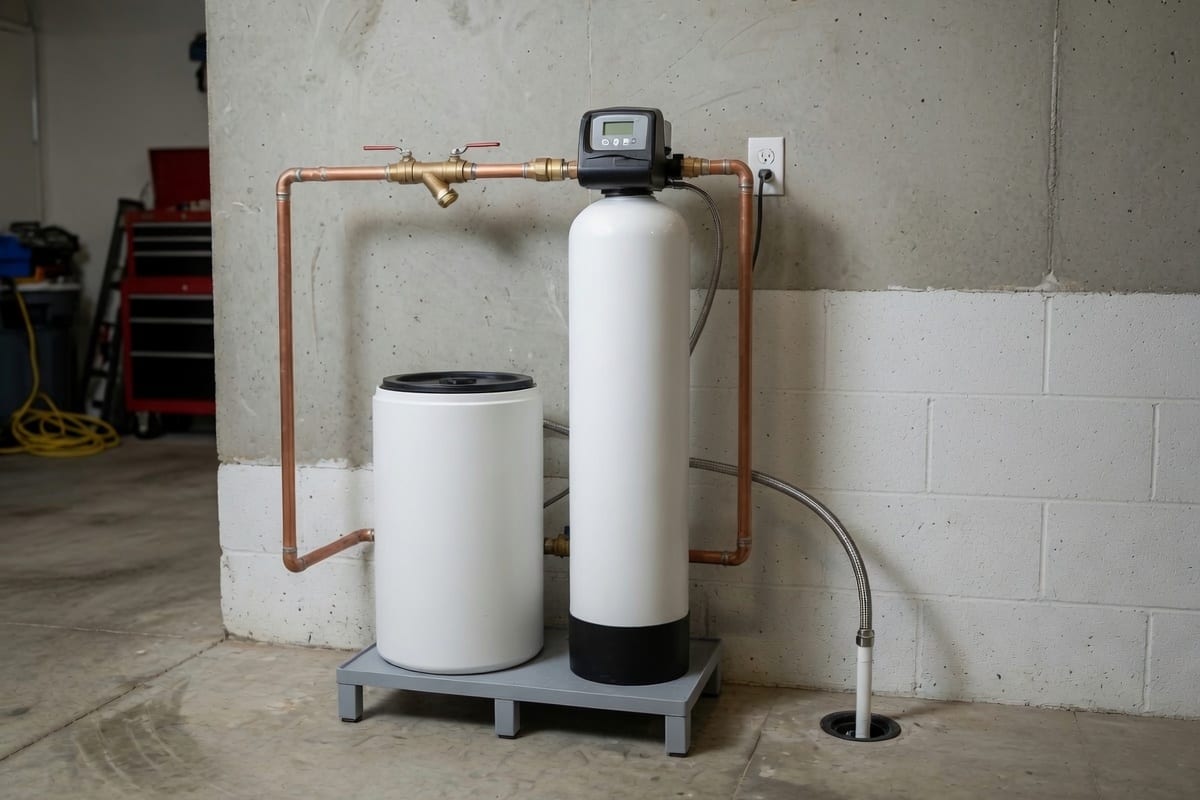
Is a Water Softener Worth It in NC? (2026)
Raleigh Water Pros • September 20, 2026 • 10 min read
If you typed “is a water softener worth it” into Google, you probably saw the suggestions underneath: reddit, are water softeners really necessary, are water softeners a waste of money. People add “reddit” to a search when they have stopped believing the pages that sell the thing. Fair enough.
We sell and install softeners, so treat what follows accordingly, and then go and check it. The useful part is that the question has a clean answer in North Carolina, and it does not depend on your house, your budget or your brand preference. It depends on where your water comes from.
Below: what the state’s utilities publish, what Triangle well owners measure, the arithmetic with its assumptions written down instead of hidden, and the list of things a softener does not do.
Is a water softener worth it in North Carolina?
It comes down to one thing: whether your water arrives through a city meter or out of your own well. On city water in this state, a softener is almost never worth it. On a Triangle private well, it very often is.
| Your supply | Hardness you are likely to see | Worth a softener? |
|---|---|---|
| North Carolina city water | 0.25 to 4.2 grains per gallon | Almost never |
| Raleigh Water specifically | 1.49 and 1.44 grains, the utility’s own figures | No |
| A Triangle private well | Commonly 10 to 20 grains or more, but it has to be measured | Usually, above about 7 |
Everything below is the reasoning behind those three rows.
On North Carolina city water, usually not
City hardness in this state is low enough that there is nothing for a softener to do. We read the published reports for 21 North Carolina utilities and the whole range came in between 0.25 and 4.2 grains per gallon, with not one system crossing 7 grains into genuinely hard water. The city by city hardness table has every figure with its source and date.
Raleigh Water is the clearest case because it publishes in grains itself, printing 1.49 at one plant and 1.44 at the other and classifying its own water as soft. That covers Garner, Wake Forest, Rolesville, Knightdale, Wendell and Zebulon too, since they sit inside the same public water system. We worked through what that means for buyers in do you need a softener on Raleigh city water.
The strongest argument against softening city water here is not ours, it belongs to a city that owns industrial softeners and chooses not to use them fully. New Bern’s plant softens with ion exchange, then deliberately bypasses a fraction of the flow around the softeners to blend the hardness back up. Its annual report gives two reasons: regeneration salt is about a third of the plant’s operating cost, and “extremely soft water also has corrosive qualities in the distribution system”, causing wear on pumps, valves and metallic pipe.
A utility with the equipment and the chemistry staff to soften completely has decided that zero hardness is the wrong target. That is worth sitting with before softening water already at 1.5 grains.
Not sure which side of the line your house is on? Request a free consultation and we measure it at your tap before anyone talks about equipment.
On a Triangle private well, usually yes
Well water here is a different animal, and the reason is contact time. Piedmont groundwater sits in fractured granite and gneiss and moves slowly through it, picking up far more dissolved mineral than reservoir water ever gets the chance to.
Triangle wells commonly measure between 10 and 20 grains per gallon, and some read higher. Be clear about the status of that figure: we have no representative dataset behind it, and it is not a prediction for any particular property in Fuquay-Varina, Holly Springs and the Chatham and Johnston county fringe, not a published dataset. North Carolina does not publish one, and the required test panel for a new well does not measure hardness at all. Your neighbour’s reading is not your reading. Have it measured before you spend anything.
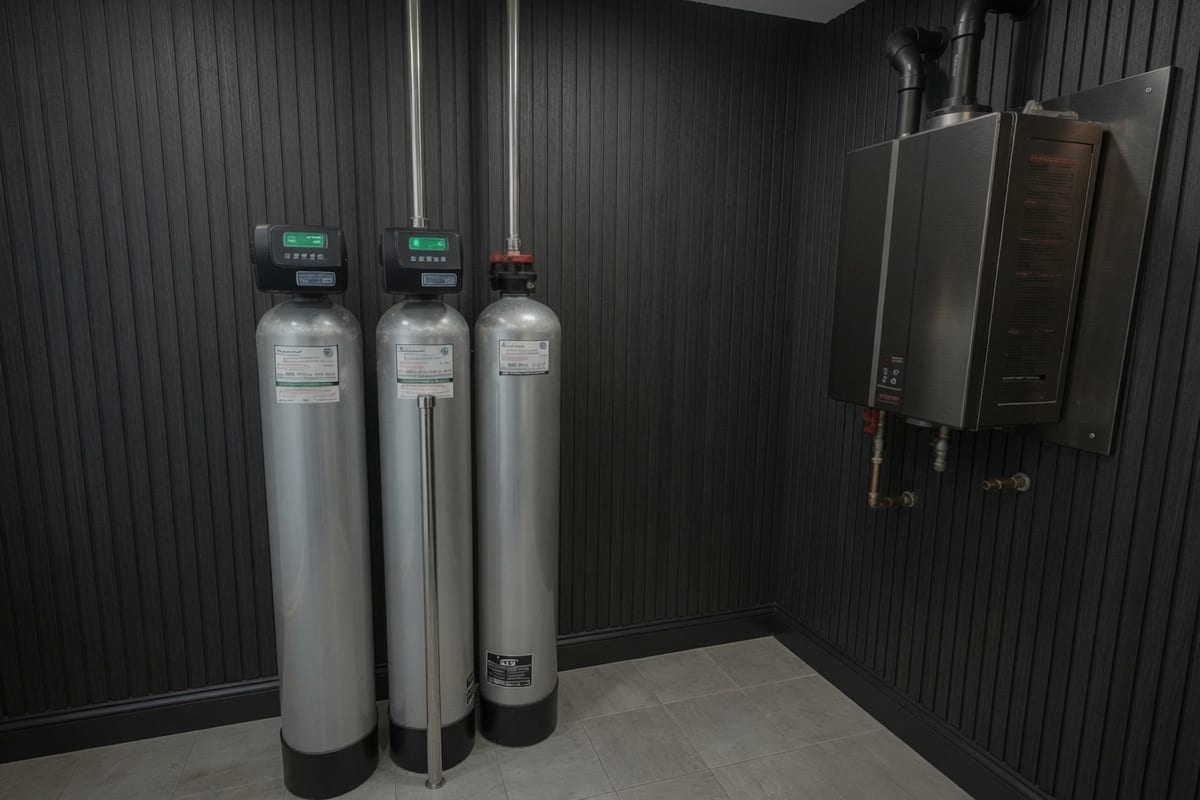
Above about 7 grains, the effects stop being theoretical: scale inside the water heater, crust on shower heads and aerators, soap that will not lather, and spotting that comes back however you rinse. That is the band where water softener installation earns its keep, and it is also where most Triangle wells sit.
The arithmetic, with the assumptions written down
Here is the part the vendor pages skip. We are not going to hand you a payback figure, because an honest one depends on your water use, hardness, appliances and energy prices, none of which we know until we measure. What we can do is show the arithmetic and the assumptions, so you can run it for your own house.
Start with mass. One pound is 7,000 grains, and the EPA puts the average American family’s home use at more than 300 gallons a day. So the hardness minerals passing through the plumbing in a year work out like this:
| Hardness | Grains per day at 300 gallons | Pounds of hardness minerals a year |
|---|---|---|
| 1.5 grains (Raleigh city water) | 450 | about 23 |
| 7 grains (the bottom of “hard”) | 2,100 | about 110 |
| 18 grains (a hard Triangle well) | 5,400 | about 282 |
Those are our calculations from the EPA’s use figure, and your household will differ. The point is the ratio: the hard-well house handles roughly twelve times the mineral load of the Raleigh city house. Not all of it deposits, but it is why the same product is a sensible buy at 18 grains and a poor one at 1.5.
Then put the cost beside it. A whole-home softener runs $1,500 to $3,500 installed in this market. Add salt at $50 to $150 a year, assume a ten-year life with no repairs or resin change, and you are looking at roughly $2,000 to $5,000 of ownership over that decade. For that to pay for itself on equipment life alone, it has to be worth $200 to $500 a year to you. At 282 pounds of mineral a year, that is a plausible argument. At 23 pounds, it is not. Those are planning ranges rather than quotes; the Raleigh water filtration cost guide covers what moves them.
Pro tip: ask anyone quoting you a savings or payback number which study it comes from and who funded it. The figures that circulate in this industry rest on assumptions about water use and appliance life that nobody has checked against your house. A measured hardness number is worth more than all of them.
What a water softener does not do
This is where a lot of buyer disappointment comes from. Ion exchange targets calcium and magnesium, and not the contaminants most people are actually worried about.
- PFAS. A softener does nothing for them. That is a carbon or reverse osmosis drinking water job.
- Bacteria. Softening does not disinfect. A well with a positive coliform result needs shock disinfection and a UV water purification system, not a softener.
- Chlorine and chloramine taste. No effect. Catalytic carbon handles chloramine, which is what most Triangle utilities carry.
- Iron and sulfur. A softener is not an iron filter. Wells with orange staining or a rotten-egg smell need dedicated well water treatment ahead of any softener, or the softener gets fouled.
- Low pH. Acidic well water, common around Pittsboro and the Triangle’s western fringe, eats copper pipe and needs a neutralizer. Softening does not raise pH.
A softener is a single-purpose appliance that does one job well. Most of the water complaints we get called about are not that job.
How to decide, in order
Measure first, then match the number to the row.
| Measured hardness | What we would do |
|---|---|
| Under 3.5 grains | Nothing. Spend the money on the actual complaint, usually taste |
| 3.5 to 7 grains | Borderline. Only if you have visible scale and it bothers you |
| 7 to 10.5 grains | Worth it, especially with a tankless or newer water heater |
| Over 10.5 grains | Yes, and check for iron and pH while you are at it |
A water testing visit gets you the hardness reading plus the iron, pH and bacteria results that decide whether a softener can even go in on its own. On a well, those three change the answer more often than the hardness number does.
Frequently Asked Questions
Are water softeners a waste of money?
On North Carolina city water, usually yes, because at 0.25 to 4.2 grains per gallon there is almost nothing for one to remove. On a private well at 10 grains or more, no, it is one of the few pieces of water equipment whose benefit shows up in something you can see. The supply decides it, not the product.
Is a water softener worth it if I am on Raleigh or Cary city water?
No on either. Raleigh Water publishes 1.49 and 1.44 grains per gallon and labels its own water soft. The Cary/Apex Water Treatment Facility publishes 30 milligrams per litre, about 1.8 grains per gallon, printed with the classification “moderately soft”, and the Town of Apex states the same in its own report. Both sit well inside the soft band, and on every North Carolina city report we have read hardness came in at or below 4.2 grains. If city water bothers you anywhere in Wake County, the complaint is nearly always taste, which is a carbon problem.
How much does a water softener cost in North Carolina?
A whole-home softener runs $1,500 to $3,500 installed, plus $50 to $150 a year in salt. Our installation cost breakdown walks through what moves the number, and every figure is a planning range until someone has seen your plumbing.
Will a salt-free conditioner do the same job?
No, and the difference matters if you are buying for a hard well. A salt-free conditioner does not remove hardness, it changes how the minerals behave so they are less likely to stick. Our salt-free versus traditional comparison sets out what each one can and cannot claim.
Does a water softener remove PFAS, lead or bacteria?
No to all three. Ion exchange resin is built to swap out calcium and magnesium, and it is the wrong tool for every one of them. PFAS and lead are point-of-use filtration questions, bacteria is a disinfection question, and a softener sold as the answer to any of them is the wrong box.
How do I find my hardness number before I buy anything?
Measure it at the tap, ahead of any treatment already fitted. A hardware store test strip costs a few dollars and gets you close enough to know which row of the table above you are in. If you are on a well, a proper panel is worth it, because hardness is rarely the only thing you will find.
Sources
- Hardness figures for North Carolina city systems come from each utility’s own annual water quality report, collected in our statewide hardness read. Raleigh’s 1.49 and 1.44 grains are published by Raleigh Water in grains per gallon.
- New Bern’s rehardening practice and its reasons are quoted from the City of New Bern’s annual water report.
- Household use of more than 300 gallons a day is from EPA WaterSense. The pounds-per-year column is our calculation at 7,000 grains to the pound.
- The 10 to 20 grain Triangle well range is not a published statistic and we have no representative dataset behind it. Treat it as a rough sense of scale rather than a prediction for any property, and measure your own.
Getting a straight answer for your own house
If you are on city water in Raleigh, Cary or Apex, we will most likely tell you not to buy a softener, and point you at the taste problem instead. If you are on a well in Fuquay-Varina, Holly Springs or Chatham County, there is a good chance the number comes back high enough to justify one, and we will show you the reading it is based on.
Either way it starts the same: a free consultation, a measurement at your tap, and an up-front written price for only what the numbers support. Call (984) 384-6991 or book a free consultation.