Is Siler City Tap Water Safe to Drink? (2026)
Raleigh Water Pros • September 27, 2026 • 9 min read

Siler City’s water system joined a regional utility on 1 July 2025, and its water now comes with a PFAS reading tied to a roughly $20 million treatment project that is still years from finished. That is a lot to sort through if the only question is whether the water from the tap is safe.
Is Siler City tap water safe to drink? The town’s most recent annual report says it had no reported violations for the compliance period that ended in 2024. That answer sits next to a real caveat. Raw water pulled from the Rocky River carries PFOA and PFOS above a federal limit whose compliance date has not arrived, and Siler City is not on the same water, or the same contamination story, as nearby Pittsboro.
Below: who runs Siler City’s water now, where it actually comes from, what the latest report shows, the PFAS number and its partly funded fix, and what is and is not known about hardness and other contaminants.
Is Siler City tap water safe to drink?
The Town of Siler City’s most recent annual drinking water quality report, covering the compliance period that ended in 2024, states that Siler City had no reported violations during that period.
The town’s 2021 annual report recorded one violation, for an overflow of backwash wastewater generated from washing filters and basins at the treatment plant. The report states plainly that there was no contamination of the drinking water associated with that event.
EPA’s national compliance record for the system (PWS ID NC0319010), read 27 September 2026, shows earlier items, the latest from 2020 to 2022, all resolved, and one lead and copper rule monitoring and reporting violation with a compliance period that began 1 January 2026, not yet marked returned to compliance. EPA does not class it as health-based, and the record does not describe it in plain language.
Two things are still worth knowing. Siler City’s raw water source carries measurable PFAS, covered below, and its reports do not state a hardness figure at all. Neither is a violation, and neither changes the compliance record above.
Who runs Siler City’s water, and where does it come from?
TriRiver Water, a regional utility that took over Siler City’s water and wastewater system on 1 July 2025, after the Siler City Board of Commissioners approved the merger in October 2024.
TriRiver Water itself is new. It formed in 2024 when Sanford and Pittsboro merged their utilities, then grew again on 1 July 2025 when Chatham County’s own water system and Siler City’s joined, taking TriRiver’s combined customer base to about 40,000.
Siler City’s water is not Pittsboro’s water, and not Chatham County’s either. The town’s own source is the Rocky River, held in the Lower Rocky River Reservoir off Piney Grove Church Road, treated at the Siler City Water Treatment Plant. Pittsboro draws from the Haw River, and the TriRiver district covering northern and eastern Chatham County draws from Jordan Lake; Siler City sits on neither. The 2024 report adds that the town buys water as needed from Chatham County’s Asbury Water System, which draws from the Cape Fear River.
The plant is permitted for 4.0 million gallons a day. The town’s 2023 filing with the state showed an average daily draw of about 2.56 million gallons, with a plan to expand the plant to 6 million gallons a day. Year-round population served in 2023 was 8,520.
What does Siler City’s 2024 water quality report show?
Disinfection byproducts under their limits, and zero samples over the action level for lead or copper.
| 2024 report (lead and copper sampled August 2022) | Siler City result | Limit |
|---|---|---|
| Total trihalomethanes | 44 ppb (30 to 58) | 80 ppb |
| Haloacetic acids | 39 ppb (33 to 44) | 60 ppb |
| Chlorine, running annual average | 2.5 ppm (2.5 to 3.8) | 4.0 ppm |
| Chloramines, running annual average | 3.0 ppm (2.8 to 3.8) | 4.0 ppm |
| Lead, 90th percentile | 0 ppb, 0 sites over the action level | action level 15 ppb |
| Copper, 90th percentile | 0.2 ppm | action level 1.3 ppm |
| Nitrate | 1.6 ppm | 10 ppm |
| Turbidity, highest single reading | 0.25 NTU; 100% of monthly samples met the limit | 95% of monthly samples must meet the limit |
Want to know what these numbers mean for your own house? Request a free consultation for a written recommendation and an up-front price.
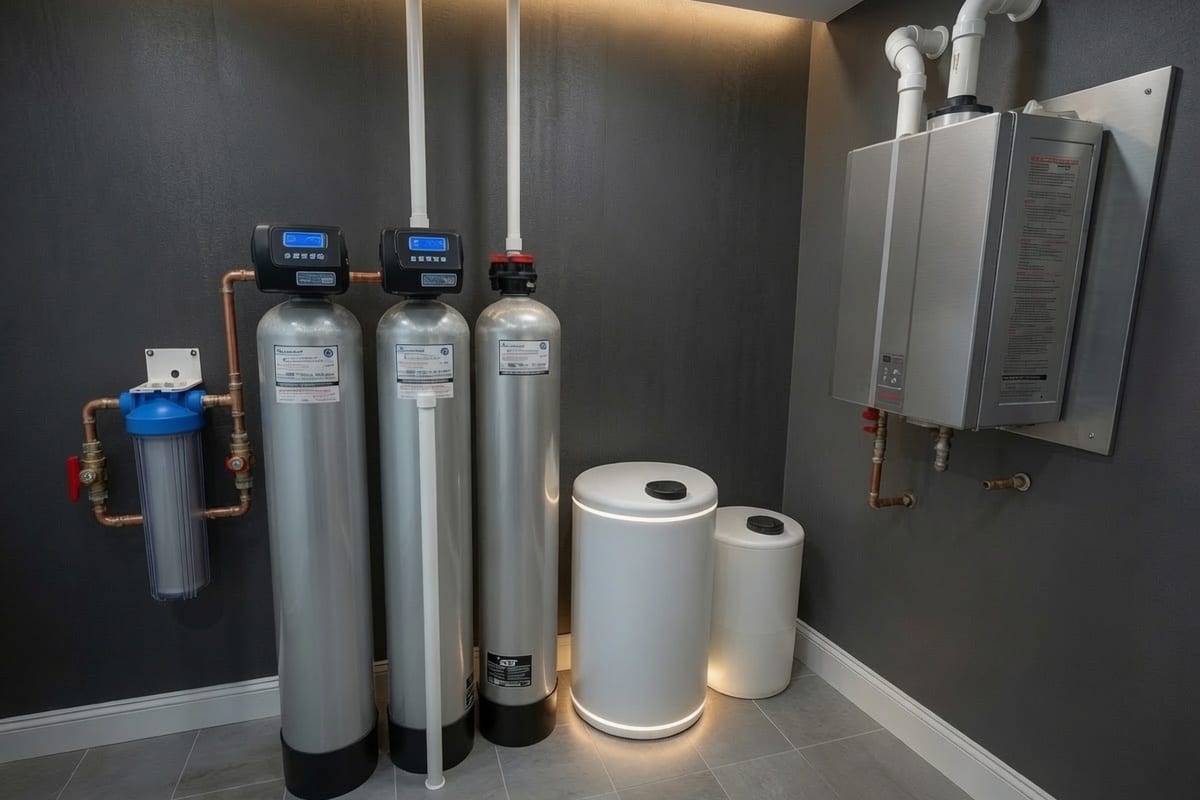
One line in the report deserves a careful read. The disinfectant residuals table lists both chlorine and chloramines with real, similar readings, and the report never states in words which one is the working residual. Either way, both sit comfortably under the 4.0 ppm limit that applies to both. A whole-house catalytic carbon filter (whole house carbon filter, $1,500 to $3,500 installed) handles chlorine or chloramine taste at every tap, whichever one is in use.
Nitrite was not detected, pH averaged 7.5, sodium came in at 61 ppm, and sulfate was 118 ppm against a 250 ppm secondary standard.
Is there PFAS in Siler City’s water?
Yes, in the raw water TriRiver draws from the Rocky River, at levels above a federal limit whose compliance date has not arrived, and a treatment project is partly funded.
TriRiver’s news release of 20 August 2026 says average raw-water sampling of the Rocky River in 2025 found PFOA at 4.5 parts per trillion and PFOS at 5 parts per trillion.
EPA finalized its first national PFAS drinking water rule on 10 April 2024. It sets enforceable limits of 4.0 parts per trillion each for PFOA and PFOS, and water systems have until 2029 to meet them. On 18 May 2026 EPA proposed letting systems ask for two more years, to 2031, and proposed dropping the 2024 limits for PFHxS, PFNA and GenX; both are proposals, not final rules.
That 4.5/5 reading is raw water, taken before the treatment plant, not a reading of what comes out of a Siler City tap. No separate finished-water PFAS figure for the Siler City system has been published.
TriRiver plans granular activated carbon filtration at the Siler City Water Filtration Facility, estimated to cost about $20 million. North Carolina approved $5 million in principal-forgiveness funding that does not have to be repaid, after an earlier $400,000 state grant paid for the engineering study. Design work could start before 2027; construction could begin in 2028 and is expected to take about 18 months.
Pro tip: when a PFAS number for Siler City shows up online, check whether it is described as raw or finished water. The 4.5/5 reading is raw Rocky River intake, measured before the new carbon filters are built, so treat it as the reason the project exists rather than as a reading of any glass poured today.
What about hardness and 1,4-dioxane in Siler City?
Neither is published for this system. Hardness has no figure in Siler City’s 2021 or 2024 annual reports, and no 1,4-dioxane monitoring result specific to the Rocky River has been published.
That second point matters because Pittsboro’s water, in the same county, has a 1,4-dioxane story tied to industrial discharges into the Haw River. Siler City draws from the Rocky River, a Deep River and Cape Fear tributary in a different sub-basin from the Haw, so Pittsboro’s dioxane numbers do not carry over. The 1,4-dioxane and PFAS guide for Pittsboro covers that system.
Without a published hardness number, there is no honest way to call Siler City’s water hard or soft. A water testing reading at the tap is the only way to know before a softener gets sized.
A private well outside Siler City’s system is a different water supply entirely, covered in the well water filtration guide for Chatham County.
What is worth filtering in Siler City tap water?
If PFAS is the concern, an under-sink reverse osmosis unit at the kitchen tap is the household-scale answer (under-sink reverse osmosis, $350 to $900 installed). It treats the water used for drinking and cooking, and it works now rather than waiting on the carbon project. The reverse osmosis drinking water page covers how a unit gets sized.
For chlorine or chloramine taste at every tap, city water treatment built around carbon media addresses it whole-house rather than at one sink. Every figure above is a planning range, not a quote, and the Raleigh water filtration cost guide carries every band this article uses.
Frequently Asked Questions
Is Siler City NC tap water safe to drink?
The Town of Siler City’s most recent report shows no reported violations for the compliance period that ended in 2024, and byproducts, lead and copper all came in under their limits.
Who runs Siler City’s water system?
TriRiver Water, since 1 July 2025. TriRiver also runs Pittsboro’s and Chatham County’s water systems, but Siler City’s own Rocky River source, treatment plant and PWSID are separate from both of those.
Does Siler City have a PFAS problem?
Its raw Rocky River source tested at PFOA 4.5 and PFOS 5 parts per trillion in 2025, above the 4 parts per trillion limit EPA finalized in April 2024, which systems must meet by 2029. That is a raw-water figure, not a tap reading. Carbon treatment is planned, with construction expected to begin in 2028.
Is Siler City’s water the same as Pittsboro’s?
No. Pittsboro draws from the Haw River and carries a documented 1,4-dioxane story; Siler City draws from the Rocky River, a separate sub-basin with no published dioxane figure. See the Pittsboro water guide for that system.
Is Siler City’s water hard?
No number is published: neither the 2021 nor the 2024 report lists hardness, so a water testing reading at the tap is the only way to know.
What did Siler City’s lead testing find?
The 2024 report’s lead and copper sampling, from August 2022, found a 90th percentile lead reading of 0 parts per billion, with zero sites over the 15 ppb action level. That is a system-wide sample, not a test of any one address.
Sources and reporting dates
- Town of Siler City 2024 Annual Drinking Water Quality Report and its 2021 annual report.
- TriRiver Water Siler City merger announcement and its PFAS treatment upgrade release, 20 August 2026.
- EPA Safe Drinking Water Information System violation records for PWSID NC0319010, read 27 September 2026.
- NC DEQ Local Water Supply Plan for Siler City, 2023, for plant capacity and population served.
- EPA’s PFAS drinking water regulation, 10 April 2024, and its proposed PFOA and PFOS compliance extension rule, proposed 18 May 2026, not final.
A system average does not describe every address on every day. Check the current report before acting on any single number.
Siler City tap water, answered
By its most recent annual report, Siler City had no reported violations for the period that ended in 2024, byproducts under their limits and zero lead or copper samples over the action level. The PFAS reading from the raw Rocky River intake sits above the federal limit systems must meet by 2029, and granular activated carbon treatment is planned, with construction expected to begin in 2028.
The free consultation, with an up-front written price, is offered across the Triangle, including Pittsboro. Coverage of Siler City is not confirmed, so ask through the contact page whether your address is covered, or call (984) 384-6991.