Is Smithfield NC Tap Water Safe to Drink? (2026)
Raleigh Water Pros • September 27, 2026 • 9 min read
Smithfield sits on the Neuse River, and unlike Clayton and the smaller towns that buy from Johnston County, the Town treats its own water. That means Smithfield’s numbers describe the plant on North 2nd Street, not a supplier elsewhere.
Is Smithfield NC tap water safe to drink? The Town’s 2024 report lists no monitoring violations, and its byproduct, lead and copper readings all landed under their limits. The one figure that needs its own explanation is PFAS, where two compounds read above a federal limit whose compliance date is 2029.
Below: where Smithfield’s water actually comes from, why “Smithfield South” on a bill does not mean this utility, what the 2024 report shows, and what the PFAS numbers mean for a Johnston County kitchen.
Is Smithfield NC tap water safe to drink?
The Town of Smithfield’s 2024 water quality report states that during 2024 it received no monitoring violations, and its disinfection byproduct, lead and copper readings all came in under their federal limits.
That is a narrower claim than a spotless file. EPA’s compliance history for Smithfield’s system (PWS ID NC0351010) lists a treatment-technique violation, which EPA’s record marks as health-based, and a linked reporting violation, both with a compliance period that opened 17 October 2024 and both returned to compliance on 14 November 2024. The record does not describe the violation in plain language. Earlier monitoring and reporting items, in 2016, 2017 to 2018 and 2022, were resolved too, and every entry carries a return-to-compliance date; none is open as of 27 September 2026.
Where does Smithfield get its water?
From the Neuse River, treated at the Town’s own plant on North 2nd Street, not purchased from a neighboring utility.
The Town of Smithfield’s Public Utilities Department runs a conventional surface water plant, using coagulation, sedimentation and filtration, permitted to withdraw up to 8.3 million gallons a day from the Neuse. In 2023 it drew about 5.0 million gallons a day on average, according to NC DEQ’s Local Water Supply Plan. A 24-million-gallon off-stream reservoir holds water pulled from the river before it reaches the plant. The system serves roughly 12,900 people through about 4,200 metered connections.
NC DEQ rates the Neuse’s susceptibility to contamination as “higher” along this stretch, though the agency’s own caveat is that a higher rating does not by itself mean poor water quality.
NC DEQ’s water supply plan shows Smithfield does not buy water from another system for regular use, only an emergency connection to Johnston County that saw zero average use. Going the other way, Smithfield sells water to Johnston County Utilities, an average of just under 2.9 million gallons a day under a contract that runs to 2033.
Smithfield South, Selma and Johnston County: whose water is on your bill?
If your bill or your neighborhood name says “Smithfield,” check which utility actually issued it before reading this guide as your own.
“Smithfield South Water District” is a separate legal water system, and its own 2024 report says outright: “The water that is used by Smithfield South Water District is provided by Johnston County Utilities.” It has no plant of its own; a Smithfield South customer is reading Johnston County’s numbers, not the Town of Smithfield’s.
Selma, just east of Smithfield, runs a separate system, drawing mostly from groundwater wells, per the Town of Selma, with a share purchased from Johnston County. Johnston County’s 2024 water supply plan lists regular sales to Benson, Four Oaks, Kenly, Micro, Pine Level and Princeton, so those towns are not on this plant either.
Clayton is covered in our guide to Clayton’s tap water. Clayton buys its water from Johnston County, which in turn buys bulk water from Smithfield, among other sellers, for its West service area. A Clayton tap, a Smithfield South tap and a Town of Smithfield tap can sit a few miles apart and describe three different reports.
Pro tip: the name on your water bill is the fastest way to check. If it says “Smithfield South” or “Johnston County,” the numbers in this guide are not describing your water: look up Johnston County’s own report instead.
What does the 2024 Smithfield water report show?
Byproducts, lead and copper all tested under their limits, and the report carries both a chlorine and a chloramine reading with no explanation of which one is primary.
| Measurement (2024 report) | Smithfield result | Federal limit |
|---|---|---|
| Total trihalomethanes | 37 ppb (21 to 45 range) | 80 ppb |
| Haloacetic acids (HAA5) | 37 ppb (25 to 43 range) | 60 ppb |
| Bromate | 0 ppb | 10 ppb |
| Chlorite | 0 ppm average (0 to 0.8 range) | 1.0 ppm |
| Copper, 90th percentile (2022 sampling) | 85.9 ppb | action level 1,300 ppb |
| Lead, 90th percentile (2022 sampling) | not detected | action level 15 ppb |
Zero of the sites sampled for lead or copper came back over their action levels. Disinfection byproducts sit well inside their limits, though the haloacetic acid figure is the tighter margin of the two.
Want to know what these numbers mean for your own house? Request a free consultation for a written recommendation and an up-front price.
On disinfectant, the report publishes both a chlorine residual (running annual average 0.97 ppm, range 0 to 2.72) and a chloramine residual (running annual average 2.97 ppm, range 1.96 to 3.91), both against the same 4.0 ppm limit. The report does not say in words which one is primary or describe any seasonal pattern; reading the higher, steadier chloramine figure as the working residual is an inference from the numbers.
Hardness is not published anywhere in the report, a gap Johnston County’s reports share. The only way to know is to have it measured, which is what a water test does.
Is there PFAS in Smithfield’s water?
Yes. A December 2024 sample found PFOA and PFOS both above the federal limit systems must meet by 2029, with no violation on record because that deadline has not arrived.
| Compound | December 2024 sample | Range | EPA limit |
|---|---|---|---|
| PFOA | 6.2 ppt | 6.0 to 6.3 ppt | 4.0 ppt |
| PFOS | 7.6 ppt | 7.4 to 7.8 ppt | 4.0 ppt |
| ”Perfluorohexanoic Acid,” as printed | 5.0 ppt | 4.9 to 5.1 ppt | no individual limit |
EPA finalized its first national PFAS drinking water rule on 10 April 2024. It sets enforceable limits of 4.0 parts per trillion each for PFOA and PFOS, and water systems have until 2029 to meet them. On 18 May 2026 EPA proposed letting systems ask for two more years, to 2031, and proposed dropping the 2024 limits for PFHxS, PFNA and GenX; both are proposals, not final rules. Compliance is judged on a running annual average, not a single sample, so the Town’s report carries no PFAS violation.
For context on the river itself, NC DEQ’s 2022 statewide survey of raw water at public water system intakes measured Smithfield’s Neuse River intake at roughly 2.15 to 6.88 ppt for PFOA and 5.78 to 9.44 ppt for PFOS. That is river water before treatment, not tap water. The report describes the plant as coagulation, sedimentation and filtration, with no granular activated carbon step.
What is worth filtering on Smithfield water?
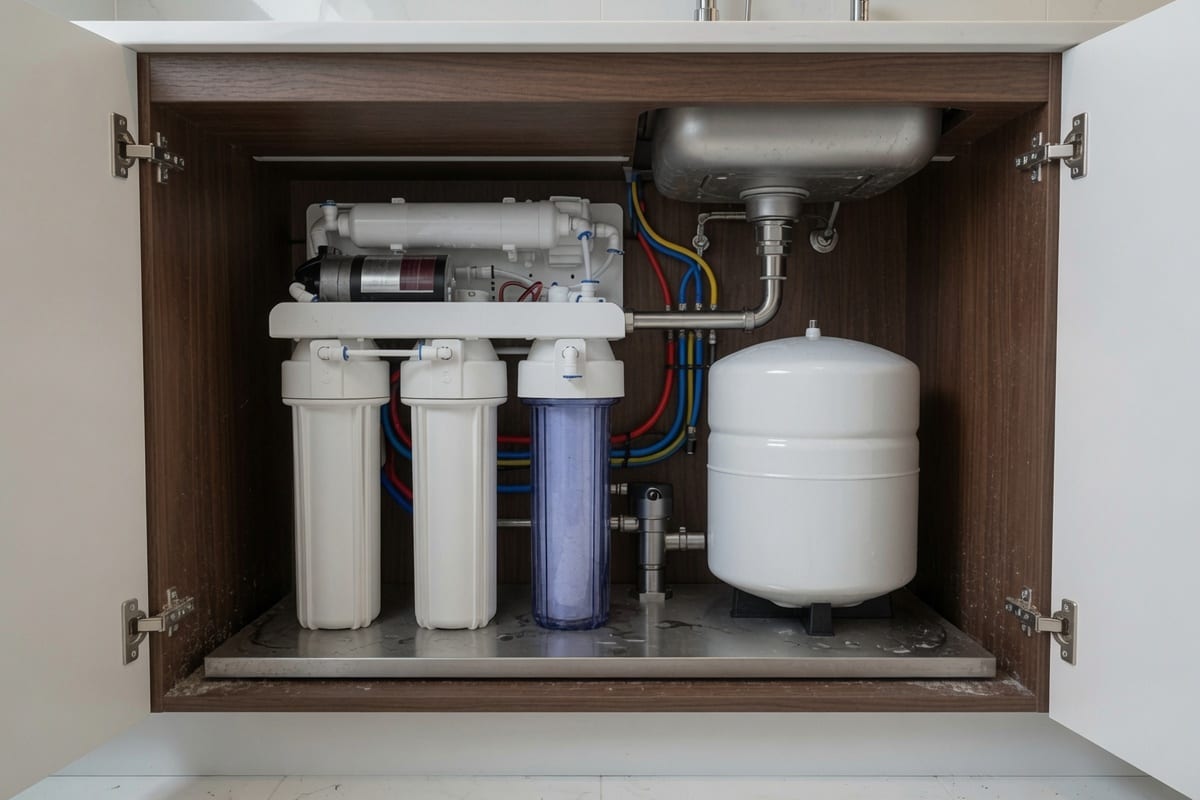
For PFAS, an under-sink reverse osmosis unit at the kitchen sink is the targeted answer (under-sink reverse osmosis, $350 to $900 installed). It treats the water used for drinking and cooking. Our reverse osmosis drinking water page covers sizing, and our North Carolina PFAS guide explains the federal rule.
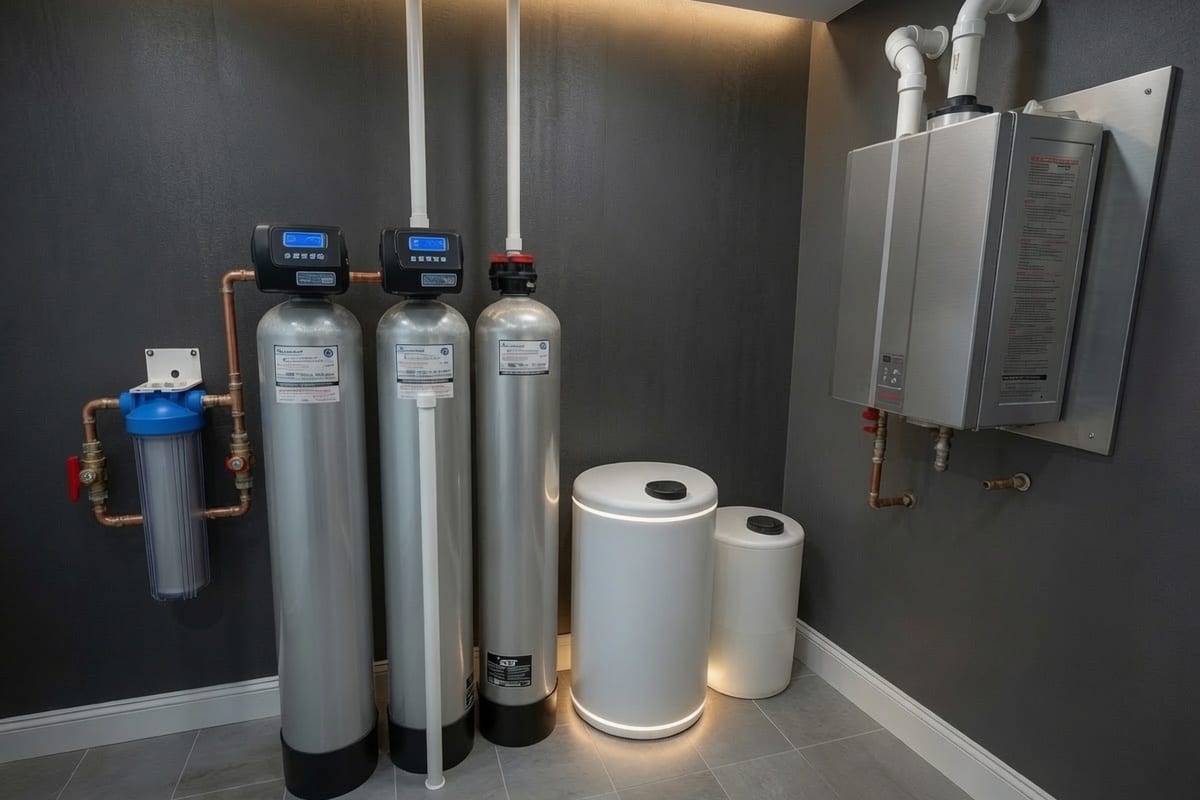
For the chloramine taste at every tap, catalytic carbon, not standard activated carbon, is the right media (whole house carbon filter, $1,500 to $3,500 installed). Our explainer on catalytic carbon for chloramine covers the difference, and carbon filtration and city water treatment cover how a whole-house system is sized.
A softener is a separate question this report cannot answer, since hardness was never published for this system. Measuring it at the tap is the only way to know, here or in Clayton and Garner next door. Every figure above is a planning range, never a quote, and the full set sits on our Raleigh price guide.
Frequently Asked Questions
Is Smithfield NC water safe to drink?
The Town’s 2024 report states it received no monitoring violations, and byproducts, lead and copper all tested under their federal limits. EPA’s file shows one treatment-technique violation and a linked reporting violation from October 2024, both returned to compliance on 14 November 2024, and none open as of 27 September 2026.
Where does Smithfield NC get its water from?
The Neuse River, treated at the Town of Smithfield’s own plant on North 2nd Street. It does not buy water from another utility for regular use, and it sells water to Johnston County.
Is Smithfield South Water District the same system as the Town of Smithfield?
No. Smithfield South’s own report states that Johnston County Utilities supplies its water, the same utility that supplies Clayton.
Does Smithfield NC water have PFAS?
Yes. A December 2024 sample found PFOA at 6.2 parts per trillion and PFOS at 7.6 parts per trillion, both above the 4 parts per trillion limit EPA finalized in April 2024, which systems must meet by 2029. No violation is on record because that deadline has not arrived.
Is Smithfield water hard?
Nobody publishes the number. The Town’s report has no hardness row, a gap that runs across Johnston County’s reports too, so the only way to know your own number is to have it measured with a water test.
Does Raleigh Water Pros serve Smithfield?
Coverage of Smithfield addresses is not confirmed. The free consultation is offered across the Triangle, and the fastest way to find out whether your address is included is to ask through our contact page before booking anything.
Sources and reporting dates
- Town of Smithfield 2024 Annual Drinking Water Quality Report, Water Treatment Plant.
- Town of Smithfield 2024 Annual Drinking Water Quality Report, Smithfield South.
- NC DEQ Local Water Supply Plan for Smithfield, 2023.
- EPA Safe Drinking Water Information System records for PWSID NC0351010, read 27 September 2026.
- EPA, PFAS national drinking water standard, 10 April 2024, and its proposed PFOA and PFOS compliance extension rule, 18 May 2026, not final.
- NC DEQ’s 2022 statewide PFAS sampling of public water system intakes.
- Town of Selma water and sewer operations page, for the aside on Selma’s own system.
A system average does not describe every address on every day. Check the current report before acting on any number here.
Smithfield tap water, answered
Smithfield treats its own water from the Neuse River. Its 2024 report lists no monitoring violations, and EPA’s record shows one October 2024 violation returned to compliance within a month. The number to watch is PFAS: two compounds reading above the limit systems must meet by 2029.
The free consultation, with an up-front written price, is offered across the Triangle, including Clayton in Johnston County and Garner. Coverage of Smithfield is not confirmed, so ask through our contact page whether your address is covered, or call (984) 384-6991.