Black Slime in Faucets? Manganese in NC Well Water
Raleigh Water Pros • September 20, 2026 • 11 min read
Black flecks in the ice from the freezer door. A dark grey slick inside the toilet tank. Whites coming out of the wash with a grey cast that was not there a year ago, and a bitter edge to a glass of cold water.
On a Triangle well the word for all of that is usually manganese. It is iron’s quieter neighbour in the same rock, it shows at a fraction of the concentration iron needs, and a filter sized for iron often walks straight past it.
The other possibility is cheaper, and this post takes it seriously: some black slime is not in the water at all. It is growing on a damp surface inside the fixture, and the answer is a cleaning routine rather than a tank in the garage. Here is how to tell the two apart, what the numbers mean, and what removes manganese when it is the real thing.
What Does Black Slime in Well Water Mean?
Usually one of two things, and they cost very different amounts to put right. Either manganese is arriving with the water and depositing on everything it touches, or something is growing on a wet surface in one or two fixtures.
Manganese is a naturally occurring metal that dissolves out of rock into groundwater. EPA sets a secondary standard of 0.05 milligrams per litre for it and lists the noticeable effects as “black to brown color; black staining; bitter metallic taste” (EPA secondary drinking water standards).
The specks have their own explanation. EPA’s health advisory document for manganese notes that “at concentrations as low as 0.02 mg/L, manganese can form coatings on water pipes that may later slough off as a black precipitate” (EPA, Drinking Water Health Advisory for Manganese). That is the ice maker explained: a coating builds quietly inside the plumbing at a concentration under the staining standard, then lets go in flakes after a pressure change or a week with the house empty.
Is It Manganese, or Is It Biofilm in the Fixture?
Manganese shows up everywhere the water goes. Biofilm shows up on two or three damp surfaces and nowhere else. That single distinction settles most cases before anyone spends money.
| Question | Points to manganese | Points to biofilm in the fixture |
|---|---|---|
| Where does it appear? | Every toilet, the dishwasher, the ice maker, the laundry | One or two damp spots: a toilet rim, a shower corner, an aerator |
| What does the laundry look like? | A grey or brown cast on whites | Nothing. The laundry is fine |
| What happens after cleaning? | Comes back as a stain or specks, on the same schedule | Comes back as a film, and stays away longer if the surface dries |
| Any taste? | A bitter metallic edge is possible | Nothing in the water |
| What does the lab say? | Manganese over 0.05 mg/L | Manganese under 0.05 mg/L |
The cheap case is common, and a water treatment company that never mentions it is not doing you a favour. The Town of Mooresville’s public utilities department, which fields these calls every year, tells residents the pink film and black gunk in bathrooms are “completely normal”, that neither is a major health concern, and that the answer for both is cleaning: scrub first, then disinfect with a strong chlorine bleach solution, and for a toilet spray bleach under the rim and add a quarter cup to the tank for fifteen to twenty minutes before flushing. It warns that bleach left standing in a tank “will damage the rubber valves and seals”, and passes on the American Water Works Association’s point that once this kind of bacteria is established it usually cannot be eliminated entirely. A routine, then, not a one-off. Our guide to pink slime in the shower covers the pink half of that in more detail.
So if manganese comes back under 0.05 mg/L and the slime sits in a couple of damp spots, you have a cleaning schedule rather than a water treatment problem, and anyone quoting you a filter for it is selling you the wrong thing.
Not sure which column you are in? Request a free consultation and we read the water first, then put any price in writing.
Manganese Is Not Iron, and That Is Why the Filter Missed It
They come out of the same rock, stain different colours, and need different chemistry to remove. Penn State Extension draws the line cleanly: iron produces an “orange or brown stain in sinks and in the laundry”, manganese a “dense black stain or solid”, and the recommended limits are “no more than 0.3 mg/L (or 0.3 parts per million) of iron and less than 0.05 mg/L of manganese” (Penn State Extension, Iron and Manganese in Private Water Systems). Manganese becomes visible at roughly one sixth of the concentration iron needs, which is why a well can look clean of orange and still throw black specks.
The part that costs people money is pH. Both metals have to be oxidised into a particle before a filter can catch them, and manganese demands more pH to get there. Penn State puts the threshold for one common oxidising media at “at least 6.8 for iron removal and 7.5 for manganese removal”. North Dakota State University Extension reports the same gap for chlorination: “the optimum rate of oxidation of iron and manganese by chlorination is at a pH of about 8.0 and 8.5, respectively” (NDSU Extension).
Put those together and an ordinary situation appears. A well at pH 6.9 gets an iron filter. The orange goes, and the black keeps coming, because the water never reaches the pH the manganese half of the job needs. The filter is not broken; it was specified against the wrong number. Our guide to iron staining in well water covers the orange side, iron filter versus water softener covers which equipment handles what, and the blue-green stains guide explains why pH correction comes first on acidic water.
Pro tip: pull the aerator off the kitchen tap and look at the screen. Orange grit is iron, black grit is manganese, and both together is the combination that decides the media. A thirty-second check that tells a technician more than any description on the phone.
What the 0.05 mg/L Standard Means, and What It Does Not
It is an appearance standard, not a health limit, and there is a separate health-based number six times higher. Confusing the two is how pages end up either alarming people or dismissing them.
The 0.05 mg/L figure is EPA’s secondary maximum contaminant level. EPA’s own manganese advisory describes it exactly: “The SMCL is based on staining and taste considerations. It is not a federally enforceable regulation, but is intended as a guideline for States.” Nothing about it is a safety threshold.
Health-based guidance exists separately, and it is non-enforceable too. EPA sets a lifetime health advisory of 0.3 mg/L, which it says “will protect against concerns of potential neurological effects”, plus a one-day and ten-day advisory of 1 mg/L for short-term exposure in the general population. Infants are handled differently. EPA advises “that for infants younger than 6 months, the lifetime HA of 0.3 mg/L be used even for an acute exposure of 10 days, because of the concerns for differences in manganese content in human milk and formula and the possibility of a higher absorption and lower excretion in young infants.”
Three numbers, three jobs, and worth keeping in proportion: manganese is an essential nutrient and most intake comes from food rather than water.
If there is an infant in the house, or anyone with a specific health concern, that conversation belongs with your child’s doctor or your county health department. We can tell you what your manganese number is and what removes it. We are not qualified to tell you what it means for a particular person, and we will not pretend otherwise.
How Common Is Manganese in Triangle Wells?
Between a fifth and a third of tested wells in every Triangle county came back over the standard. North Carolina’s Division of Public Health publishes county summaries of private well samples run by the NC State Laboratory of Public Health from 1998 to 2010.
| County | Samples with a manganese result | Average, µg/L | Share over 50 µg/L |
|---|---|---|---|
| Wake | 2,570 | 87.9 | 22.68% (583 wells) |
| Durham | 470 | 123.9 | 34.68% (163 wells) |
| Chatham | 1,544 | 126.9 | 32.71% (505 wells) |
| Johnston | 1,460 | 90.1 | 29.11% (425 wells) |
| Orange | 4,666 | 100.4 | 26.10% (1,218 wells) |
Figures from the NC DPH county reports, for example Wake County, which also records a highest single Wake result of 25,710 µg/L. NC DEQ’s statewide private well sampling for 2018 to 2019 found manganese over standards in 27.99 percent of samples (NC DEQ), the same picture from a different decade.
NC DPH states the caveat itself: county averages “are not detailed enough to predict the specific groundwater concentrations of contaminants in smaller regions and may not reflect the quality of groundwater in a single well.” Yours is a question for a test. What the numbers establish is that black staining on a well around Clayton, Pittsboro or the Durham county fringe is a normal local finding, not a freak result.
How Is Manganese Removed From Well Water?
Test first, correct pH if it is low, then oxidise and filter. The order is what makes the equipment work.
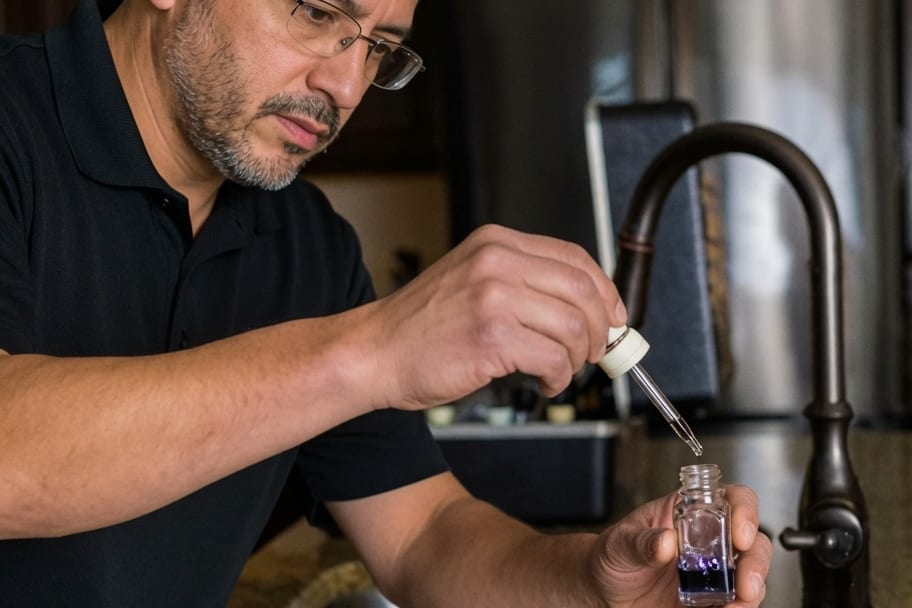
Get a number, not a colour. Ask a lab for manganese, iron, pH and hardness on one sample. Manganese in milligrams per litre sizes the media; pH decides whether the media can do its job at all. Our water testing and analysis page covers the panel to request.
Raise pH if the test says to. On a well below about 7, pH correction goes in ahead of the filter. Skipping it is the most common reason a manganese filter disappoints.
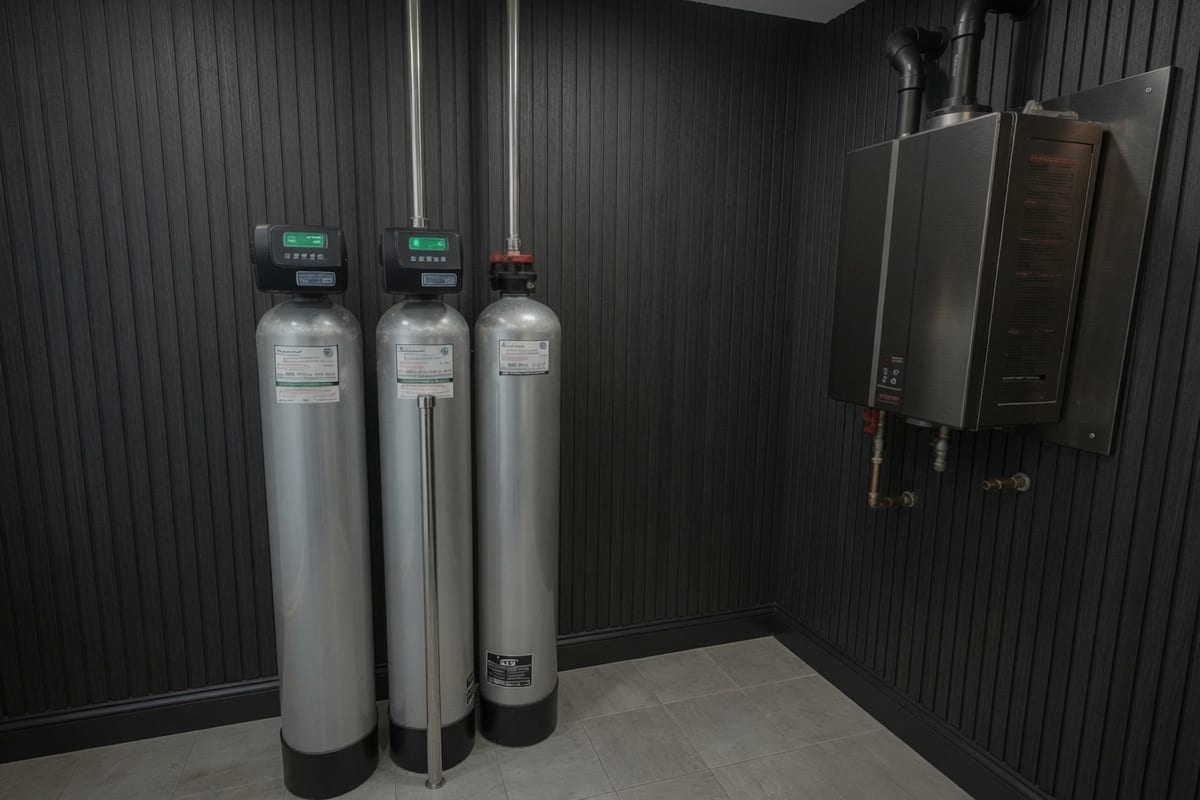
Oxidising or catalytic media filter. The main event for a whole house. Penn State puts oxidising filters in range “when the combined iron and manganese concentration is in the range of 3 to 10 mg/L”, and says above 10 mg/L “the most effective treatment involves oxidation followed by filtration” with a chemical feed ahead of the tank. An iron and sulfur filter rated for both metals runs $1,800 to $3,500 installed on the band in our Raleigh water filtration cost guide, a planning range rather than a quote.
A softener is a partial answer at best. Penn State recommends one for these metals only “when the water pH is greater than 6.7, the water hardness is between 3 and 20 grains per gallon and the dissolved iron concentration is less than 5 mg/L”, and oxidised manganese fouls resin rather than exchanging on it.
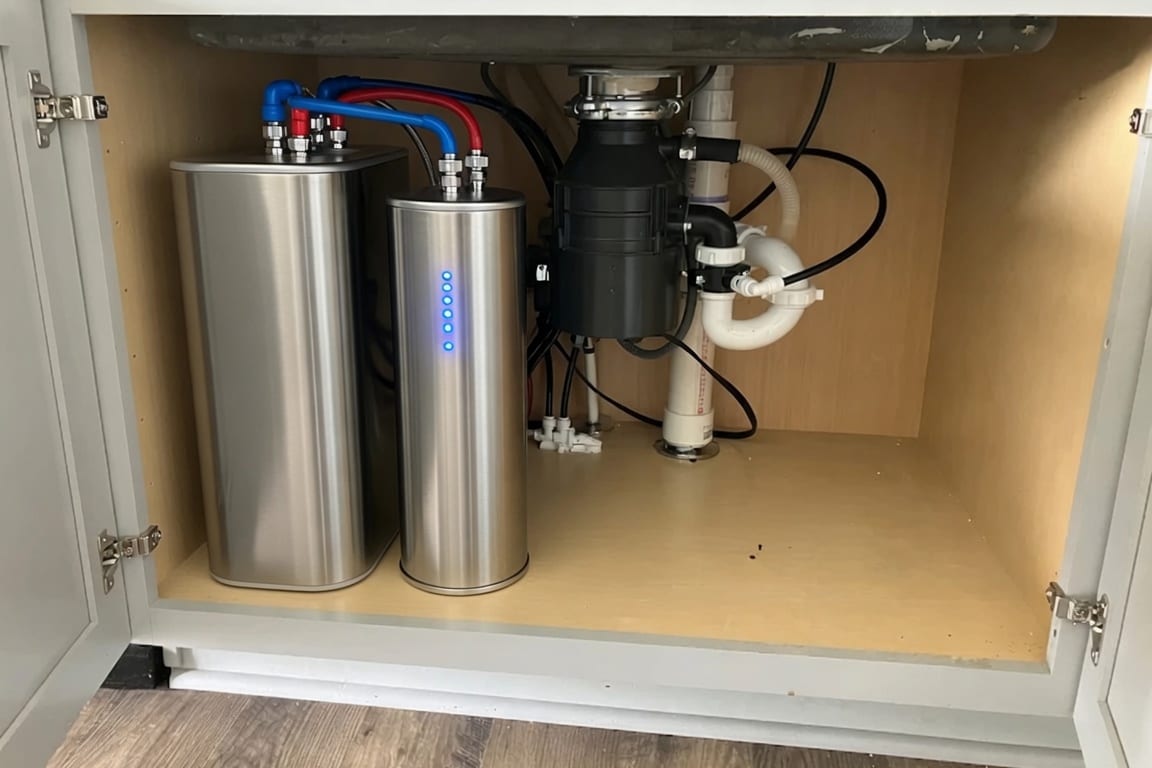
Point of use for drinking water only. EPA lists reverse osmosis among the technologies that remove manganese, and an under-sink unit at $350 to $900 covers a drinking tap and formula water. It does nothing for laundry, fixtures or the ice maker, so it adds to whole-house treatment rather than replacing it.
Frequently Asked Questions
Is manganese in well water safe to drink?
EPA’s 0.05 mg/L standard is about staining and taste, not safety, and its health-based lifetime advisory is 0.3 mg/L. Manganese is also an essential nutrient that people get mostly from food. Anyone with a specific concern, and particularly any household with an infant, should raise it with their doctor or county health department rather than a filtration company.
Why does my iron filter not remove the black staining?
Almost always pH. Manganese needs more pH to oxidise than iron does, so a filter that clears orange at pH 6.9 can leave black behind on the same water. Correcting pH ahead of the filter usually fixes it, and our iron and sulfur removal page covers media rated for both metals.
Can I use well water with manganese to make baby formula?
That is a question for your child’s doctor, not for us. The published guidance is this: EPA advises that for infants younger than six months the 0.3 mg/L lifetime figure be applied even to a ten-day exposure, because of how young infants absorb and excrete manganese. Get the lab number first so the conversation has something real in it.
Does a water softener remove manganese?
Some, under narrow conditions. Penn State sets them at pH above 6.7, hardness of 3 to 20 grains per gallon and dissolved iron under 5 mg/L. Outside that, oxidised manganese fouls the resin instead of exchanging on it.
How do I test for manganese in my well?
A certified lab panel in milligrams per litre. Manganese is on the panel North Carolina requires for a newly constructed private well, so a recently drilled well has a result on file with the county. Older wells in Chapel Hill and across Orange, Chatham and Wake counties can be tested through the county health department or an independent lab.
Is black slime in the toilet tank always manganese?
No, which is the point of testing before buying. Manganese stains everything the water reaches, including the ice maker and the laundry. Slime confined to a damp rim or a shower corner, with a clean manganese result, is bacteria on a wet surface and a cleaning job. Our well water treatment page covers what is worth treating.
Get the Manganese Number Before You Buy Anything
Black staining has two completely different answers, and one of them costs the price of a bottle of bleach. A lab number separates them in a single test, and it is the same number that sizes the equipment if treatment turns out to be the answer.
We test, size and install iron and manganese treatment across Raleigh, Clayton, Durham, Pittsboro and the rest of the Triangle, and we read the water before quoting anything.
Call (984) 384-6991 or book a free consultation for an up-front written price on treating the water behind the staining.