Water Softener Salt: A Practical Guide for NC Homes
Raleigh Water Pros • September 20, 2026 • 10 min read
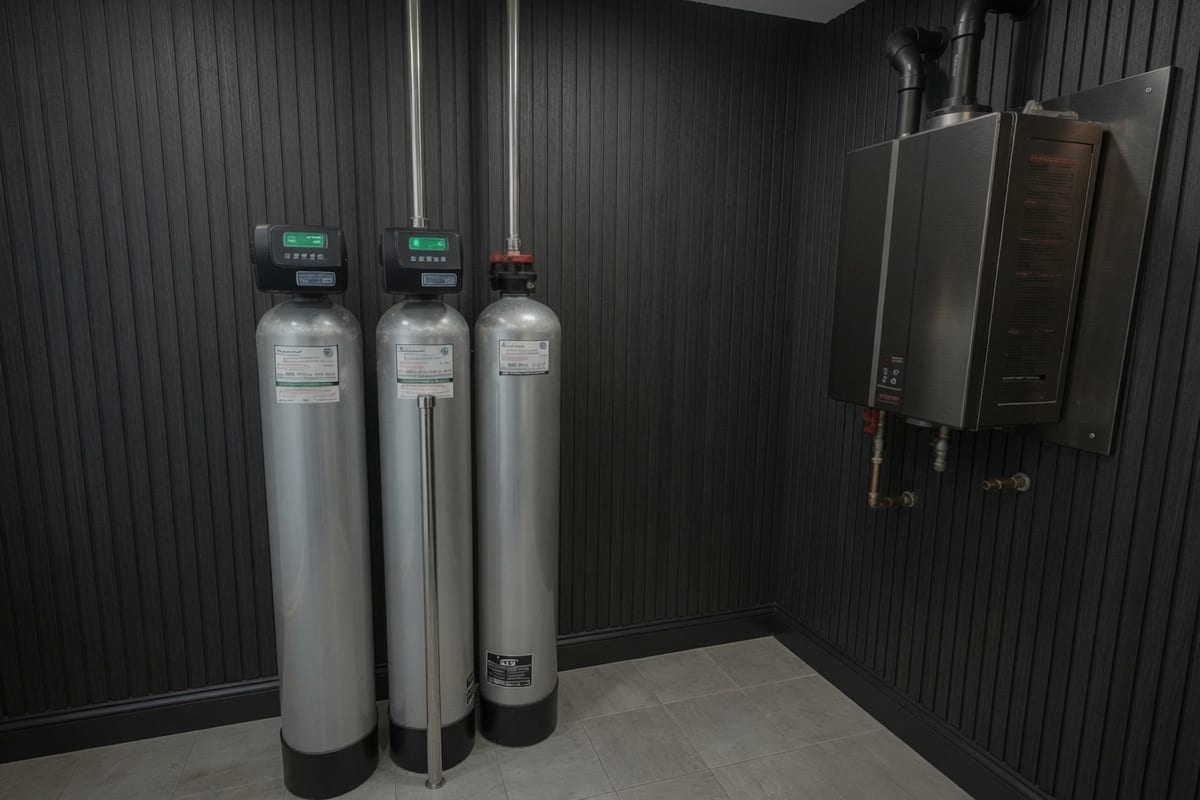
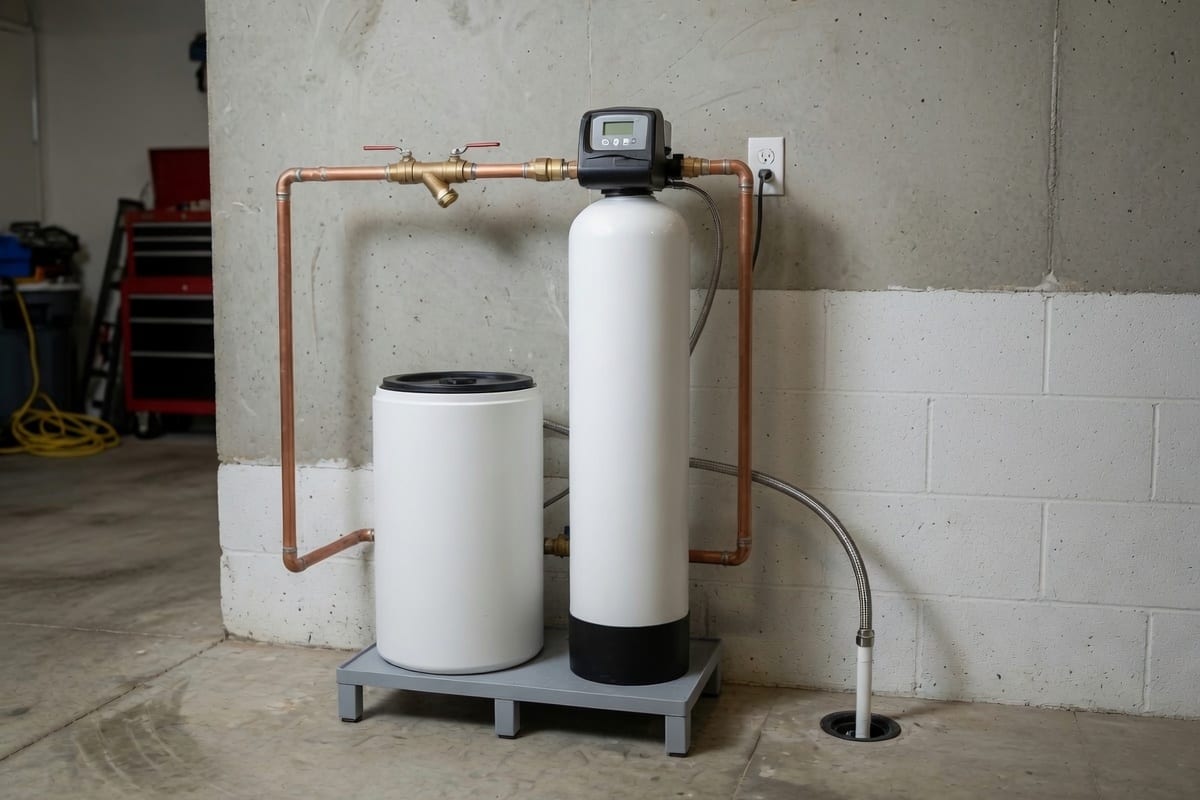
You lift the brine tank lid, the salt has barely moved in six weeks, and you cannot tell whether that is good news or a problem. Meanwhile the hardware store aisle offers four kinds of water softener salt at four different prices, and none of the bags explain which one your tank wants.
The right answer turns on one number you probably do not have: the hardness of the water entering your house. A home on a well south of Apex and a home on Raleigh city water three miles away are running completely different machines, even with an identical softener in the garage.
This guide covers the four salt types, how much salt a Triangle household really burns in a year at different hardness levels, how often to check the tank, and how to break a salt bridge before it quietly turns your softener into an expensive plumbing ornament.
Which Water Softener Salt Should You Use?
Evaporated pellets are the safest default, solar crystals are fine in most tanks, and rock salt is the one to skip unless your owner’s manual calls for it. All four do the same chemical job. They differ in how much insoluble material they leave behind and how they behave in a humid Carolina garage.
| Salt type | What it is | The catch |
|---|---|---|
| Rock salt | Mined and crushed, the least refined | Leaves the most insoluble grit on the tank floor, so you clean it out more often |
| Solar salt (crystals) | Seawater or brine evaporated by sun and wind | Packs together in humid storage and is the most likely type to bridge |
| Evaporated pellets | Brine boiled down and pressed into uniform pellets | Highest price per bag of the three sodium options |
| Potassium chloride | Potassium instead of sodium as the exchange ion | Several times the price per bag, and many valves need the salt dose raised |
Rock salt suits an older unit on a tight budget, solar crystals most Triangle wells with heavy use, pellets low water use and tanks that sit for weeks between regenerations, and potassium chloride households watching dietary sodium.
That sodium question deserves a number. Penn State Extension puts the exchange at 7.5 milligrams of sodium per quart for each grain per gallon of hardness removed (Penn State Extension, Water Softening). Run it on your own reading: a well that measures 15 grains per gallon works out at about 113 milligrams per quart of softened water. On Raleigh city water it is closer to 11. Potassium chloride is stocked at most stores that sell softener salt if you would rather skip the sodium (Minnesota Department of Health, Home Water Softening).
One rule overrides all of it: check the manual. A few valve designs specify pellets and nothing else, and a resin bed already fighting iron does not need rock salt sediment on top of it.
How Much Water Softener Salt Does a Triangle Household Use in a Year?
Plan on $50 to $150 a year for salt, and the spread inside that range is driven by hardness far more than by brand. These are planning ranges, never a quote.
Here is the arithmetic, done openly so you can redo it with your own numbers. EPA WaterSense puts average family use at more than 300 gallons a day at home, roughly 70 percent of it indoors (EPA WaterSense, How We Use Water), so call it 210 gallons a day through the softener. A softener in decent condition recovers about 3,000 to 4,000 grains of hardness per pound of salt, 4,000 being the high-efficiency benchmark (Water Conditioning and Purification, Softener Efficiency). At 3,500 grains per pound, a year looks like this:
| Feed water hardness | Grains per day | Salt per year | 40 lb bags |
|---|---|---|---|
| 1.5 gpg (Raleigh city water) | about 315 | about 33 lb | roughly 1 |
| 5 gpg (mild well) | about 1,050 | about 110 lb | roughly 3 |
| 10 gpg (common Triangle well) | about 2,100 | about 219 lb | 5 to 6 |
| 15 gpg | about 3,150 | about 329 lb | 8 to 9 |
| 20 gpg (hard well) | about 4,200 | about 438 lb | about 11 |
The bottom row uses roughly thirteen times the salt of the top row, in identical houses with identical equipment. Household size, iron and a valve set wrong all move the number, but hardness is the whole story.
Want the number for your own tank instead of a table? Request a free consultation and we test your hardness first, then quote in writing.
The Raleigh city water footnote nobody in the salt aisle mentions
If you are on Raleigh Water, your softener has very little work to do. Raleigh Water’s 2025 report puts system hardness at 25.2 mg/L, about 1.47 grains per gallon, and its per-plant table classifies the water “Soft” at both the E.M. Johnson and Dempsey E. Benton plants (City of Raleigh, 2025 Consumer Confidence Report). The same treated water serves Garner, Wake Forest, Rolesville, Knightdale, Wendell and Zebulon under one PWSID.
Minnesota’s health department sets the practical line for needing a softener at greater than 7 grains per gallon. Raleigh sits at roughly a fifth of that. Keep a city-water softener fed and clean, but do not let anyone treat your salt consumption as a hardness emergency. Our hard water by NC city guide has the published numbers for twenty-one utilities.
Wells are a different machine. Private well water around the Wake, Chatham and Johnston County fringe commonly runs 10 to 20 grains per gallon or higher, and the state never measures it for you: General Statute 87-97 lists what a new private well must be tested for, and hardness is not on the list (NC General Statute 87-97). On a well in Fuquay-Varina or Pittsboro, your hardness number exists only if somebody paid to measure it.
How Often Should You Check and Refill the Brine Tank?
Look in the tank once a month, and keep the salt at least a third full and a few inches above the water line. A monthly glance takes ten seconds and catches every problem on this page while it is still free to fix.
Refill at about a third of the tank, and do not fill to the rim. A packed, brim-full tank is the most reliable way to create a salt bridge, because the weight of the column above compacts the crystals below.
Should you let the tank run empty first? No. That advice circulates widely and the real effect is that any regeneration attempted on a dry tank runs on plain water, does nothing to the resin, and hands you hard water plus a wasted cycle. To clear old sediment, let the level get low and then clean the tank on purpose, with the unit in bypass.
Pro tip: Date each bag with a marker before you pour it in. Two or three dated bags is all the record you need to know your real salt use, and if that number doubles with no change in the house, the valve is regenerating more often than it should. That is a diagnosis, not a guess.
What Is a Salt Bridge, and How Do You Break One Safely?
A salt bridge is a hard crust of salt fused into an arch across the tank, leaving an air gap underneath so the water below never touches salt. The tank looks full. The brine is plain water. The resin never regenerates, and the first thing you notice is the soft water feeling disappearing while the salt level appears not to drop for weeks.
Humidity and heat build them, which is why an unconditioned Triangle garage in August is bridge weather. To check, press a broom handle straight down through the salt. If you hit a hard layer and then break through into a void, you found it. To clear it:
- Put the softener in bypass so the house is not pulling water through it mid-repair.
- Crack the crust in several spots with the broom handle. Use wood or plastic, never a metal bar, and never lever against the tank wall or the brine float.
- Pour a gallon or two of hot water over the broken crust.
- Wait a few hours, break up any remaining chunks, and bring the level back to a third full.
- Return the valve to its normal service position, then run a manual regeneration. The order matters: a unit sitting in bypass has no feed water reaching it, so a regeneration started in bypass cannot draw brine or rinse the bed and simply wastes a cycle. Your model’s manual is the authority on the exact sequence and on which position the valve should be in, so check it rather than following a generic list.
A salt mushroom is the related failure: a solid column standing on the tank floor that will not dissolve, and it usually needs the tank emptied and scooped out by hand. If the mass will not yield to hot water, have it serviced rather than attacking it with a screwdriver, because cracking a brine tank or snapping a float turns a twenty-minute job into a parts order. Our water softener service checklist covers what a technician checks in the brine tank.
How Should You Store Softener Salt?
Indoors, off the concrete, on a pallet or shelf, with the bags closed. Salt pulls moisture out of humid air, and a bag on a slab floor through a Carolina summer wicks up enough to fuse solid before you open it.
Two or three bags on hand is right for most households; buying eight in March means the last four spend the summer absorbing water, and those are the bags that bridge. If you run a softener alongside well water treatment for iron, watch the tank floor too: iron leaves a rust-colored sludge that rock salt makes worse and that eventually reaches the injector.
Frequently Asked Questions
Can I mix salt types in the same brine tank?
Yes, mixing sodium chloride types is fine, though it is better practice to run the tank low before switching. Do not casually mix sodium chloride and potassium chloride: the two have different exchange capacities, and most valves need the salt dose revisited when you switch.
How often should a water softener regenerate?
Most metered residential units regenerate every few days, and the interval should track your water use and hardness rather than a calendar. Penn State Extension notes about 50 gallons of water per regeneration cycle, so a unit regenerating daily on soft city water is wasting salt and water both. A sudden jump in frequency with no change in the household is a service issue, not a salt issue.
Does softened water taste salty?
It should not. Softened water carries sodium, not salt crystals, at roughly 7.5 milligrams per quart for each grain per gallon removed, below the taste threshold for almost everyone. A genuinely salty taste usually means the valve is failing to rinse and brine is reaching the house. Our water softener repair cost guide covers what that fix runs.
Do I need a softener at all on Raleigh city water?
Probably not on hardness grounds. Raleigh Water publishes 1.47 grains per gallon and labels it “Soft”, well under the 7 grains per gallon threshold where softening is usually indicated. Raleigh’s water complaints are chloramine taste and odor rather than scale, which is a city water treatment question.
Will a water softener remove iron from my well water?
Only a little, and it pays for that badly. A softener handles a small amount of dissolved clear-water iron, and past that the iron coats the resin, kills capacity and drives salt use up. Wells in Wake Forest and across the rural fringe usually need iron handled ahead of the softener rather than by it.
How much should I budget for salt each year?
Plan on $50 to $150 a year for a typical Triangle household. City-water homes sit near the bottom of that range, and the harder your well measures, the closer to the top you land. Potassium chloride pushes you toward the top. Our water softener maintenance cost guide and the Raleigh water filtration cost page carry the rest of the ownership numbers.
Get Your Hardness Measured Before You Buy Another Bag
Everything on this page turns on one number, and most Triangle homeowners have never seen theirs. We test hardness at the tap, check what your softener is actually removing, and set the salt dose to the water you have rather than to a factory default somebody left in the valve.
We work across Raleigh, Apex, Fuquay-Varina and Pittsboro, on city water and on wells. If your softener needs installation or replacement, or just a hardness test to settle the argument, request a free consultation or call (984) 384-6991. You get an up-front written price before any work starts, and if your water does not need a softener we will tell you that too.