Is Chapel Hill Tap Water Safe to Drink? (2026)
Raleigh Water Pros • September 26, 2026 • 9 min read
Chapel Hill and Carrboro share one water utility, and it is not the Town of Chapel Hill. It is OWASA, the Orange Water and Sewer Authority, a public authority on Jones Ferry Road in Carrboro. Search “is Chapel Hill water safe to drink” and you get score sites and filter ads; search OWASA’s own site and you get a one-page report card plus a longer test summary that answer most of the questions directly.
We read both. Is Chapel Hill tap water safe to drink? Yes, by every published measure. And the more interesting story is how OWASA got its PFAS numbers down with a chemical it was already using, then deferred an expensive new plant.
Below: where the water comes from, what the 2025 report card shows, PFAS, hardness, the March chlorine switch, and what is worth filtering.
Is Chapel Hill tap water safe to drink?
Yes. OWASA says that in 2025 it “met state and federal standards for contaminant levels in our drinking water”, and EPA’s record shows no violation of any kind in the three years to September 2026.
The federal file holds one violation in the system’s history: a monitoring and reporting item for December 2022 to February 2023, not health based, closed on 15 May 2023. The report card covers byproducts, lead and copper, fluoride and a PFAS panel, and everything regulated came in under its limit.
Safe is not the same as empty. The water carries a chloramine residual eleven months a year and low, measurable PFAS. Neither is a violation, and both are worth knowing before anyone sells you a filter.
Where does Chapel Hill’s water come from?
Two reservoirs OWASA owns: Cane Creek Reservoir and University Lake. In OWASA’s words, “Together, these water sources hold 3.45 billion gallons that are pumped to the Jones Ferry Road Water Treatment Plant.”
In 2025 Cane Creek supplied an average of about 4 million gallons a day and University Lake about 2.8. The Quarry Reservoir on N.C. Highway 54 holds about 200 million gallons today as storage, and OWASA says it “will eventually hold 2.2 billion gallons.” The plant is permitted for 20 million gallons a day and, by OWASA’s account, treats about seven.
OWASA also holds a 5 percent share of Jordan Lake’s water supply pool, about 5 million gallons a day, but it has no direct pipe to the lake. It can only reach that water through Durham’s and Cary’s systems, and in 2025 it drew none of it. During this year’s drought, OWASA said on 30 July 2026 that it is “working with our regional utility partners to evaluate the use of our Jordan Lake allocation to relieve immediate demand on our reservoirs.”
| Where you live | Water system | Source |
|---|---|---|
| Chapel Hill and Carrboro | OWASA, NC0368010 | Cane Creek Reservoir, University Lake |
| City of Durham | City of Durham, NC0332010 | Lake Michie, Little River Reservoir |
| Pittsboro | TriRiver Water (since 1 July 2024) | Haw River |
| Rural Orange County on a private well | Your own well | Groundwater |
A Chapel Hill page should never borrow Durham’s numbers, and this one does not. Durham’s report is covered in our Durham tap water guide.
Want to know what is in your own glass rather than the system average? Request a free consultation and we measure your tap first, then put the readings in writing.
What does OWASA’s 2025 report card show?
Byproducts far under their limits, PFAS under the future federal limits, and no lead service lines.
| Published figure | OWASA result | Limit |
|---|---|---|
| Total trihalomethanes, highest locational average | 17.2 ppb (8.3 to 26.2) | 80 ppb |
| Haloacetic acids, highest locational average | 11.4 ppb (3.0 to 16.1) | 60 ppb |
| Chloramines, running annual average | 3.1 ppm (0.2 to 3.9) | 4 ppm |
| PFOA, average | 2.2 ppt (0 to 3.5) | 4 ppt, compliance from 2029 |
| PFOS, average | 1.0 ppt (0 to 3.8) | 4 ppt, compliance from 2029 |
| Lead, 90th percentile (2023 round) | 0.73 ppb; 1 of 30 sites above 15 ppb | action level 15 ppb |
| Copper, 90th percentile | 0.033 ppm | action level 1.3 ppm |
| Total hardness (2025 test summary) | 25.1 mg/L, about 1.5 grains | no limit |
Byproducts at 17.2 and 11.4 ppb are low for a surface water system. Lead needs one sentence of context: the 90th percentile is well under the action level, and one home of the 30 sampled in 2023 came in above it. OWASA’s 2024 inventory “confirmed there are no lead service lines in our drinking water distribution system”, and the 2025 report card counts 90 customer-owned galvanized lines that need replacing. Lead in a glass here comes from a home’s own service line or plumbing, not from OWASA’s mains.
Is there PFAS in Chapel Hill water?
Yes, at low levels. OWASA’s 2025 testing found PFOA averaging 2.2 parts per trillion and PFOS averaging 1.0 part per trillion in treated water. EPA set a limit of 4 parts per trillion for each in 2024. The compliance date of 2029 has not arrived, EPA has proposed allowing extensions to 2031 (a proposal, not a final rule), and OWASA reports no violation. Its most recent quarter, the third quarter of 2026, showed PFOA at 2.3 parts per trillion and PFOS below a detectable amount. OWASA says GenX and PFNA “have never been detected in our treated drinking water.”
How it got there is the useful part. OWASA already fed powdered activated carbon for taste and odour. It started tuning that carbon for PFAS in summer 2023, and in August 2024 found a product that “works well for our facility and goals.” On 22 January 2026 the Board deferred the design of a granular activated carbon plant to consider it within a wider PFAS strategy. OWASA also received $1.96 million for PFAS treatment from a multi-party settlement with 3M.
Where does it come from? OWASA points to Cane Creek Reservoir in particular, saying its presence there “could be from another municipality’s previous biosolids land application practices in the watershed.”
1,4-dioxane was not detected in any of six state samples of OWASA water in 2022. OWASA says it has “no industrial discharges in its service area or in our water sources’ watersheds.” Chapel Hill’s reservoirs are headwater lakes, not the Haw River mainstem; that story belongs to Pittsboro and is covered in our guide to 1,4-dioxane in the Haw River.
Is Chapel Hill water hard or soft?
Soft. OWASA’s 2025 test summary puts total hardness at 25.1 milligrams per litre, about 1.5 grains per gallon, with a range of 16 to 34. OWASA described it in its 2021 report card as “fairly soft water, overall.”
The US Geological Survey classes anything under 60 milligrams per litre as soft, so OWASA water sits well inside that band. A softener has very little to remove on a Chapel Hill or Carrboro meter, and nobody should sell you one on hardness grounds.
Rural Orange County wells are a different case. Hardness there is unknown until measured, and state lab data put Orange at the top of the three local counties for acidic well water. Our guide to blue-green stains from acidic well water covers that.
Why does Chapel Hill water smell like chlorine in March?
Because OWASA switches from chloramine to plain chlorine every March. Its report card says: “Every March, we switch to using just chlorine to ensure stronger disinfection throughout the distribution system in accordance with state recommendations.” In 2025 the switch began at midnight on 1 March and ran through the month.
For the other eleven months the residual is chloramine, which standard carbon handles poorly. That is why a Chapel Hill filter needs catalytic carbon, explained in our guide to catalytic versus standard carbon for chloramine, and why the carbon filtration page sizes it on flow. Our annual chlorine switch guide explains why North Carolina utilities do this.
Pro tip: OWASA’s report card also tells chloramine customers to use “rubber materials in your plumbing that are chloramine-resistant, including toilet flappers, flexible hoses, and connectors.” If a Chapel Hill toilet flapper keeps failing, that is a cheap fix to try before blaming anything else. The same report card carries a chloramine warning for aquarium owners.
Frequently Asked Questions
Is Chapel Hill tap water safe to drink?
Yes. OWASA met state and federal standards in 2025, and EPA’s record shows no violation in the three years to September 2026. PFOA averaged 2.2 and PFOS 1.0 parts per trillion, both under the 4 parts per trillion federal limit, whose 2029 compliance date has not arrived.
Is Carrboro water the same as Chapel Hill’s?
Yes. OWASA serves the Chapel Hill and Carrboro community from the same reservoirs and the same Jones Ferry Road plant, so every figure here applies in Carrboro. Our Chapel Hill water filtration page covers both towns.
Does Chapel Hill have hard water?
No. OWASA’s 2025 test summary gives 25.1 milligrams per litre, about 1.5 grains per gallon, which is soft. A softener earns its place on a rural Orange County well only if a measured reading supports it, not on an OWASA meter.
Does Chapel Hill water have PFAS?
At low levels. PFOA averaged 2.2 parts per trillion and PFOS 1.0 in 2025, and the third quarter of 2026 showed PFOA at 2.3 and PFOS below detection. For a further step at the kitchen tap, an under-sink reverse osmosis drinking water system is the household option.
When does OWASA switch to chlorine?
Every March, in OWASA’s own words. The 2025 switch ran from 1 March through the end of the month; we did not find a 2026 notice, so check OWASA’s news page each February. Durham’s window is different and longer, covered on our Durham water filtration page.
What is worth filtering on Chapel Hill water?
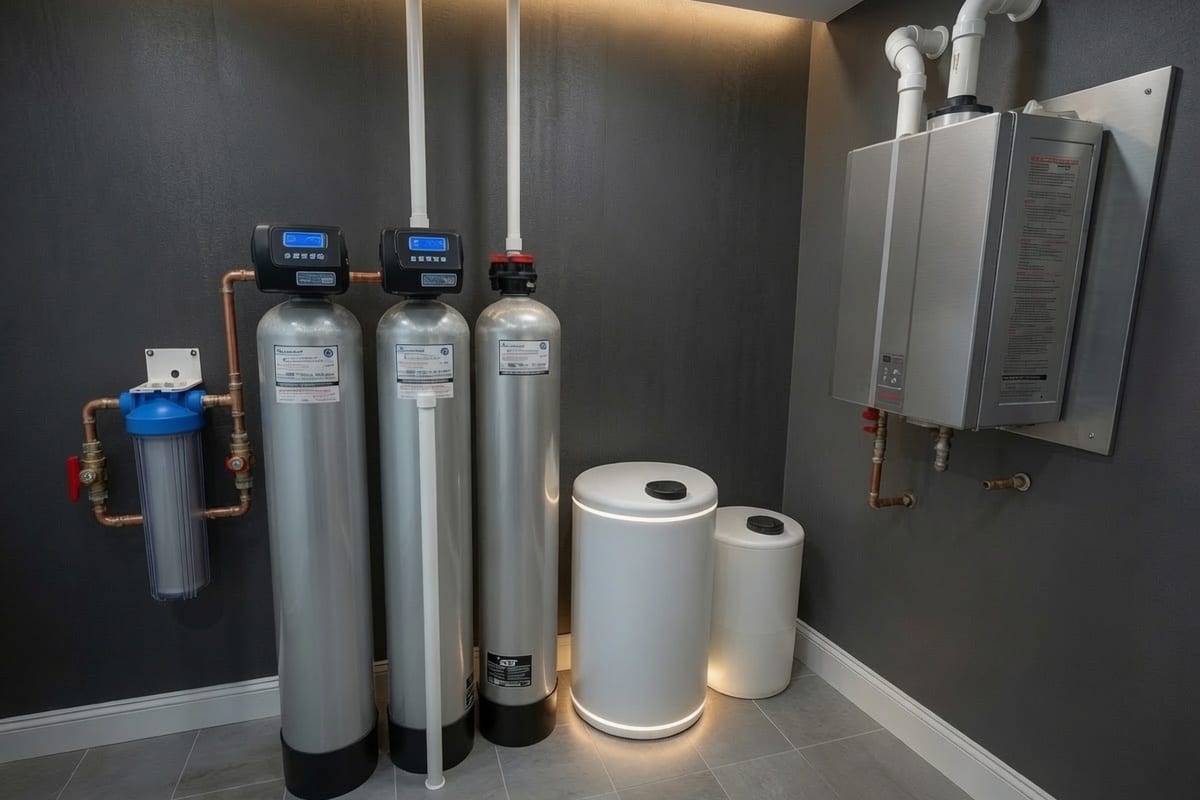
For most homes, only chloramine taste, which takes catalytic carbon. A whole house catalytic carbon filter treats every tap; an under-sink unit treats drinking water only. Planning ranges for both are on our water filtration cost page.
Sources and reporting dates
- OWASA 2025 Annual Water Quality Report Card and 2025 Drinking Water Test Results Summary (hardness read from the table’s page position, since its text layer shifts rows).
- OWASA drinking water monitoring and treatment page (modified 3 September 2026), the Jones Ferry Road project page on the January 2026 deferral, and the 2026 drought page.
- NC DEQ Local Water Supply Plan for OWASA, 2025, for withdrawals, plant capacity and the Jordan Lake allocation.
- EPA violation records for NC0368010, read September 2026; NC DEQ 2022 1,4-dioxane sampling.
- EPA’s proposed PFOA and PFOS compliance extension, proposed 18 May 2026, not final; the US Geological Survey hardness classification.
A system average does not describe every address on every day. Check the current report card before acting on any single number.
Chapel Hill tap water, answered
OWASA water is soft, low in byproducts and low in PFAS, and it has passed every test it is required to pass. The practical question for most Chapel Hill and Carrboro homes is chloramine taste, which catalytic carbon settles, and whether you want the drinking tap taken a step further.
Every visit starts with a free consultation in Chapel Hill, Carrboro, Durham or Pittsboro: we test at your tap, compare it with what OWASA publishes, and give you an up-front written price for only what the readings support, including when that is nothing. Call (984) 384-6991 or book your free consultation.