Is Concord NC Tap Water Safe to Drink? (2026)
Raleigh Water Pros • September 13, 2026 • 9 min read
Concord is the only city in the Charlotte metro whose drinking water has actually measured above the federal PFAS limit. Not near it. Above it, in all four rounds of the EPA’s most recent national monitoring programme.
Concord tap water is also the only supply in the metro with the treatment already built to bring it back down, finished years ahead of the federal deadline rather than after it.
Both of those sentences are true at once, and a Concord homeowner deserves both halves rather than whichever half makes the better headline. Below is what the EPA measured at the Hillgrove plant, on which dates, against which limit, and what the city has built since. Then the parts of the water that have nothing to do with PFAS: the disinfection byproducts that run highest of any system in this metro, two lakes and a river basin most people do not expect, and the one number Concord does not publish at all.
Is Concord NC tap water safe to drink?
Yes, and the one result that made people ask about it has now been treated at the plant. Concord’s PFOS readings sat above the EPA’s 4.0 parts per trillion limit through four rounds of federal monitoring, and in August 2026 the city finished an $18 million carbon treatment system built to strip it out.
Those are not competing facts. The measurement was real and it mattered. The response was real too, and it landed well ahead of schedule. What follows is the detail behind both.
What did the PFAS testing actually find?
EPA’s raw monitoring data recorded PFOS between 7.3 and 9.1 parts per trillion at Concord’s Hillgrove plant, roughly twice the 4.0 ppt federal limit, in every one of four sampling rounds. Here is the full set.
| Sample date | PFOS | PFHxS | PFOA |
|---|---|---|---|
| 23 October 2024 | 8.2 ppt | 3.6 ppt | not detected |
| 7 January 2025 | 9.1 ppt | 5.0 ppt | not detected |
| 1 April 2025 | 8.6 ppt | 4.9 ppt | not detected |
| 1 July 2025 | 7.3 ppt | 3.4 ppt | not detected |
Every detection came from one sample point, the Hillgrove plant. PFOA, the other compound EPA now regulates at 4.0 ppt, was not detected in any of the twelve results for it. PFHxS has no federal limit of its own yet, so its numbers are context rather than a pass or fail. For comparison in the same monitoring round, Charlotte and Gastonia both recorded zero PFOA and PFOS detections.
Pro tip: Concord’s annual report prints those PFAS values in a column headed ug/L when the numbers are really ng/L, which is parts per trillion. It is a units typo and the values themselves match EPA’s dataset exactly. It is still a good reminder to check which unit a report is using before deciding whether a number looks big or small, because those two units are a thousand-fold apart.
Want to know what your own tap reads rather than what the plant average says? Book a free consultation and we test your water in your kitchen, then put a written price on paper for only what the numbers support.
What has Concord built to fix it?
In August 2026, after a three-year build, Concord finished an $18 million granular activated carbon system at the Hillgrove Water Treatment Plant. Four carbon vessels treat roughly 4 million gallons of water a day as the final filtration step before it enters the mains.
City Water Resources Director Jeff Corley told WBTV that preliminary data coming back from the new system had been extremely positive so far. The project was funded through water rates and reached completion five years ahead of the 2031 federal compliance deadline cited for the work.
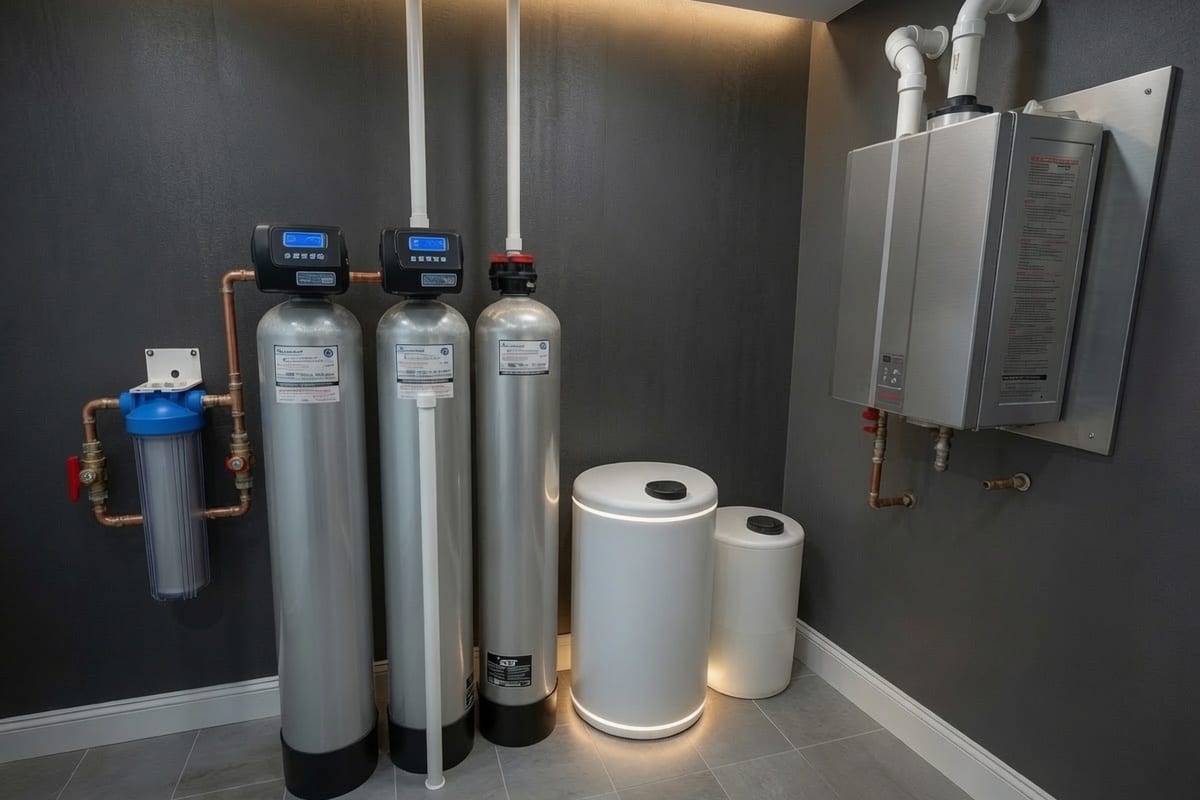
Granular activated carbon is worth understanding, because it is the same idea at two very different scales. A plant pushes millions of gallons through carbon vessels the size of grain silos. A whole house carbon filtration system pushes your household flow through a tank in the garage. Same media, same chemistry, different size.
Where does Concord’s water come from?
Concord Water Resources serves 115,203 people across Concord, Midland and part of unincorporated Cabarrus County, through 788 miles of water main and roughly 47,000 meters. Its own supply is surface water from Lake Don T. Howell in western Cabarrus County and Lake Fisher near Kannapolis, treated at two plants: Coddle Creek and Hillgrove.
Then there is the part almost nobody knows. Concord buys about 4.66 million gallons a day from the City of Albemarle, and Albemarle’s water comes from Tuckertown Reservoir and Narrows Reservoir on Badin Lake. Those are Yadkin River basin, not Catawba.
That makes Concord the only system in this metro that is not drinking pure Catawba water. Charlotte, Huntersville and Gastonia all pull from the Catawba chain. Concord blends its own Rocky River basin reservoirs with a Yadkin basin purchase, which is a genuinely different water chemistry arriving in the same pipe.
Does Concord have hard water?
Nobody can answer that from a published figure, because Concord does not publish one. There is no hardness line and no calcium line in the “Other Miscellaneous Water Characteristics” table of Concord’s annual report, in either the 2025 edition or the current 2024-titled one. That is unusual, and saying so plainly beats guessing.
What we do know is the neighbourhood. Charlotte Water publishes total hardness of 32 ppm, about 1.9 grains per gallon. Two Rivers Utilities in Gastonia puts its own water at roughly 14 ppm, about 0.8 grains. Both are soft by any standard, and Gastonia’s utility tells customers outright that most people do not need a softening device.
Concord probably sits in that neighbourhood, but “probably” is not a number, and the Albemarle blend is a real reason not to assume Concord is identical to Charlotte. If hardness matters to you, a water test at your own tap settles it in one visit. A softener is a $1,500 to $3,500 decision, and it should follow a measurement, never a sales demonstration that turns a glass cloudy.
What is worth filtering in Concord water?
Two things, and neither of them is PFAS any more.
Disinfection byproducts
This is Concord’s real number. Haloacetic acids, the group reported as HAA5, ran a highest annual average of 47.7 parts per billion against a federal limit of 60 in 2025. That is the highest HAA5 figure of the four cities in this metro, about 80 percent of the limit. Trihalomethanes came in at 62.8 ppb against an 80 ppb limit.
Both are compliant. Both are also the predictable result of chlorinating lake water full of natural organic material. Concord disinfects with free chlorine at an average residual of 1.06 ppm, not chloramine, and that detail decides what you buy: standard activated carbon handles free chlorine and its byproducts properly, so you do not need the pricier catalytic carbon that chloraminated systems call for.
A whole house carbon filter runs $1,500 to $3,500 installed for a correctly sized system, and it treats every tap including the shower, where trihalomethanes matter most because they go airborne in hot water. Our water filtration cost guide breaks the pricing down further. Treat any range like that as planning numbers, not a quote.
Drinking and cooking water
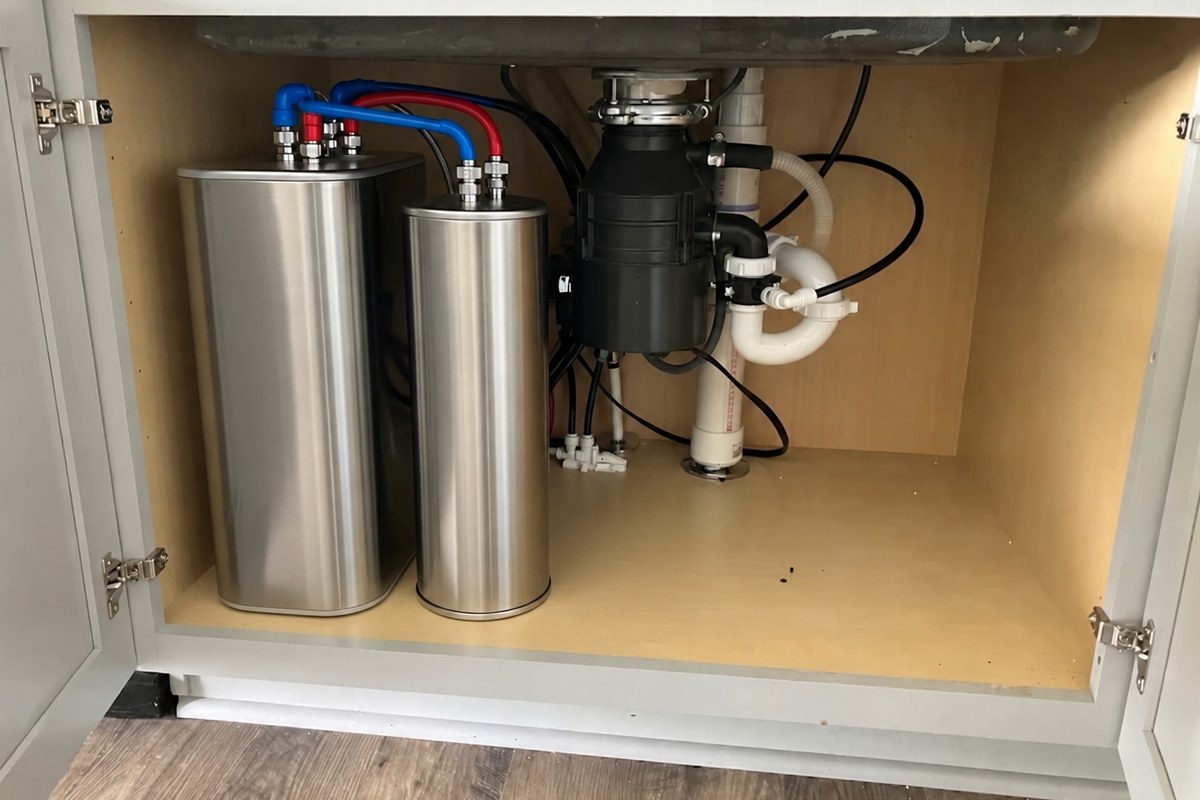
If your interest is the glass and the coffee pot rather than the whole house, a reverse osmosis system under the kitchen sink is the tighter barrier, at $350 to $900 installed. It is the belt-and-braces option for anyone who wants a second line of defence behind the plant’s new treatment stage.
What you can stop worrying about: lead and copper. Concord’s August 2025 sampling put lead at the 90th percentile as non-detect with zero of 51 sites above the action level, and copper at zero of 51 as well. The water also leaves the plant at pH 8.1, comfortably non-corrosive.
Frequently Asked Questions
Is the PFAS problem in Concord fixed now?
The treatment that addresses it is built, running, and reporting positive early results, and Concord got there five years before its federal deadline. The city’s own report also notes a compliance expectation of 2029 and says that timeline may change, so the two published dates do not agree; either way Concord is ahead of both. Carbon is the proven answer at plant scale, which is exactly what Wilmington installed for Cape Fear River PFAS.
Was Concord water ever unsafe to drink?
Concord recorded no drinking water violations for those PFAS results, because the 4.0 ppt limit has a compliance deadline later this decade rather than an immediate one. The readings were genuinely above the limit EPA has set, which is why the city spent $18 million ahead of schedule. Anyone with a specific medical concern should raise it with their doctor rather than a filtration company, including us.
Do I need a water softener in Concord?
Probably not, but Concord is the one city in this metro where you cannot check the answer in the utility’s report, because hardness is not published there. Charlotte’s 32 ppm and Gastonia’s 14 ppm both sit firmly in the soft range, and Concord draws from the same region plus a Yadkin basin purchase. Get the grains per gallon measured at your own kitchen tap before anyone sells you a softener.
Why does Concord water smell like a swimming pool?
That is free chlorine, averaging 1.06 ppm across the system. It is doing its job over 788 miles of pipe between the plant and your house. Carbon removes it at every tap, and a simple pitcher filter is enough if it only bothers you in one glass.
Is Harrisburg water the same as Concord water?
Largely yes. Concord sells Harrisburg an average of about 1.59 million gallons a day, along with water to Kannapolis, so Harrisburg taps are drinking Concord-treated water and share the same Hillgrove and Coddle Creek story. Mount Pleasant and Charlotte Water hold emergency connections too.
How do I find out what is actually in my own tap?
Read the utility’s annual report for the system-wide picture, then measure the things that change house by house: hardness, lead, copper and chlorine at the fixture. A free consultation covers that, and we hand you the numbers in writing whether or not you buy anything.
Sources and reporting dates
Every figure above comes from the sources below. Water quality changes between reports, and a reported average does not describe conditions at every address on every day, so check the current report before acting on any number here.
- City of Concord Water Resources annual water quality report, covering calendar year 2025. Source of the hardness, disinfectant, byproduct, lead and copper figures.
- EPA Safe Drinking Water Information System, for population served, violation history and compliance dates.
- EPA UCMR5 occurrence data, the national PFAS monitoring round, for any result described as federal monitoring.
- NC DEQ Source Water Assessment Program, for source water susceptibility ratings.
- EPA PFAS drinking water rule, for the limits and their compliance dates.
Getting Concord tap water right
Concord’s story is a utility that found a real problem in its data and spent $18 million fixing it early. What is left for a homeowner is smaller and ordinary: HAA5 running at 80 percent of the federal limit, a chlorine taste some people dislike, and a hardness figure nobody has published.
Compare this supply with other cities in our North Carolina water quality guide, or see how we approach city water treatment.
We work across Concord, Harrisburg, Kannapolis and the wider Cabarrus and Mecklenburg area. Every visit starts with a free consultation, we test your water, walk you through the results, and give you an up-front written price for only what the numbers justify. Call (984) 384-6991 or ask for a free consultation and we will tell you straight if the answer is nothing at all.