Is Gastonia Tap Water Safe to Drink? (2026)
Raleigh Water Pros • September 13, 2026 • 10 min read
Gastonia’s water plant does something no other municipal plant in North Carolina did first: it pushes every drop through membrane filtration as the primary purification step. The City of Gastonia says it was the first municipal water treatment facility in the state built to purify this way, part of a $65 million modernisation completed in 2019.
The data backs the choice. In the EPA’s most recent nationwide PFAS round, Two Rivers Utilities returned 120 results and zero detections, and in 2025 it won the state’s Best Tasting Water award. So anyone asking if Gastonia tap water is safe to drink starts from a set of results with no PFAS detections reported.
This post covers where the water comes from, what the 2025 report says, where the utility’s own documents disagree with each other, and what a home filter is genuinely worth here.
Is Gastonia tap water safe to drink?
Yes. Two Rivers Utilities recorded zero PFAS detections across all 120 results in the EPA’s most recent monitoring round, its 90th percentile lead result came back non-detect, and its 2025 report records no violation on disinfectant residual, disinfection byproducts, or lead and copper.
Of the four Charlotte metro systems we have covered, this one reported the fewest problems. Charlotte logged a single tap test at 44 parts per billion of lead. Concord’s water exceeded the federal PFOS limit and the city built an $18 million carbon plant in response. Gastonia had neither problem.
Safe and finished are different things, though. Two figures in that report deserve a closer look, and the report prints one of them twice with values that do not match.
Where does Gastonia tap water come from?
Gastonia drinks the same lake most of Charlotte does. Two Rivers Utilities draws surface water from Mountain Island Lake, a 3,281 acre impoundment on the Catawba River created in 1924 and sitting northwest of Charlotte. NC DEQ’s source water assessment rates that lake “Moderate” for susceptibility to potential contaminant sources.
There is a second permitted source most customers never hear about. NC DEQ’s water supply plan lists the South Fork Catawba River as a secondary supply for the Gastonia plant, and 67 percent of the service population actually sits in the South Fork sub-basin rather than on the main stem of the Catawba.
One plant treats all of it: the Gastonia Water Treatment Plant, permitted at 27.3 million gallons a day and processing roughly 5 billion gallons a year. Two Rivers Utilities was formed in 2011, when Gastonia and the Town of Cramerton merged their water and sewer systems. It serves 94,911 people and supplies Bessemer City, High Shoals, Stanley, Cramerton, McAdenville, Ranlo, Clover in South Carolina, and parts of Lowell, Belmont, Dallas and Kings Mountain.
The membrane step is the part worth understanding. A conventional plant settles solids, then filters the water through beds of sand and coal. Gastonia strains it through membranes instead, separating particles, cysts and cloudiness by physical size rather than by chemistry. Clarity that consistent is what taste panels notice.
Pro tip: A membrane is a physical barrier, not a chemical one. It is excellent on particles, cysts and turbidity, and it does nothing about anything already dissolved. Chlorine byproducts form after the plant, in the miles of pipe between Gastonia and your kitchen, which is why a carbon filter at the house still has a job here.
What does the 2025 water quality report say?
Every result printed in the 2025 report sits under its limit, and the disinfection byproducts sit closest to a line. Here is the short version.
| What | Gastonia’s reported result | Limit |
|---|---|---|
| PFOA and PFOS | not detected, all samples | 4 parts per trillion |
| Trihalomethanes (TTHM) | 60.8 ppb, highest running average | 80 ppb |
| Haloacetic acids (HAA5) | 39.3 ppb, highest running average | 60 ppb |
| Lead, 90th percentile | non-detect, zero sites over the action level | 15 ppb action level |
| Chlorine residual | 1.2 ppm average, range 0.6 to 1.8 | 4.0 ppm |
| pH | 7.4 average | 6.5 to 8.5 secondary range |
| Manganese | 0.002 ppm | 0.050 ppm secondary |
That pH of 7.4 is the lowest of the four metro cities and close to neutral, which is where you want a municipal supply to land.
Two Rivers Utilities disinfects with free chlorine, not chloramine, at an average of 1.2 ppm, and that matters for what you buy. Standard activated carbon handles free chlorine and the byproducts it forms. The pricier catalytic carbon that chloraminated cities need is not required in Gaston County, and a filter company telling you otherwise has not read the report.
One honest note on that trihalomethane figure. The 2025 report states the highest running annual average as 60.8 ppb and, on the same table, prints the sample range as 20.4 to 52.8 ppb. Both cannot describe the same data set. We quote 60.8 because it is the higher published figure and the one to plan around. Either way it sits under the 80 ppb limit, and it is ordinary for a free chlorine system treating lake water.
Want your own tap measured rather than the system average? Request a free consultation and we will test the water in your kitchen and give you the numbers in writing.
Does Gastonia have hard water?
No. Two Rivers Utilities puts its hardness at about 14 milligrams per litre, which works out to 0.82 grains per gallon. Anything under roughly 3.5 grains per gallon counts as soft. Gastonia is a quarter of the way to that line.
Be clear about where that number comes from. It is published on the utility’s customer FAQ, not in the annual report, and that page carries no date. Hardness does not appear in the 2025 report at all. So treat 14 mg/L as the utility’s own long-standing figure rather than a fresh measurement. The two published units at least agree with each other: 14 divided by 17.1 is 0.82.
The utility’s own conclusion is blunt, and we agree with it. Due to the lack of hardness, most people find water-softening devices are not necessary. A softener costs $1,500 to $3,500 installed, and here it would strip minerals the water barely contains. Full pricing sits on our water filtration cost guide, but the right spend on a Gastonia softener is usually zero.
What is actually worth filtering in Gastonia?
Less than in most cities, and that is a fine thing for an installer to say out loud. Three candidates.
Chlorine taste and trihalomethanes
This is the real one. Free chlorine at 1.2 ppm is enough to taste at the tap, and when chlorine meets organic material from lake water it forms trihalomethanes. Gastonia’s highest running average was 60.8 ppb against an 80 ppb limit, the largest number on the report.
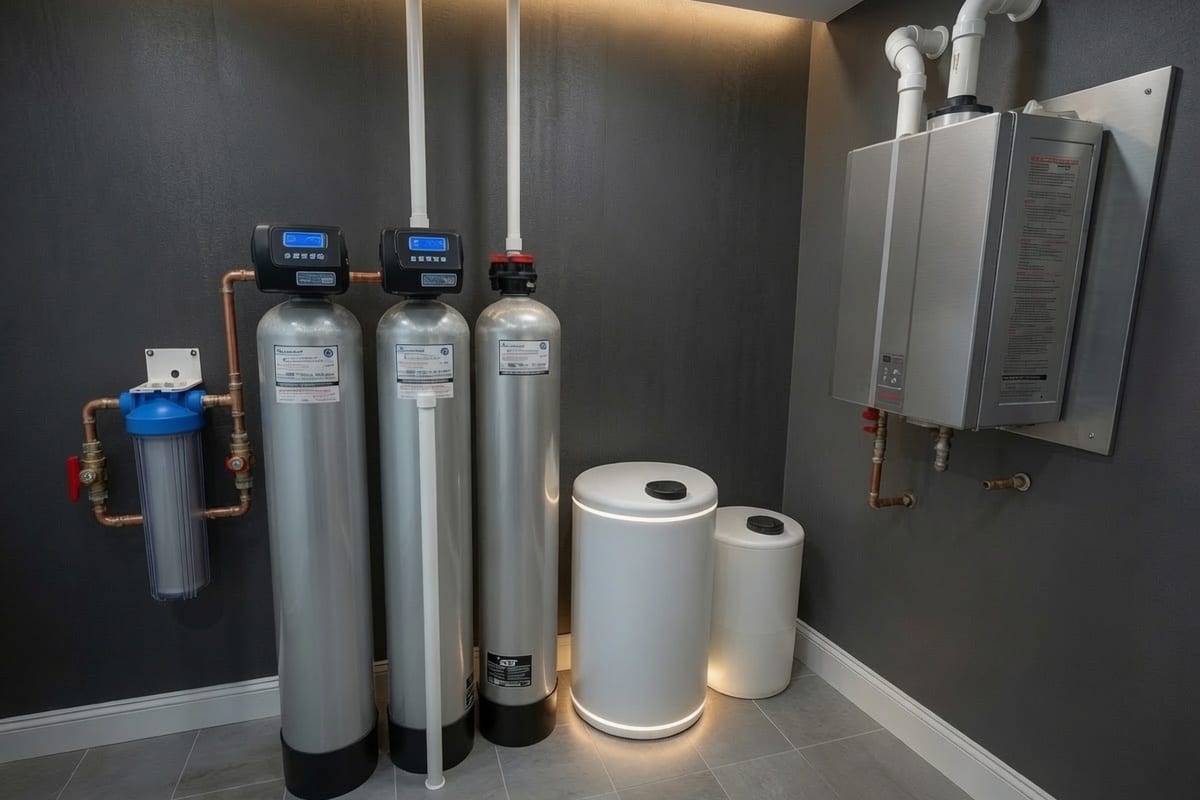
Carbon is the fix at household scale. A whole house carbon filtration system pulls chlorine and its byproducts out at every fixture, including the shower, where trihalomethanes matter most because they evaporate into the steam. A correctly sized unit runs $1,500 to $3,500 installed.
Lead, and why you check your own address
Gastonia’s lead numbers are good: 90th percentile non-detect, no sampled site over the action level, the highest single tap at 2.4 parts per billion. But lead is an address-level problem rather than a system one, because it comes from the service line and household plumbing, not the plant.
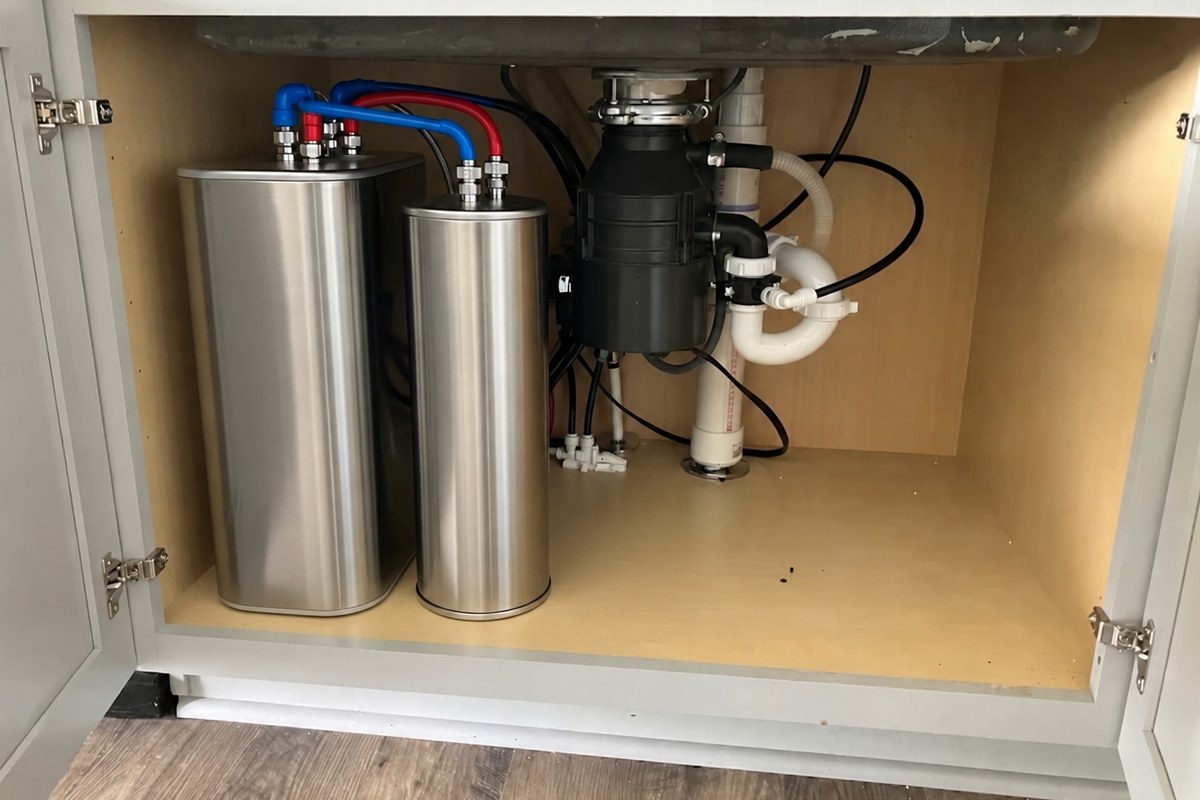
Here the utility’s documents disagree. The customer FAQ says flatly that Two Rivers has no lead service lines. The 2025 report says the utility identified the material for 18,300 lines during 2025 and will continue in 2026. An inventory still being assembled cannot support a blanket claim, so check the published inventory for your own address rather than either sentence. If your line is lead or galvanised, an under-sink reverse osmosis system is the tightest barrier for drinking and cooking water, at $350 to $900 installed.
Nothing at all, for plenty of houses
A Gastonia home with a modern service line, no taste complaint and no medical reason to filter can reasonably buy nothing, and we will say so on a visit. Membrane-treated Catawba water at 0.82 grains, with non-detect lead and no PFAS, is a good starting product. A system that fixes nothing still costs money to service.
Frequently Asked Questions
Do I need a water softener in Gastonia?
Almost certainly not. Two Rivers Utilities reports hardness of about 14 mg/L, or 0.82 grains per gallon, and its own FAQ says that because of the lack of hardness most people find softening devices unnecessary. If a salesperson runs a cloudy-glass demonstration at your table, ask for the reading in grains per gallon and hold it against 0.82.
Why does my Gastonia water smell like a swimming pool?
That is free chlorine, averaging 1.2 ppm across the system with a range of 0.6 to 1.8. It keeps the water clean from the plant to your tap, well inside the 4.0 ppm ceiling. A carbon filtration system removes it at every fixture, and a pitcher filter handles a single glass.
Does Gastonia tap water have PFAS in it?
No PFAS compound was detected in Gastonia’s water in the EPA’s fifth monitoring round. All 120 results came back non-detect, sampled four times between October 2023 and July 2024 at the plant’s distribution header. Both other Charlotte metro utilities logged at least one detection in the same programme; Gastonia logged none.
Is Gastonia tap water better than Charlotte’s?
On the published numbers, yes, and they share a reservoir. Gastonia had zero PFAS detections where Charlotte picked up trace short-chain compounds, its trihalomethanes run a few points lower, and Charlotte has a lead tap result on record that Gastonia does not. Both systems are compliant and neither is a cause for alarm.
Should I worry about 1,4-dioxane in Gaston County?
No. NC DEQ treats 1,4-dioxane as a Cape Fear basin issue, and the drinking water systems it names sit in that basin, including Wilmington, which we cover separately. Dioxane does not appear in Gastonia’s 2025 report. The Catawba is a different river with a different problem list.
What does the membrane plant not remove?
Anything already dissolved. Membrane filtration separates particles, cysts and turbidity by size, so it is excellent on clarity and microbes and does nothing about the chlorine byproducts that form later in the pipes. That gap is the whole argument for a carbon filter at the house, and the reason our water filtration cost guide prices carbon ahead of everything else for city customers.
Sources and reporting dates
Every figure above comes from the sources below. Water quality changes between reports, and a reported average does not describe conditions at every address on every day, so check the current report before acting on any number here.
- Two Rivers Utilities annual water quality report, covering calendar year 2025. Source of the hardness, disinfectant, byproduct, lead and copper figures.
- EPA Safe Drinking Water Information System, for population served, violation history and compliance dates.
- EPA UCMR5 occurrence data, the national PFAS monitoring round, for any result described as federal monitoring.
- NC DEQ Source Water Assessment Program, for source water susceptibility ratings.
- EPA PFAS drinking water rule, for the limits and their compliance dates.
What to do about Gastonia tap water
Gastonia has the best published water in the Charlotte metro, and the membrane plant is a large part of why. Worth being precise, though: a membrane is not primarily a PFAS barrier, so the clean EPA result says as much about what is not in Mountain Island Lake as about what happens at the plant. Source and treatment both look good.
Compare this supply with other cities in our North Carolina water quality guide, or see how we approach city water treatment.
What is left is chlorine taste, trihalomethanes at 60.8 ppb against an 80 ppb limit, and whatever your own service line adds at your address. We size and install carbon filtration and reverse osmosis for homes in Gastonia, Cramerton, Belmont and Bessemer City. Every visit starts with a free consultation: we test the water, show you the results, and give you an up-front written price for only what those numbers support. Call (984) 384-6991 or book a free consultation, and if the answer is that you need nothing, we will tell you that too.