Is Monroe NC Tap Water Safe to Drink? (2026)
Raleigh Water Pros • September 13, 2026 • 8 min read
Most North Carolina cities drink from a river or a reservoir somebody else also drinks from. Monroe is different. It owns its supply outright: three reservoirs, Lake Twitty, Lake Lee and Lake Monroe, holding more than two billion gallons between them and yielding up to 11 million gallons a day.
And when those lakes are not enough, Monroe reaches across a state line. Its interconnection with Union County Water can bring in up to 1.99 million gallons a day of treated water whose source is the Catawba River in Lancaster County, South Carolina.
Is Monroe NC tap water safe to drink?
Yes. The city’s own reservoirs are rated moderate susceptibility by the state, and its published results sit inside every limit.
The City of Monroe serves about 43,081 people through roughly 13,064 connections. Water from the Monroe Lakes is treated at the John Glenn Water Treatment Plant: coagulation, settling, filtration through carbon and sand beds, then disinfection, fluoride and a pH adjustment for corrosion control.
Owning your own reservoirs is a quieter advantage than it sounds. It means Monroe is not downstream of another city’s wastewater plant, which is the situation that defines water quality for much of the Cape Fear basin.
The one thing that decides what you should buy
Monroe chloraminates. Its treatment description says chlorine and ammonia are added to disinfect the water, and chlorine plus ammonia is chloramine. The results table confirms it with a chloramines row averaging 3.04 ppm in 2025, with a range from 0.96 to 4.4 against a limit of 4.0.
That is a heavier chloramine residual than most systems in this state carry, and it has one clear consequence for a homeowner.
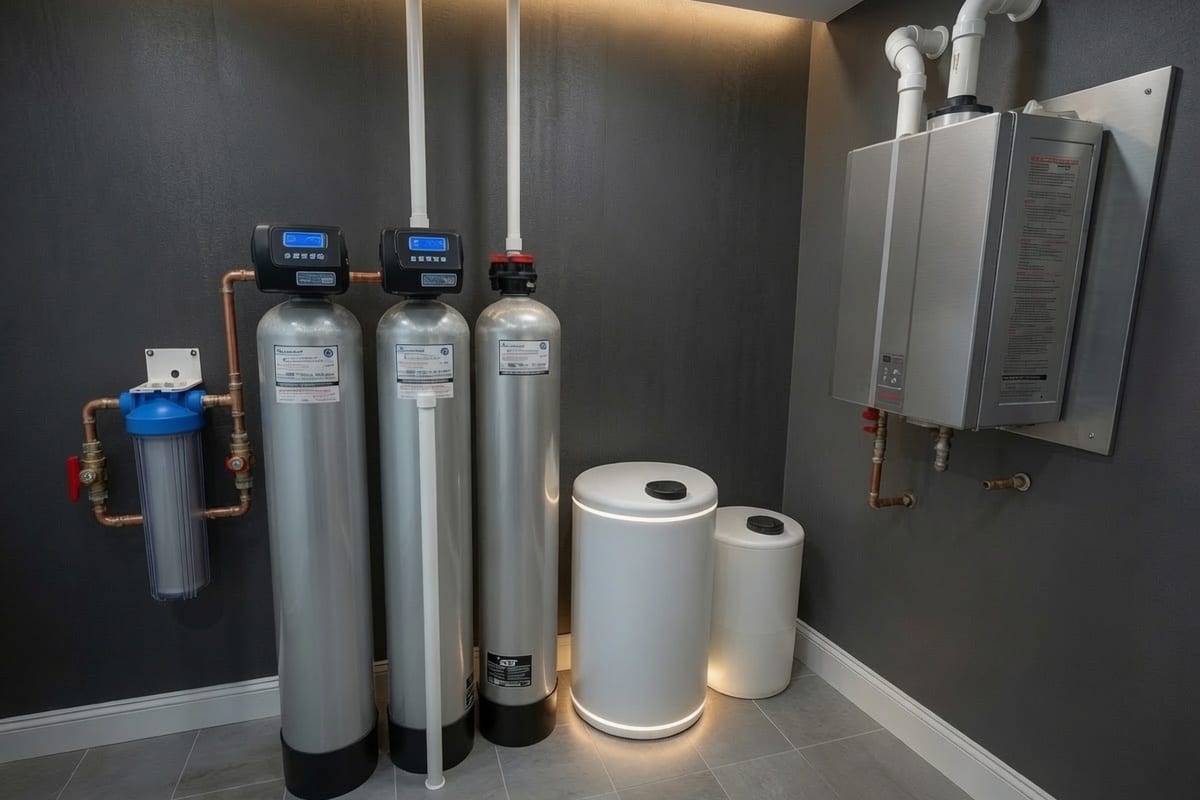
Standard activated carbon is the wrong media here. It removes free chlorine well and chloramine poorly. Catalytic carbon is engineered for chloramine, and the two cost about the same installed, so specifying correctly is free.
| City | Disinfectant | Residual | Correct carbon |
|---|---|---|---|
| Monroe | Chloramine | 3.04 ppm | Catalytic |
| Greensboro | Chloramine | 2.1 ppm | Catalytic |
| Charlotte | Free chlorine | 1.04 ppm | Standard |
| Mooresville | Free chlorine | 1.43 ppm | Standard |
A correctly specified carbon filtration system runs $1,500 to $3,500 installed. Our cost guide covers what moves that figure.
Pro tip: ask any installer quoting you a whole-house system in Monroe to put the media rating in writing. “Carbon” on a quote means nothing on a chloraminated supply; “catalytic carbon” means something.
Not sure what your tap is actually carrying? Request a free consultation and we will test it and give you the numbers.
Does Monroe have hard water?
Monroe does not publish a hardness figure, and has not in any annual report from 2021 through 2025. Neither the word hardness nor grains appears in them.
We will not fill that gap with a guess. What we can say is that Monroe’s water is a blend whose proportions change: mostly its own reservoir water, topped up from the Catawba when the lakes need supplementing. Two sources with different mineral profiles means the answer genuinely moves through the year.
The only reliable number is one measured at your tap. A water test does that in a single visit, and unlike a published plant average it reflects the blend you are actually drinking today.
What Union County’s farmland puts in the water
Monroe’s reports carry two detections you do not see in most city water: atrazine at 0.22 parts per billion and simazine at 0.09, both agricultural herbicides, against limits of 3 and 4 respectively.
Both are comfortably inside the standard, roughly a tenth and a fortieth of their limits. They are worth knowing about because they tell you something true about the watershed: these are reservoirs in a county with working farmland, and runoff carries what is applied to fields.
Activated carbon is effective on this class of compound, which is one of the more substantive reasons to fit a whole-house filter here rather than a purely cosmetic one. Manganese also showed at 10.6 parts per billion against a secondary limit of 50, well under and unlikely to cause the staining that higher levels produce.
Frequently Asked Questions
Monroe had a violation. What was it?
A Tier III monitoring and reporting violation covering July to September 2024, because an outside laboratory did not analyse a sample from one site within the required time. A replacement sample taken two days after the city became aware was within compliance. It is a laboratory timing failure, not a water quality failure, and the distinction matters.
Is the South Carolina water different from Monroe’s own?
It comes from a different river in a different state and is treated by a different utility before Monroe buys it, so yes. Union County Water publishes its own annual report, which Monroe links from its own, and reading both is the thorough approach if you want the full picture of what reaches your tap.
What about PFAS in Monroe?
The 2024 report listed one compound, PFBS, and the 2025 report lists no PFAS at all. There is a complication worth flagging: the 2024 figure is printed with a unit that does not match its magnitude, so the number as published cannot be read literally. Ask the city’s water treatment superintendent for the underlying result rather than relying on that table.
Should I be concerned about the herbicides?
Not at those levels. Atrazine at 0.22 ppb against a 3 ppb limit and simazine at 0.09 against 4 are small fractions of the standard. If you would rather filter them anyway, carbon is the right technology and you would be fitting it for the chloramine regardless.
Is Monroe downstream of anyone’s wastewater?
Not for its primary supply. Monroe’s three reservoirs are its own impoundments rather than run-of-river intakes, which is the structural difference between Monroe and the systems along the Haw and Cape Fear. Towns like Pittsboro draw from a river that receives upstream discharges, and that is the situation Monroe’s reservoir ownership avoids.
How is chloramine different from the chlorine other cities use?
Chloramine is chlorine combined with ammonia. Utilities use it because it stays stable further through the pipe network and forms fewer of the disinfection byproducts that free chlorine creates. The trade-off is that it is harder to remove at home and more persistent as a taste and odour, which is why the media choice matters more on a chloraminated supply. Charlotte runs free chlorine instead, which is why a standard carbon filter is adequate there and not here.
Why is Monroe’s chloramine reading higher than other cities?
The published range runs from 0.96 to 4.4 ppm, and residual varies with distance from the plant, water age in the mains and season. A higher average is not a quality problem in itself; it does mean taste and odour complaints are more likely, and it makes the catalytic carbon choice more consequential than it would be elsewhere.
Do I need a reverse osmosis unit here?
Only if you want a barrier for drinking and cooking water beyond what a whole-house filter provides, or if your home has older plumbing that could contribute lead or copper. An under-sink reverse osmosis system at $350 to $900 installed covers that. Nothing in Monroe’s published results demands one.
Does the herbicide detection mean the reservoirs are polluted?
No. It means the reservoirs sit in a watershed with farmland, which is true of a great many drinking water supplies in the southeast, and that the city’s laboratory is sensitive enough to find compounds at a fraction of their legal limit. Detecting something at a tenth of the standard is evidence the monitoring works, not evidence of a problem.
How often does Monroe actually use the South Carolina water?
The city does not publish a running figure, and the wording in its own reports has shifted between describing the Catawba as an intermittent supply and describing the interconnection as a way to supplement local supplies when needed. The practical reading is that it is a drought and peak-demand resource rather than a constant share of what comes out of your tap.
Sources and reporting dates
Every figure above comes from the sources below. Water quality changes between reports, and a reported average does not describe conditions at every address on every day, so check the current report before acting on any number here.
- City of Monroe Water Resources annual water quality report, covering calendar year 2025. Source of the hardness, disinfectant, byproduct, lead and copper figures.
- EPA Safe Drinking Water Information System, for population served, violation history and compliance dates.
- EPA UCMR5 occurrence data, the national PFAS monitoring round, for any result described as federal monitoring.
- NC DEQ Source Water Assessment Program, for source water susceptibility ratings.
- EPA PFAS drinking water rule, for the limits and their compliance dates.
Getting Monroe water right
Monroe is in a stronger structural position than most: it owns its reservoirs, it is not downstream of anyone else’s discharge, and it has an out-of-state backup when the lakes run low. The decisions for a homeowner are narrow and specific, and one of them is easy to get wrong.
Buy catalytic carbon, not standard carbon. Test at your tap rather than relying on a hardness figure the city does not publish. And be sceptical of anyone selling a PFAS system here on national headlines rather than Monroe’s own numbers.
Compare this supply with other cities in our North Carolina water quality guide, or see how we approach city water treatment.
We serve Monroe, Charlotte, Concord, Mooresville and the rest of North Carolina. Every visit starts with a free consultation: we test your water, compare it against what the city publishes, and give you an up-front written price for only what the numbers support. Call (984) 384-6991 or request a free consultation.