Does a Tankless Water Heater Need a Softener in NC?
Raleigh Water Pros • September 20, 2026 • 11 min read
The plumber quoting your tankless water heater has mentioned a softener, or the installation manual has a line about water hardness in it, or somebody on a neighbourhood forum has said tankless units die young on hard water. All three can be true and still not answer your question, because the answer turns on one number nobody in that conversation has measured.
Does a tankless water heater need a water softener? On the Triangle’s municipal supplies the published hardness figures answer it quickly, and the answer is usually no. On a private well the question is genuinely open, and scale inside a tankless heat exchanger is an expensive failure to run into.
Below: what the manufacturers print in their own manuals, what Raleigh Water and the Town of Cary publish, why nobody can tell you your well’s number without testing it, and how softening, conditioning and descaling differ.
Does a tankless water heater need a water softener?
It depends on your supply, and on the hardness limit printed in your own unit’s manual rather than on a general rule. Here is the split as the published numbers set it:
| Your supply | What is published | What it usually means for a tankless unit |
|---|---|---|
| Raleigh Water | 25.2 mg/L as CaCO3 system-wide in 2025, about 1.47 grains per gallon, and the utility’s own report prints Classified as "Soft" | Well inside every manufacturer limit we checked. Softening is not indicated on hardness grounds |
| Cary and Apex | 30 mg/L as CaCO3, range 23 to 37, printed Classified as "moderately soft" | Same conclusion. About 1.8 grains per gallon (converted) |
| Clayton, Fuquay-Varina, Holly Springs, Johnston County | No hardness figure published at all in their most recent reports | Ask the utility, or test at the tap |
| A private well | Nothing for your well, and hardness is not on the required new-well panel | Unknown until measured. This is where the question is real |
Want your own number before anyone sells you equipment? Request a free consultation and we test your water first, then quote in writing if treatment is actually indicated.
What the manufacturers actually print
These are manufacturer statements, not physical constants, and they vary by maker and by model. Two manuals we read for this page, chosen because both are public documents rather than because we recommend either brand:
| Manual | What it states about hardness |
|---|---|
| Noritz NR98DVC installation manual | ”If the water supply is in excess of 12 grains per gallon (200 mg/L) of hardness, acidic or otherwise impure, treat the water with approved methods in order to ensure full warranty coverage.” Its water quality table lists “Total Hardness: 200 mg/L (12 gpg) or less”, footnoted “Maximum limit suggested by Noritz” |
| Rinnai VB Series Indoor LS manual | Its Water Quality table gives a maximum level of “Total Hardness Up to 200 mg / L”, advising that “if the water quality exceeds the target levels provided in the table, you may want to treat or condition the water” |
Two things are worth noticing. Both land near 200 mg/L, about 12 grains per gallon, which is many times the hardness Raleigh or Cary delivers. And the consequence is written as warranty language: Noritz states that “damage to the water heater as a result of” water above 12 gpg “is not covered by the Noritz America Limited Warranty”, and Rinnai that “damage caused by lime build-up is not covered by the unit’s warranty.”
That is a contractual condition on a purchase, not a prediction about your house. Your own manual governs. Read its water quality section before you buy either machine.
What scale actually does inside a tankless heat exchanger
Calcium carbonate becomes less soluble as water gets hotter, so it comes out of solution on the hottest surfaces it touches. A tankless unit heats water quickly through narrow passages, which is the geometry that suffers most when a deposit forms: flow drops, the burner works harder, and the sensors watching outlet temperature read through a coating.
Rinnai’s manual describes the endpoint as an error code: “An ‘LC’ or ‘00’ error code indicates the unit is beginning to lime up and must be flushed. Failure to flush the appliance will cause damage to the heat exchanger.”
What that does not mean is that hard water destroys a tankless heater on a schedule, or that a softener makes one last forever. Scale rate depends on hardness, set temperature, how much hot water the house draws and the unit itself. A softener changes the chemistry arriving at the appliance. It does not repair a heat exchanger that is already coated, and it is not a maintenance plan.
Pro tip: if you are replacing a tank heater with a tankless one, look at what comes out of the old tank before it leaves. A tank drained with heavy scale in it is evidence about your water that no brochure can give you, and a tank that came out clean after ten years is evidence too. It is the cheapest hardness clue you will ever get.
On Raleigh, Cary and Apex water, the published numbers answer it
Raleigh Water publishes hardness in two units and sums it up in one word. The 2025 annual finished water quality report prints 1.49 grains per gallon (25.5 mg/L) at the E.M. Johnson plant and 1.44 grains per gallon (24.7 mg/L) at Dempsey E. Benton, and in the column where a legal limit would sit it prints Classified as "Soft" on both rows. System-wide, the consumer confidence report gives 25.2 mg/L for 2025, range 21.9 to 35.3.
Cary’s water quality testing summary, covering the Cary/Apex facility that also serves Morrisville, prints 30 mg/L as CaCO3 (range 23 to 37) and 2 grains per gallon (range 1 to 2), labelled Classified as "moderately soft". Thirty milligrams per litre is about 1.8 grains per gallon.
Set those against a manual asking for 200 mg/L or less and the arithmetic is not close. A customer in Cary or Apex being sold a softener to protect a tankless heater should ask which measured number the recommendation rests on. Our post on whether Raleigh city water needs a softener asks the same question for the house as a whole.
Two caveats. Several nearby utilities publish no hardness figure at all, so “my town is soft too” is an assumption unless you have seen the number. And a utility figure is a system average with a range around it, not a reading at your tap.
On a private well, nobody can answer it for you
This is where the question stops being rhetorical, and it is also where you should be most suspicious of confident numbers, including ours. We do not have a representative local dataset that predicts your well’s hardness. Test your own water.
There is a structural reason no such dataset exists to point at. North Carolina General Statute 87-97(h) sets what a newly constructed private well must be tested for, and the list runs to bacterial indicators, nitrate, nitrite, iron, manganese, magnesium, pH and other analytes. Hardness is not on it. So a well in Clayton or Johnston County can have a complete, compliant new-well file that says nothing about scale at all.
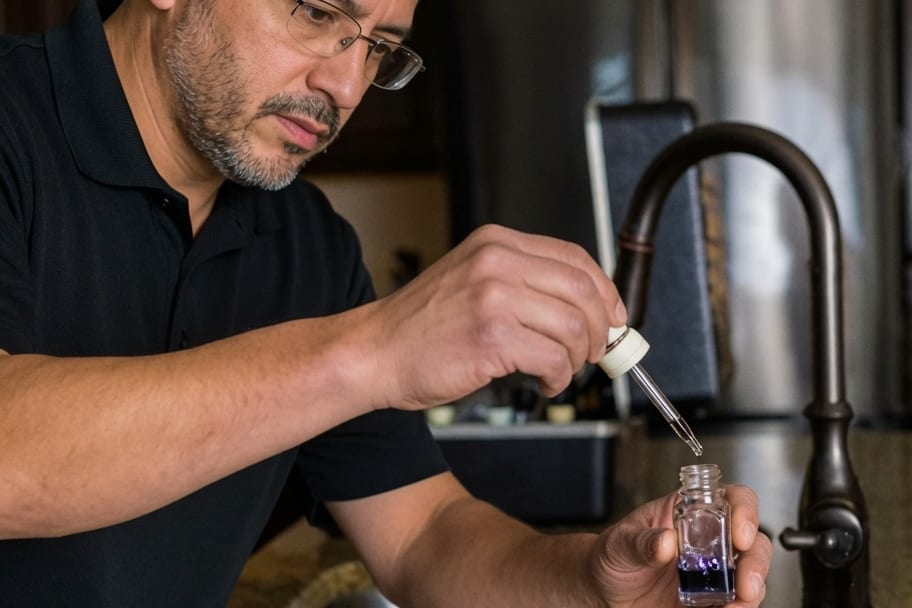
The practical route is short: get a hardness number from a lab or a verified test, compare it against the limit in your own heater’s manual, and decide from those two figures. Water testing is a couple of hours of work that settles an argument which otherwise runs for years. Our guide to whether a water softener is worth it in NC covers the arithmetic once you have the number.
Softener, conditioner, or just descaling?
These are three different things and they are not interchangeable for this purpose.
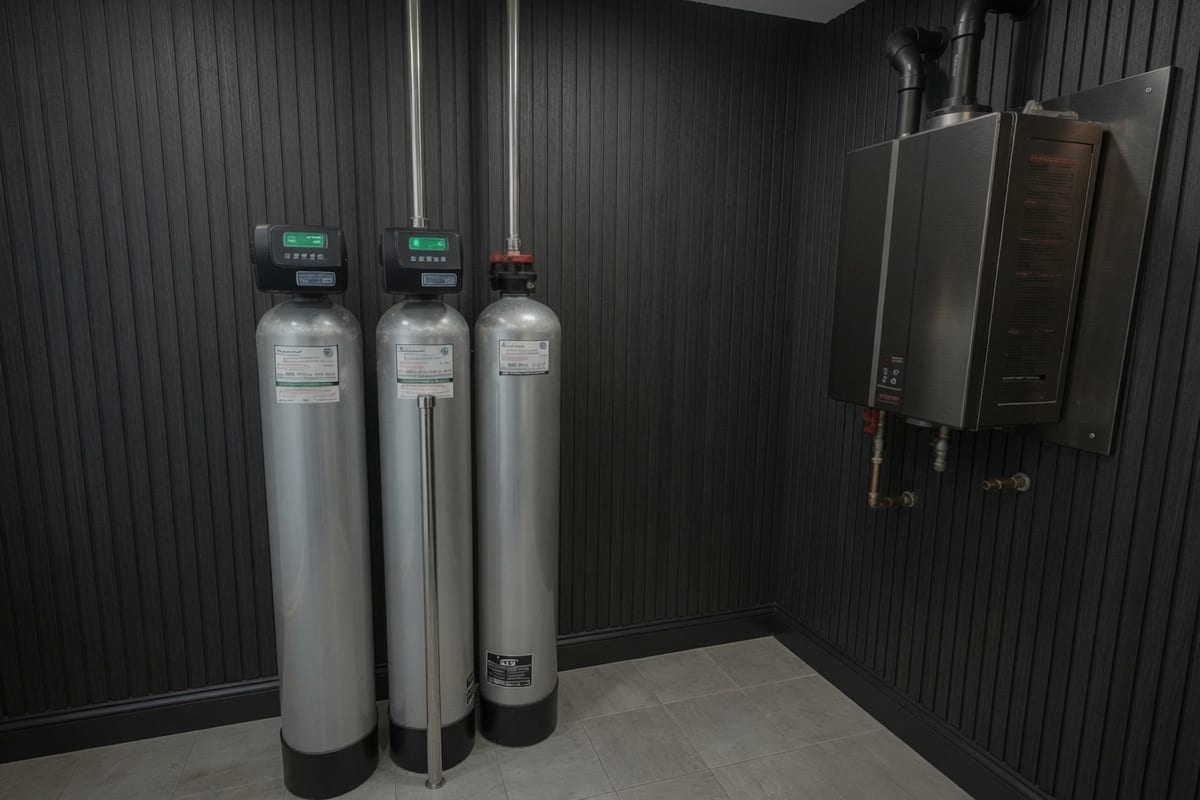
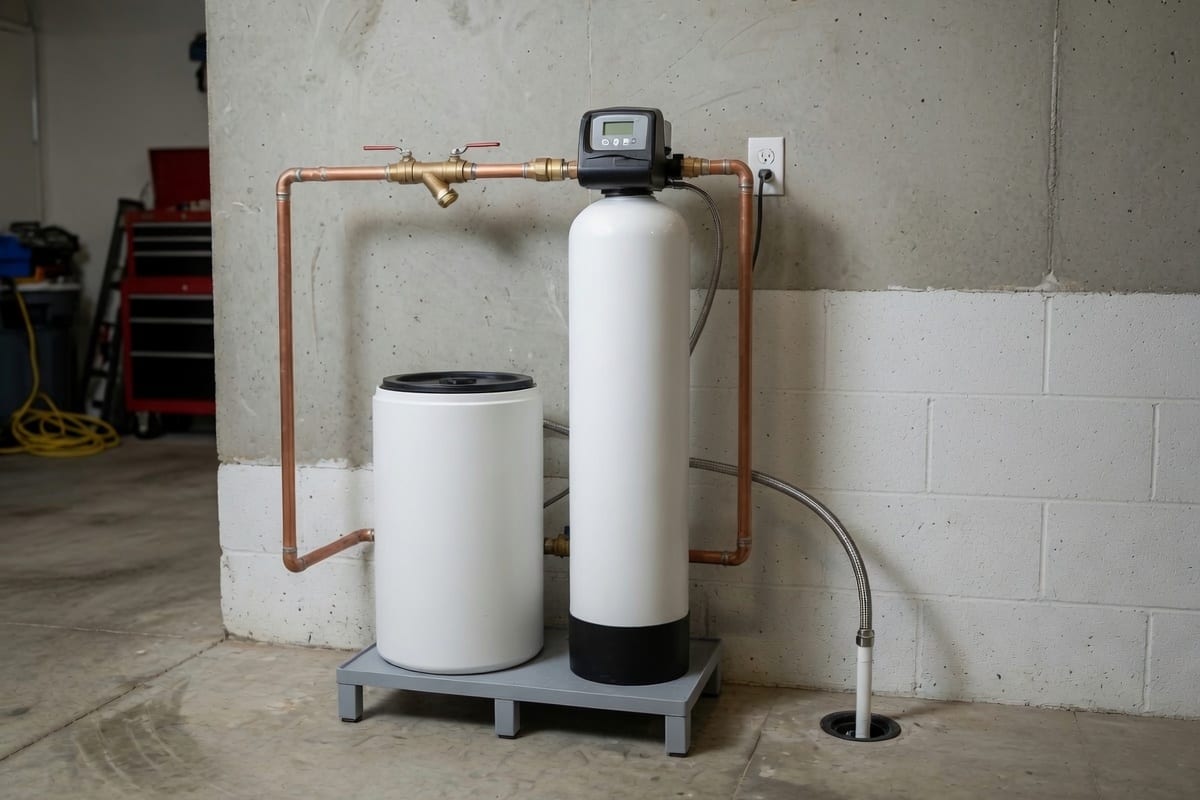
A salt-based softener exchanges calcium and magnesium for sodium, so the measured total hardness of the water leaving it genuinely drops. That is the only one of the three that changes the number a manual is written in. A whole-home softener runs $1,500 to $3,500 installed in this market, a planning range from our Raleigh water filtration cost guide rather than a quote.
A salt-free conditioner works on how scale forms rather than on how much hardness is present, so measured total hardness after one is essentially unchanged. If your manual states a maximum total hardness, a conditioner does not obviously satisfy that condition, and whether the manufacturer accepts it is a question for the manufacturer in writing, not for us or the installer. Rinnai’s manual does use the words “treat or condition”, which is worth quoting back when you ask. Our salt-free versus traditional softener comparison covers what each does.
Descaling is neither. It removes deposits that have already formed, on a schedule, for the life of the appliance. Even a softened house still descales, because the maintenance requirement does not disappear.
Flushing intervals, and who does that work
Intervals are set by your manual and your water, not by a rule of thumb. Some manuals specify a period; the Rinnai VB manual instead ties flushing to the “LC” error code, and its procedure is specific: four gallons of undiluted food-grade white vinegar, circulated through the heat exchanger “for at least 1 hour at a rate of 4 gallons per minute”, then rinsed. Different models, different procedures. Follow yours.
One boundary worth being plain about: flushing or descaling a tankless water heater is plumbing work on the appliance, and we do not do it. That is your plumber or the manufacturer’s service network. We size, install and service treatment ahead of the appliance: water softener installation on hard supplies, well water treatment where the water needs more. If somebody offers both halves in one quote, ask who is doing which.
Frequently Asked Questions
Do I need a water softener for a tankless water heater in Raleigh?
Usually not on hardness grounds. Raleigh Water’s 2025 report puts hardness at about 1.47 grains per gallon and prints Classified as "Soft", while both manufacturer manuals we checked set their maximum around 200 mg/L, roughly 12 grains per gallon. If you are on a private well inside the Raleigh area rather than on the utility, that answer does not apply to you. Our water filtration cost guide shows what the equipment runs if it is justified.
Will hard water void a tankless water heater warranty?
Manufacturers write the condition themselves, and at least one states it directly: Noritz’s manual says damage from water “in excess of 12 gpg (200mg/L) of hardness” is not covered by its limited warranty. Rinnai similarly excludes “damage caused by lime build-up”. Whether your unit is covered is between you and the maker, and the manual for your exact model settles it.
How hard is well water in the Triangle?
Nobody can tell you without testing, and we will not give you a regional number we cannot support. NC General Statute 87-97(h) does not include hardness in the required new-well panel, so a compliant well file will not contain it either. A lab result for your own well is the only figure worth acting on.
Does a salt-free conditioner protect a tankless heater?
It works differently from a softener and does not lower the measured total hardness of your water. Since manufacturer limits are written in total hardness, a conditioner does not obviously satisfy one, so ask the manufacturer in writing before relying on it. Homeowners in Apex on already-soft water rarely need either.
How often should a tankless water heater be flushed?
That is a manufacturer question rather than a general one, and the answer ranges from a stated interval to an error-code trigger depending on the model. Hardness, set temperature and hot water use all change it. Whatever your manual says, the work itself is plumbing, and not something we take on.
Should I soften the whole house or just the hot water line?
Softening only the hot side is sometimes proposed to protect appliances while leaving drinking water untouched, and it is a real plumbing option with real trade-offs. On a supply that is already soft the question rarely arises. Get the hardness number first, because on 1.5 grain water neither version earns its price.
Sources
Read in September 2026. Your own unit’s installation manual takes precedence over anything quoted here.
- Noritz NR98DVC Installation Manual, 2017: the 12 gpg (200 mg/L) hardness statement, the water quality table footnoted “Maximum limit suggested by Noritz”, and the warranty exclusion above that hardness.
- Rinnai VB Series Indoor LS Installation and Operation Manual, document 100000159: the 200 mg/L total hardness maximum, the “treat or condition” wording, the LC lime-up code, the lime build-up warranty exclusion, and the vinegar flushing procedure.
- Raleigh Water, 2025 Annual Finished Water Quality Report: 1.49 gpg / 25.5 mg/L at E.M. Johnson, 1.44 gpg / 24.7 mg/L at Dempsey E. Benton, both
Classified as "Soft". - Town of Cary, 2025 Water Quality Testing Summary: 30 mg/L as CaCO3 (range 23 to 37) and 2 gpg (range 1 to 2) for the Cary/Apex facility,
Classified as "moderately soft". - NC General Statute 87-97, subsection (h): the analyte list for a newly constructed private well, which does not include hardness.
Get the hardness number before you buy either machine
A tankless heater and a softener are two large purchases, and on Triangle city water only one of them is usually justified. The manufacturer’s limit is a real condition worth respecting; it just sits a long way above what Raleigh, Cary and Apex actually deliver.
We test, size and install water treatment for homes in Raleigh, Cary, Apex and Clayton, on city supply and on wells. Call (984) 384-6991 or book a free consultation for an up-front written price, and a straight answer if the honest recommendation is that your water does not need treating at all.