Is Greensboro Tap Water Safe to Drink? (2026)
Raleigh Water Pros • September 13, 2026 • 8 min read
Greensboro is the only city in the Triad that is itself a regulated 1,4-dioxane discharger. Its T.Z. Osborne wastewater plant operated under a Special Order by Consent with the state from 2021, after NC DEQ issued a notice of violation over a discharge of 957 micrograms per litre in August 2019.
That is the fact people half-remember, and they usually get it backwards. The dioxane goes into South Buffalo Creek from the wastewater plant, and there are thirteen drinking water intakes downstream on the Haw and Cape Fear. Greensboro’s own drinking water comes from three lakes in northern Guilford County, upstream of all of it. The city’s problem flows away from its own taps.
The thing Greensboro residents should actually be asking about is different, and it is in the city’s own report.
Is Greensboro tap water safe to drink?
Yes by every standard in force today, and there is a real caveat. The 2025 report records no water quality violations. But sampling under the EPA’s national monitoring programme put PFOS in Greensboro’s finished water well above the federal limit that utilities must meet later this decade, and the city is spending heavily on treatment to close that gap.
Here is what the monitoring found, by plant.
| Compound | Townsend plant | Mitchell plant | Federal limit |
|---|---|---|---|
| PFOS | 18.1 average (14.1 to 21.2) | 27.34 average (15 to 35.6) | 4.0 |
| PFOA | not detected | 3.65 average (ND to 5.6) | 4.0 |
| PFHxS | 9.1 (7.3 to 10.5) | 13.3 (7.4 to 16.8) | hazard index |
| PFHxA | 5.22 (4.4 to 6.3) | 7.5 (3.8 to 10.4) | unregulated |
All figures in parts per trillion, from sampling in 2023 and 2024.
One honest note on those numbers. Greensboro’s report prints the units as micrograms per litre. Read literally that would put PFOS at thousands of times the limit, which is not what happened. These are national monitoring results, which are reported in nanograms per litre, that is parts per trillion. It is a units typo in a table, not a hidden crisis, and the figures above are the real ones.
Pro tip: the two plants are not interchangeable. Mitchell treats Lake Brandt water and ran consistently higher on every PFAS compound than Townsend, which treats Lake Townsend. Which plant serves your address determines what has been coming out of your tap.
What the city is doing about it
Both plants are being fitted with granular activated carbon contactors, under the Mitchell Advanced Treatment Emerging Contaminants Project and the Townsend Advanced Treatment Facility Project. The city’s stated purpose is meeting future PFAS requirements.
That is the correct fix and the same one Wilmington used on the Cape Fear, where carbon filters brought GenX down to a fraction of a part per trillion. It is also not finished yet, and EPA proposed in May 2026 to push the compliance deadline for PFOA and PFOS from 2029 to 2031.
So the position in 2026 is: a utility that is legally compliant, transparent about results that do not flatter it, and building the right thing. Whether you want your own barrier in the meantime is a personal call, and it is a reasonable one to make either way.
Want to know what your specific address is getting? Request a free consultation and we will test at your tap and show you the numbers next to what the city publishes.
Does Greensboro have hard water?
No. The city’s own 2025 lab data puts hardness at 47 milligrams per litre on average, a range of 40 to 55, which works out to about 2.7 grains per gallon. Greensboro’s own FAQ describes its water as moderately soft at 2 to 3 grains.
A softener has very little to do here. What is interesting is why the number is not lower: Greensboro deliberately adds lime to raise hardness and pH, because harder, more alkaline water leaches less metal out of household plumbing. The mineral content you might instinctively want to remove is partly there on purpose, protecting your pipes.
Iron and manganese both read below 0.01 milligrams per litre every month of 2025, so the staining problems common on Piedmont well water are absent from city supply here.
What is worth filtering in Greensboro?
Buy catalytic carbon, not standard carbon. This is the single most important product fact in this market. Greensboro uses chlorine inside the plant but switches to monochloramine as the secondary disinfectant for the distribution system, holding about 1 part per million to the tap, with the annual average residual reported at 2.1.
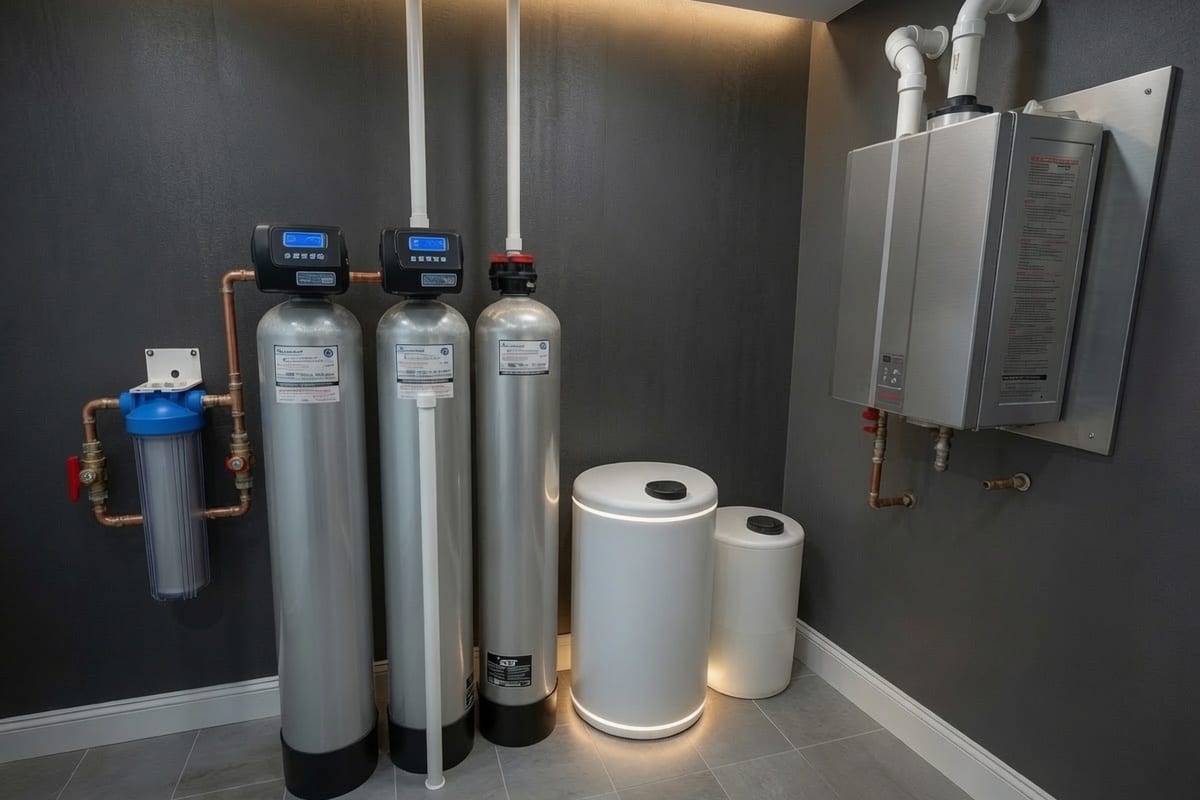
Standard activated carbon underperforms on chloramine. Catalytic carbon is built for it. A carbon filtration system specified correctly for a chloraminated supply runs $1,500 to $3,500 installed, the same band as a standard whole-house system, so getting it right costs you nothing extra. Getting it wrong costs you the performance you paid for. Our cost guide covers what moves that number.
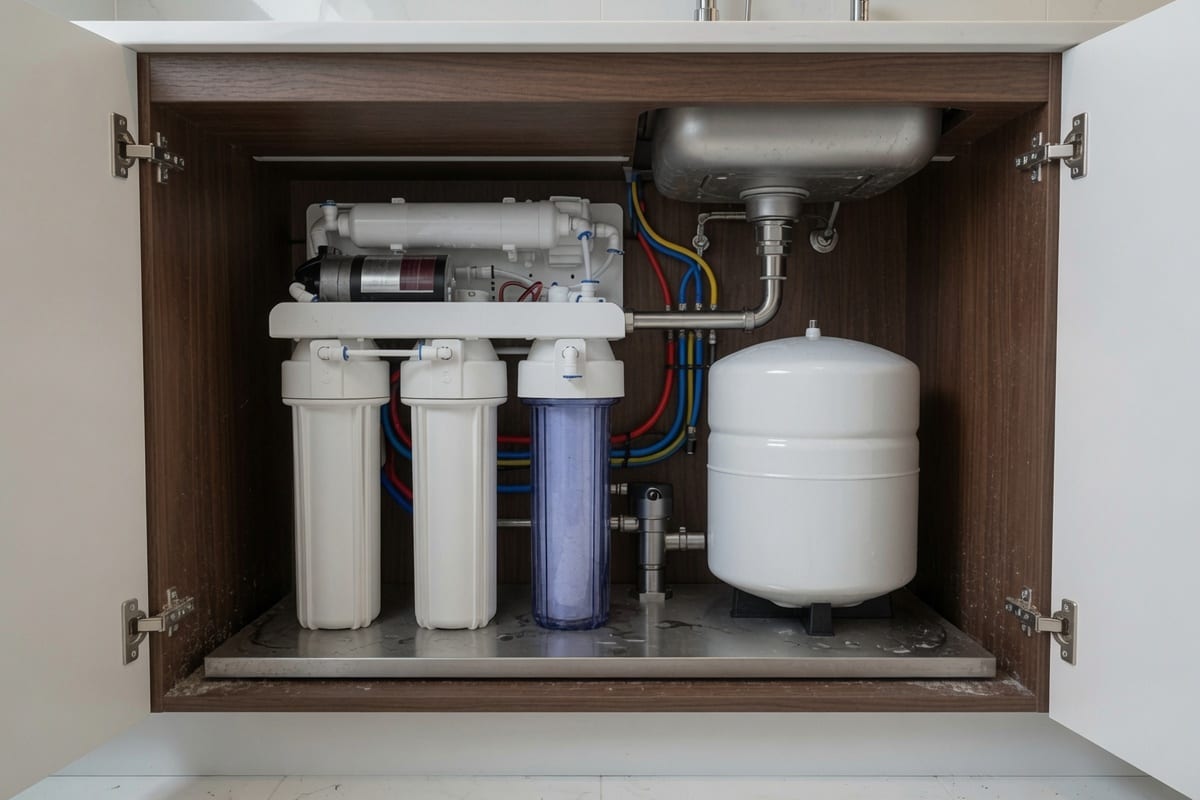
For PFAS specifically, the household answer is a point-of-use reverse osmosis system at the kitchen sink, at $350 to $900 installed. Reverse osmosis is one of the treatments EPA recognises for these compounds, and it covers the water you actually drink and cook with while the city’s plant-scale carbon is built.
Trihalomethanes ran 61 parts per billion against an 80 limit and HAA5 42 against 60, both compliant and both worth a carbon filter if taste matters to you.
Frequently Asked Questions
Is Greensboro’s water in violation?
No. The city reported no water quality violations for 2025. It received an administrative notice in August 2025 for failing to file a lead and copper certification form on time, and resolved it in September. That is paperwork, not water. The PFOS results sit above a federal limit that is not yet in force, which is exactly the situation the compliance deadline exists to cover.
Should I stop drinking the tap water?
Nothing in the published data supports that, and we are not going to tell you it does. If PFAS specifically concerns you, a reverse osmosis unit at the kitchen tap is the proportionate response, not bottled water for the household.
Does Greensboro’s 1,4-dioxane end up in my tap?
It does not. The discharge goes from the T.Z. Osborne wastewater plant into South Buffalo Creek, which flows away from the city’s drinking water reservoirs. Greensboro draws from Lake Brandt, Lake Townsend and Lake Higgins in northern Guilford County, upstream of the discharge, and 1,4-dioxane does not appear as a detected contaminant in the city’s drinking water report. The communities affected are downstream, starting with Pittsboro about 60 river miles away.
Which plant serves my house?
The city has not published an address lookup, so ask the Water Quality Laboratory on 336-373-7527. It matters because the Mitchell plant, fed by Lake Brandt, measured higher on every PFAS compound than Townsend.
Will a regular carbon filter work here?
Not as well as it should. Greensboro runs monochloramine to the tap, and standard activated carbon is poor at removing it. Specify catalytic carbon. Any installer quoting you a whole-house carbon system in Greensboro should raise this before you do, and if they do not, that tells you something.
Does Greensboro buy water from anywhere else?
Yes, it purchases from Burlington, Reidsville, the Piedmont Triad Regional Water Authority and Winston-Salem. That matters mostly during drought and maintenance, and it is one reason the city’s figures move between sampling rounds.
How does Greensboro compare with other NC cities?
On PFAS it is the outlier of the systems we have looked at. Charlotte tested clean for both regulated compounds, and Wilmington, which had the worst contamination in the state, now averages a fraction of a part per trillion after building carbon. On hardness Greensboro is unremarkable, sitting close to Charlotte and most Piedmont surface supplies. The PFOS result is the number that separates it.
Sources and reporting dates
Every figure above comes from the sources below. Water quality changes between reports, and a reported average does not describe conditions at every address on every day, so check the current report before acting on any number here.
- City of Greensboro Water Resources annual water quality report, covering calendar year 2025. Source of the hardness, disinfectant, byproduct, lead and copper figures.
- EPA Safe Drinking Water Information System, for population served, violation history and compliance dates.
- EPA UCMR5 occurrence data, the national PFAS monitoring round, for any result described as federal monitoring.
- NC DEQ Source Water Assessment Program, for source water susceptibility ratings.
- EPA PFAS drinking water rule, for the limits and their compliance dates.
Getting Greensboro water right
Greensboro publishes results that do not make it look good, which is more than many utilities do, and it is building the right treatment in response. In the meantime the two things a household can control are a catalytic carbon system for the chloramine and taste, and reverse osmosis at the kitchen tap if PFAS is what is on your mind.
Compare this supply with other cities in our North Carolina water quality guide, or see how we approach city water treatment.
We serve Greensboro, High Point, Burlington, Winston-Salem and the rest of North Carolina. Every visit starts with a free consultation: we test your water, compare it against what your utility publishes, and give you an up-front written price for only what the numbers support. Call (984) 384-6991 or request a free consultation, and if your answer is a $400 unit under the sink rather than a system in the garage, that is what we will tell you.