Is Hendersonville Tap Water Safe to Drink? (2026)
Raleigh Water Pros • September 14, 2026 • 9 min read
Two of Hendersonville’s four water intakes sit inside Pisgah National Forest, in watersheds North Carolina classifies WS-I. That is the state’s highest water supply protection class, reserved for watersheds that are essentially natural, undeveloped and publicly owned. Between them they can supply up to half the city’s daily demand, and they do it by gravity, with no pump at all.
You cannot buy raw water much better than that.
In December 2025 the city activated a fourth intake on the French Broad River, in a watershed classified WS-IV, the least protective of the classes in the county code. That is not a scandal, it is a growing utility securing supply. But it is a real change in the character of the water, and it is the reason one part of the record below has a gap in it.
Is Hendersonville tap water safe to drink?
Yes. The 2025 report shows every regulated result inside its limit, and the system has just four violations in its entire recorded history.
Turbidity came in at 0.09 NTU against a 1.0 treatment threshold, with 100 percent of monthly samples meeting the standard. Nitrate measured 0.045 parts per million against a limit of 10. Lead’s 90th percentile came back not detected in the most recent round, with none of 40 sites above the action level, and copper at 0.057 parts per million with none above either.
There was one violation in 2025 and it is worth describing properly, because the label sounds worse than the facts. The city collected its byproduct samples on time in February. The state rejected the results because of laboratory quality control errors, the city resampled the day after being told, and those results were fine. But the corrected submission landed after the monitoring period closed, so the state issued a notice for monitoring and reporting. It was a Tier 3 item, not health-based, returned to compliance on 26 May 2025, and the city now samples earlier in each quarter.
City of Hendersonville Water and Sewer serves about 79,278 people through more than 685 miles of main, well beyond the city limits, reaching Etowah, Edneyville, Saluda and Fletcher.
Four intakes, and they are not equal
| Source | Watershed class | How it arrives |
|---|---|---|
| North Fork of the Mills River | WS-I, maximum protection | Gravity, inside Pisgah National Forest |
| Bradley Creek | WS-I, maximum protection | Gravity, inside Pisgah National Forest |
| Mills River main stem | WS-II and WS-III | Pumped |
| French Broad River | WS-IV, least protective | Pumped, activated December 2025 |
The two Pisgah intakes contribute roughly 4.5 million gallons a day under normal conditions. The treatment plant, on Haywood Road in Mills River, was built in the 1960s, rebuilt in a $20 million renovation in 2010, and expanded to 15 million gallons a day with an added filter in 2025.
The state’s susceptibility assessment rates Bradley Creek, the North Fork and the Mills River main stem all as moderate. The French Broad intake is too new to carry a rating at all, which the city says plainly in its own report.
Does Hendersonville have hard water?
No. The lowest hardness figure any North Carolina utility has published belongs to Hendersonville: 4 parts per million, which the report pairs with 0.25 grains per gallon.
One caveat you should have. That figure comes from the 2020 report, and the utility has not published hardness since. We checked the 2023, 2024 and 2025 reports directly, and none of them carries a hardness or alkalinity line at all.
So the honest statement is that Hendersonville published essentially zero hardness five years ago, from the same mountain sources it still uses for most of its supply, and has stopped publishing the number. Nothing about the treatment suggests it has changed. But if you want a current figure for your own address, it has to be measured. Request a free consultation and we will take that reading and put it in writing.
For a softener, the conclusion is the same either way. At a quarter of a grain there is nothing to remove.
The plant is actively fighting the softness
Here is a detail that explains more than the hardness number does. The plant feeds sodium bicarbonate specifically to raise alkalinity, alongside an orthophosphate blend for lead and copper protection.
Alkalinity was 20 to 25 parts per million in the last report to publish it, which is very low buffering. Water that soft and that lightly buffered is chemically aggressive toward copper pipe and lead solder, so the utility is adding back exactly the buffering capacity the mountains never gave it.
That treatment is working: no action level exceedance for lead or copper in any published round. But it puts the emphasis in the right place. In Hendersonville, the pipe inside your own house matters more than the water leaving the plant, and that is especially true of homes built before the mid-1980s.
What is actually worth filtering
Disinfection byproducts, and your utility says so itself.
Hendersonville reported trihalomethanes at 47 parts per billion against an 80 limit, with a range reaching 66, and the haloacetic acid group at 26 against 60. Both compliant, and the trihalomethane figure sits higher than most systems in the state because clean mountain surface water still carries dissolved organic material for chlorine to react with.
The city’s own report tells customers what to do about it, recommending that they run the tap briefly before use, refrigerate drinking water, and use certified carbon filters. That is a municipal utility endorsing point-of-use carbon in writing, which is not something we get to say often.
Pro tip: trihalomethanes are volatile, so a share of household exposure happens in a hot shower rather than in a glass. That is the argument for treating the whole house here rather than only the kitchen tap.
PFAS, and the honest gap in the record
Under EPA’s national monitoring round, Hendersonville produced 120 results covering 29 PFAS compounds plus lithium, across four quarterly samples from October 2024 to July 2025. Every one was non-detect, below a reporting limit of 4 parts per trillion for PFOA and PFOS.
Now the gap. That monitoring window closed in July 2025, and the French Broad intake did not come online until December 2025. No federal monitoring result covers water drawn from the French Broad.
The city addresses this directly. Its own testing found no PFAS in the three original sources, and it states that samples from the French Broad River show extremely small amounts of PFAS, well below the new federal standards. That is the utility’s characterisation, and the next monitoring round is the thing that will confirm it.
We would rather flag that than quote a clean sweep that predates a new source. See where every NC city landed on PFAS for the comparison.
What to buy in Hendersonville
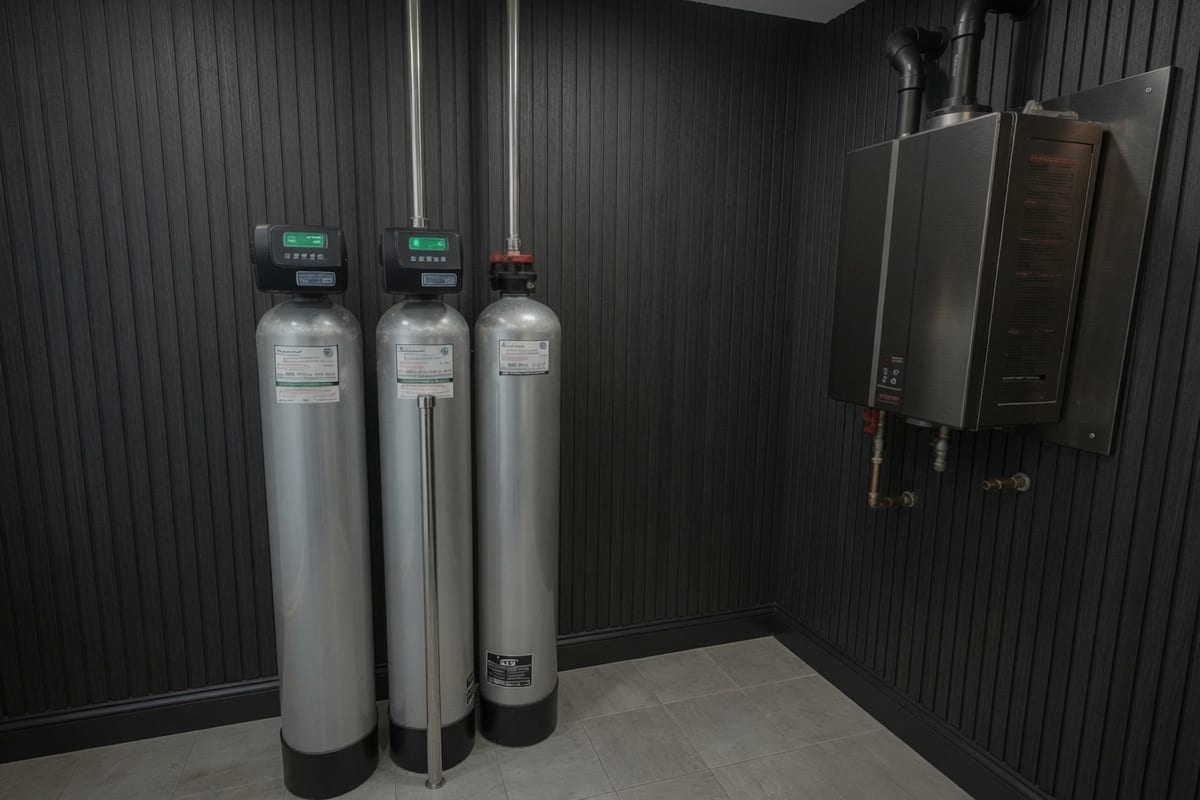
Activated carbon, standard grade. Hendersonville disinfects with chlorine gas injected into filtered water, and runs free chlorine at 1.4 parts per million. There is no ammonia anywhere in the system, so you do not need the catalytic carbon that a chloraminated city requires. A whole house carbon system at $1,500 to $3,500 installed addresses the byproducts at every tap. Our cost guide covers what moves that.
Reverse osmosis at the sink, if you want a second barrier. At $350 to $900 installed it covers drinking and cooking water and handles whatever your own plumbing contributes, which in this water is the thing worth covering. See our reverse osmosis page.
Not a softener. A quarter of a grain per gallon.
Frequently Asked Questions
I live in Etowah, Fletcher or Saluda. Is this my water?
It may well be. Hendersonville’s system serves roughly five times the city’s own resident population and reaches all three. The question that matters is whether you get a water bill from the city or run a private well, not whether your address says Hendersonville.
How is this different from Asheville water?
Different utility, different sources, different plants. Both run free chlorine and both are very soft, so the filter advice is similar. The differences are that Hendersonville draws two gravity-fed intakes from protected national forest watersheds, and that Asheville’s story since Hurricane Helene is dominated by resilience work that Hendersonville did not need.
Should I be worried about the new French Broad intake?
No, but you should know it exists. It draws from a less protected watershed than the Pisgah sources, the city tested it before activating it, and it reports very low PFAS well under the standards. The reasonable position is to watch the next round of published results rather than to assume anything.
What does WS-I actually mean?
It is the state’s most protective water supply classification, applied to waters in natural, undeveloped watersheds in public ownership. The county overlay for these two watersheds permits only low-intensity uses. Very few utilities anywhere draw from land with that level of protection.
Was the 2025 violation a contamination event?
No. The state rejected a set of byproduct results over laboratory quality control problems, the city resampled immediately and passed, and the replacement data arrived after the reporting deadline. The violation is for the missed deadline, not for anything found in the water.
I am on a private well in Henderson County. What should I test for?
More than the state requires, and radon is the headline. Henderson County is one of eight EPA Zone 1 radon counties in North Carolina, and a study of private wells across Buncombe, Henderson and Transylvania found a median radon of 6,060 picocuries per litre. Regional studies of these crystalline rock aquifers also find high radioactive constituents in about 30 percent of the area and nuisance problems, mostly from low pH, in about half. None of that appears on the state’s required panel. Our guide to what NC well testing misses sets out what to add, and our water testing visit covers the readings that decide equipment.
Why does my well water taste metallic when city water does not?
Because the plant is doing work your well does not get. Mountain groundwater here is commonly acidic and low in minerals, which pulls metal out of pipes and pumps. A complete well system starts with pH correction rather than with a filter.
Sources and reporting dates
Every figure above comes from the sources below. Water quality changes between reports, and a reported average does not describe conditions at every address on every day, so check the current report before acting on any number here.
- City of Hendersonville Water and Sewer annual water quality report, covering calendar year 2025. Source of the hardness, disinfectant, byproduct, lead and copper figures.
- EPA Safe Drinking Water Information System, for population served, violation history and compliance dates.
- EPA UCMR5 occurrence data, the national PFAS monitoring round, for any result described as federal monitoring.
- NC DEQ Source Water Assessment Program, for source water susceptibility ratings.
- EPA PFAS drinking water rule, for the limits and their compliance dates.
Getting Hendersonville water right
Hendersonville has some of the best-protected raw water in the state, effectively zero hardness, a clean lead and copper record and no PFAS in any federally monitored sample. What it also has is byproduct levels its own utility recommends carbon for, water soft enough that the plant adds buffering back, and a new fourth source that the published record has not yet caught up with.
Standard carbon, not catalytic. No softener. And if your house has any age on it, a lead reading before anything else.
Compare this supply with other cities in our North Carolina water quality guide, or see how we approach city water treatment.
We serve Hendersonville, Asheville, Hickory and the rest of North Carolina. Every visit starts with a free consultation: we test your water, compare it against what the city publishes, and give you an up-front written price for only what the numbers support. Call (984) 384-6991 or request a free consultation.