Is Mooresville Tap Water Safe to Drink? (2026)
Raleigh Water Pros • September 13, 2026 • 8 min read
Most water quality reports are an exercise in reading small numbers carefully. Mooresville’s 2025 report contains one sentence that makes that unnecessary for the question everyone is asking. Under the heading for the EPA’s national monitoring programme, it says: all contaminants were not detected.
That is every PFAS compound tested, at a reporting limit of a few parts per trillion, none of them found. No PFAS detections were reported in those results, which stands in sharp contrast to Greensboro, where PFOS measured several times the federal limit.
Is Mooresville tap water safe to drink?
Yes, and on the contaminant most people are asking about it is as clean as a public water supply gets.
The Town of Mooresville runs its own system serving about 52,509 people, drawing surface water from Lake Norman and treating it at two plants on Charlotte Highway with 18 million gallons a day of combined capacity. Actual production runs about 5.5 million gallons a day, rising to 7.5 in summer.
Mooresville shares Lake Norman with Huntersville, which is fed from the same reservoir through Charlotte Water’s Dukes plant. Both carry the state’s “Higher” susceptibility rating on that intake, which describes what sits in the watershed upstream rather than the quality of treated water.
| Mooresville | Huntersville | |
|---|---|---|
| Utility | Town of Mooresville | Charlotte Water |
| Source | Lake Norman | Lake Norman, Blythe Landing |
| Disinfectant | Chlorine | Chlorine |
| PFAS result | all non-detect | PFOA and PFOS not detected |
| Hardness published | no | yes, 1.9 grains |
Want to know what your own tap reads, given the town does not publish hardness? Request a free consultation and we will measure it and give you the number in writing.
The number actually worth watching here
Mooresville’s pH is 6.6 at one plant and 6.7 at the other. The secondary standard runs from 6.5 to 8.5, so the town sits just inside the bottom of that range, and lower than any other North Carolina city supply we have looked at.
Slightly acidic water is mildly aggressive toward metal. Over years it can pull copper out of household plumbing, which shows up as blue-green staining around drains and fixtures, or as a faint metallic taste. This is not a contamination problem and it is not a violation. It is a chemistry fact about soft, low-alkalinity surface water from a Piedmont reservoir.
Pro tip: blue-green staining in a Mooresville sink is a plumbing interaction, not something in the water leaving the plant. If you see it, the useful test is at your own tap for copper, not a general water quality panel.
For comparison, Greensboro deliberately adds lime to push its pH to 8.1 precisely to stop that leaching. Mooresville reports pH at the low end without describing a comparable adjustment in its report.
Does Mooresville have hard water?
Nobody outside the utility can tell you, because the town does not publish it. The word hardness does not appear in any Mooresville water quality report from 2019 through 2025.
We are not going to invent a figure. What can be said is that Lake Norman is a Piedmont reservoir on the Catawba, and every other utility drawing from the Catawba system publishes soft water: Charlotte at 1.9 grains per gallon, Gastonia at about 0.8. It would be surprising if Mooresville were materially different, but surprising is not the same as verified.
If the answer matters to you, a water test at your kitchen tap settles it in one visit, and it also picks up the copper question raised by that pH reading.
What is worth filtering in Mooresville?
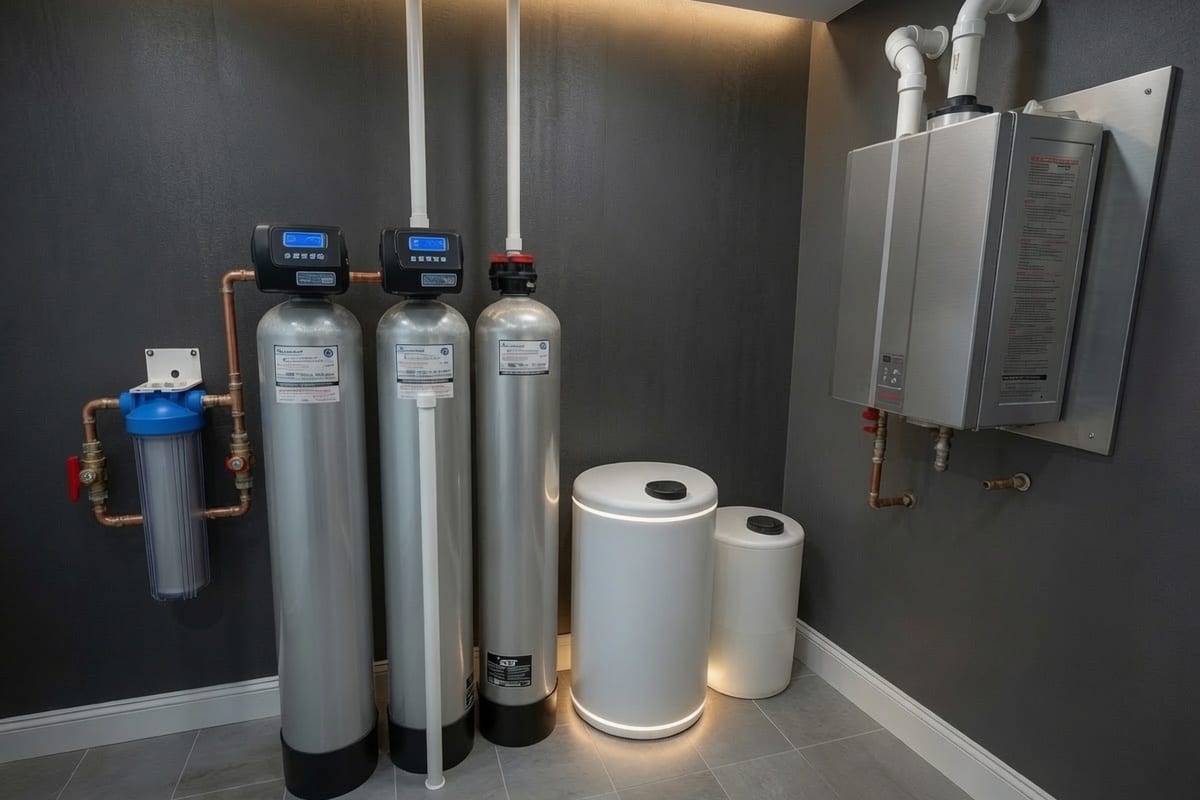
Chlorine taste, if it bothers you. Mooresville disinfects with free chlorine, not chloramine, at a 1.43 ppm running annual average with individual readings up to 2.3. That is a slightly heavier residual than many systems, which is consistent with treating surface water. Free chlorine means standard activated carbon is the correct media, and you do not need the more specialised catalytic carbon that chloraminated cities like Monroe and Greensboro require. A whole house carbon filtration system runs $1,500 to $3,500 installed, and our cost guide covers what changes it.
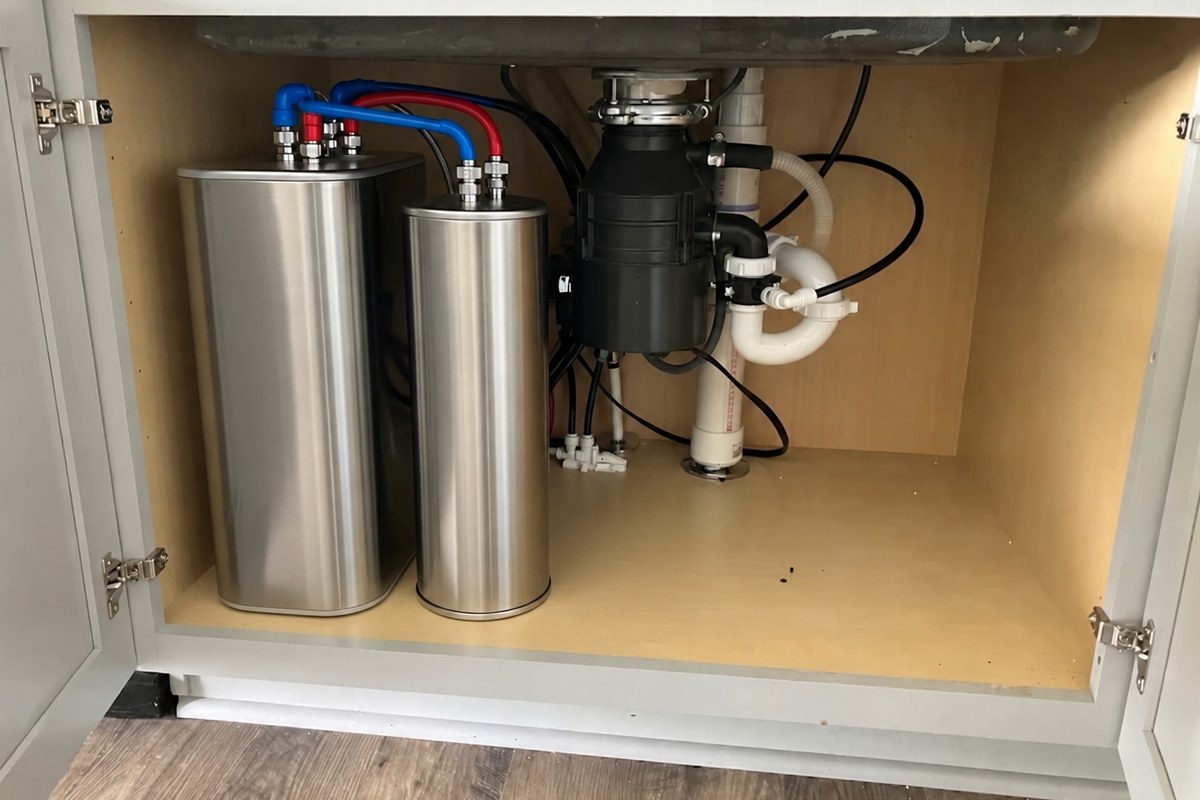
Copper, if you have staining. The low pH makes this the one genuinely Mooresville-specific thing to check. An under-sink reverse osmosis system at $350 to $900 installed removes copper and lead from drinking and cooking water, which is where it matters most.
Not PFAS. There is nothing to remove. A company selling you a PFAS system in Mooresville on the strength of national headlines is selling you a solution to a problem the town’s own testing says it does not have.
Frequently Asked Questions
Is Mooresville water really PFAS free?
Its 2025 report states that all contaminants in the national monitoring round were not detected, which means below the laboratory reporting limit rather than literally zero. That is the strongest result available to a utility. The town directs anyone wanting the underlying numbers to its water treatment plant manager, and asking for them is reasonable.
Should the low pH worry me?
Not in itself. At 6.6 the water sits inside the secondary standard, and the secondary standards address taste, appearance and plumbing effects rather than health. It is worth knowing because it explains blue-green staining if you have it, and because it is the one number in Mooresville’s report that is near an edge.
There was a coliform detection. Is that a problem?
The 2025 report records one total coliform detection in the distribution system, with all repeat samples negative for both total coliform and E. coli. That is the system working as designed: a single positive triggers immediate resampling, and the repeats came back clean.
What does “Higher” susceptibility on Lake Norman actually mean?
It is a state rating of how exposed an intake is to potential contaminant sources in the watershed above it, based on things like land use, permitted discharges and how much development sits upstream. NC DEQ is explicit that a higher rating does not imply poor water quality. Lake Norman carries a lot of shoreline development and boat traffic, which is enough to move the rating, and the treated results are the measure of what that actually amounts to.
Mooresville treats at two plants. Does it matter which one serves me?
Barely. Both sit on Charlotte Highway, both draw from Lake Norman, and their published figures are close: pH 6.6 against 6.7, chlorine ranges of 1.48 to 2.3 and 1.43 to 2.16. This is unlike cities such as Greensboro, where two plants on different reservoirs produced meaningfully different PFAS results.
Do I need a softener in Mooresville?
Probably not, though the town has not published the figure that would settle it. Every neighbouring Catawba system reports soft water. Test before buying, and be sceptical of anyone quoting you a Mooresville hardness number without having measured your tap.
Why does my water taste different from Charlotte’s?
Different plants, different treatment, and a slightly different chlorine residual, even though both draw on the Catawba system. Mooresville runs 1.43 ppm on average against Charlotte’s 1.04, which is enough to notice.
Is Mooresville affected by the 1,4-dioxane story?
No. Mooresville draws from the Catawba basin, and the state’s 1,4-dioxane investigation covers the Cape Fear basin. The compound is not mentioned in Mooresville’s reports.
What should I ask the town if I want more detail?
Ask for the underlying results from the national monitoring round, which the report offers by email, and ask for a current hardness figure, which the report does not contain. Those two questions cover the gap between what Mooresville publishes and what you need to size a system. If you would rather not chase it, a water test at your tap answers both plus the copper question in one visit.
Is bottled water a better option here?
No, and it would be an odd call on a supply with no PFAS detections. Bottled water is regulated as a food product and is not required to publish the annual testing a public utility must produce, so switching trades a system you can audit for one you cannot. If a specific concern is driving it, a filter certified for that contaminant is the more reliable answer.
Sources and reporting dates
Every figure above comes from the sources below. Water quality changes between reports, and a reported average does not describe conditions at every address on every day, so check the current report before acting on any number here.
- Town of Mooresville annual water quality report, covering calendar year 2025. Source of the hardness, disinfectant, byproduct, lead and copper figures.
- EPA Safe Drinking Water Information System, for population served, violation history and compliance dates.
- EPA UCMR5 occurrence data, the national PFAS monitoring round, for any result described as federal monitoring.
- NC DEQ Source Water Assessment Program, for source water susceptibility ratings.
- EPA PFAS drinking water rule, for the limits and their compliance dates.
Getting Mooresville water right
Mooresville reported no PFAS detections and publishes less supporting detail than any system covered here. Those two facts pull in opposite directions: there is very little to worry about, and also very little published to check your own water against.
That makes a test at your own tap more useful here than in most towns, particularly if you have staining that the low pH would explain.
Compare this supply with other cities in our North Carolina water quality guide, or see how we approach city water treatment.
We serve Mooresville, Huntersville, Charlotte, Concord and the rest of North Carolina. Every visit starts with a free consultation: we test your water, compare it against what the town publishes, and give you an up-front written price for only what the numbers support. Call (984) 384-6991 or request a free consultation.