Is New Bern Tap Water Safe to Drink? (2026)
Raleigh Water Pros • September 14, 2026 • 9 min read
New Bern sits where the Neuse meets the Trent and drinks from neither. Every drop comes out of the ground, through 20 wells into two different aquifers.
The interesting part is what happens next. The city runs its water through industrial ion-exchange softeners, which is the same chemistry as the tank a salesperson wants to put in your garage, only much larger. Those softeners strip out every bit of hardness. And then the city deliberately puts some of it back.
That is not a mistake. The reason is printed in the city’s own report, and it is the single most useful thing a New Bern homeowner can know before buying water equipment.
Is New Bern tap water safe to drink?
Yes. The 2025 report shows no violations of any kind: no exceedance of any contaminant limit, no disinfectant limit, and no site above the lead or copper action level.
Its PFAS record is among the most extensive sets of non-detections in the state. Under the federal monitoring round, New Bern’s water was sampled at four points across 2024, covering both the treatment plant and the Cove City wells, and tested for 29 PFAS compounds plus lithium. That produced 240 results, with not one detection of anything, GenX included.
Trihalomethanes came in at 32 parts per billion against an 80 limit, and the haloacetic acid group at 11 against 60. No source in the system carries a “Higher” susceptibility rating from the state, which is unusual.
The city serves New Bern, Trent Woods, the Craven County Industrial Park and the Rocky Run area, moving 1.38 billion gallons last year at a daily average of 3.77 million.
Two aquifers, treated completely differently
| Castle Hayne aquifer | Black Creek aquifer | |
|---|---|---|
| Wells | 15, feeding the treatment plant | 5, near Cove City, ten miles west |
| Water quality | Iron, manganese, hydrogen sulfide, high calcium and magnesium | Described by the city as very high quality |
| Treatment | Full plant: aeration, oxidation, greensand filtration, softening | Minor disinfection only |
The Castle Hayne is the bigger, more easily replenished source, and it is the one that needs work. Aeration starts the iron and manganese oxidising and drives off most of the hydrogen sulfide, which is the rotten-egg smell. Potassium permanganate finishes the oxidation, then greensand filters catch the result. Anything not fully oxidised would pass straight through, which is why the order matters.
Then the softeners. Then a blend of unsoftened water back in. Then chlorine, ammonia and orthophosphate for corrosion control.
The plant opened in May 2010, is permitted for 5.5 million gallons a day and was designed to go to 7.
Why the city adds hardness back on purpose
This is worth reading twice, because it is the argument against a product we sell.
The city gives two reasons in its report. First, cost: the salt used to regenerate those softeners accounts for about a third of the treatment plant’s entire operating cost, electricity included. Softening is expensive, and softening completely is more expensive still.
Second, and more interesting: extremely soft water is corrosive in a distribution system. The city’s words are that it causes increased wear and maintenance on pumps, valves, and metallic pipe and fittings. So the plant bypasses a fraction of the flow around the softeners to land on a target hardness that its operators settled on through testing and by comparing notes with neighbouring systems on the same aquifer.
Pro tip: a municipal utility with full softening capacity chose not to deliver zero-hardness water, because zero-hardness water eats pipe. That is the honest counterargument to any pitch that softer is always better.
Does New Bern have hard water?
The city does not publish a finished hardness number, and there is a specific wrong answer floating around.
The 2025 report has no hardness row anywhere. Its tables cover lead and copper, disinfection byproducts, disinfectant residuals and fluoride only. The city confirms elsewhere that it monitors hardness routinely, it just does not publish the value. The water plant laboratory supervisor will give it to you on request.
Here is the trap. Craven County publishes a hardness figure of two to three grains from its plant, and one grain from its Black Creek wells. Craven County’s water system is a different utility from the City of New Bern. Those numbers are correct for county customers and wrong for city customers, and search results will happily hand you one for the other.
What you can act on: your water was softened at the plant and partially rehardened on purpose, to a level the utility does not disclose. The only number that answers your question is one taken at your tap. Request a free consultation and we will measure it and give it to you in writing.
New Bern chloraminates, which decides your filter
The city has used chloramines as its secondary disinfectant since June 2010, formed by adding a small amount of ammonia shortly after chlorination. The 2025 running average was 2.96 parts per million.
That makes catalytic carbon the correct media here, not standard activated carbon. Standard carbon handles free chlorine well and chloramine poorly at household contact times. A filter specified for a free-chlorine coastal city like Jacksonville, an hour down the road, is the wrong filter for New Bern.
The city flags the two groups who must remove chloramine regardless: kidney dialysis patients and fish owners.
The annual reversion, and why your water smells like a pool for a month
Once a year New Bern switches off the ammonia and runs on free chlorine for four to six weeks, to clear any microbial growth that built up under the more stable chloramine residual. This is standard practice for chloraminated systems and the city announces the window in its annual report, most recently a mid-April to late-May stretch.
During those weeks the water tastes and smells more strongly of chlorine. Afterwards the city flushes the mains at high velocity, mostly between 9pm and 3am, and you may see discoloured water for a while. Running a tap for five minutes clears your service line.
None of that is a fault. If the timing matters to you, the water treatment division publishes the dates, and it contacts dialysis centres directly.
One number worth noting
New Bern’s copper 90th percentile came in at 0.212 parts per million in its last round, against an action level of 1.3. That is comfortably compliant and nowhere near a problem.
It is worth mentioning because it is materially higher than neighbouring coastal systems, and it fits the chemistry: softened water is more aggressive toward copper pipe, which is exactly why the city doses orthophosphate and blends hardness back. Lead, by contrast, came back not detected at the 90th percentile with no site above the action level, and the city publishes a public lead service line inventory map.
What to buy in New Bern
Catalytic carbon, whole house. This is the product that matches the water. It handles the chloramine, it handles the annual free-chlorine period, and it covers every tap. A whole house system runs $1,500 to $3,500 installed. See our cost guide for what moves that figure, and make sure any quote names catalytic rather than standard media.
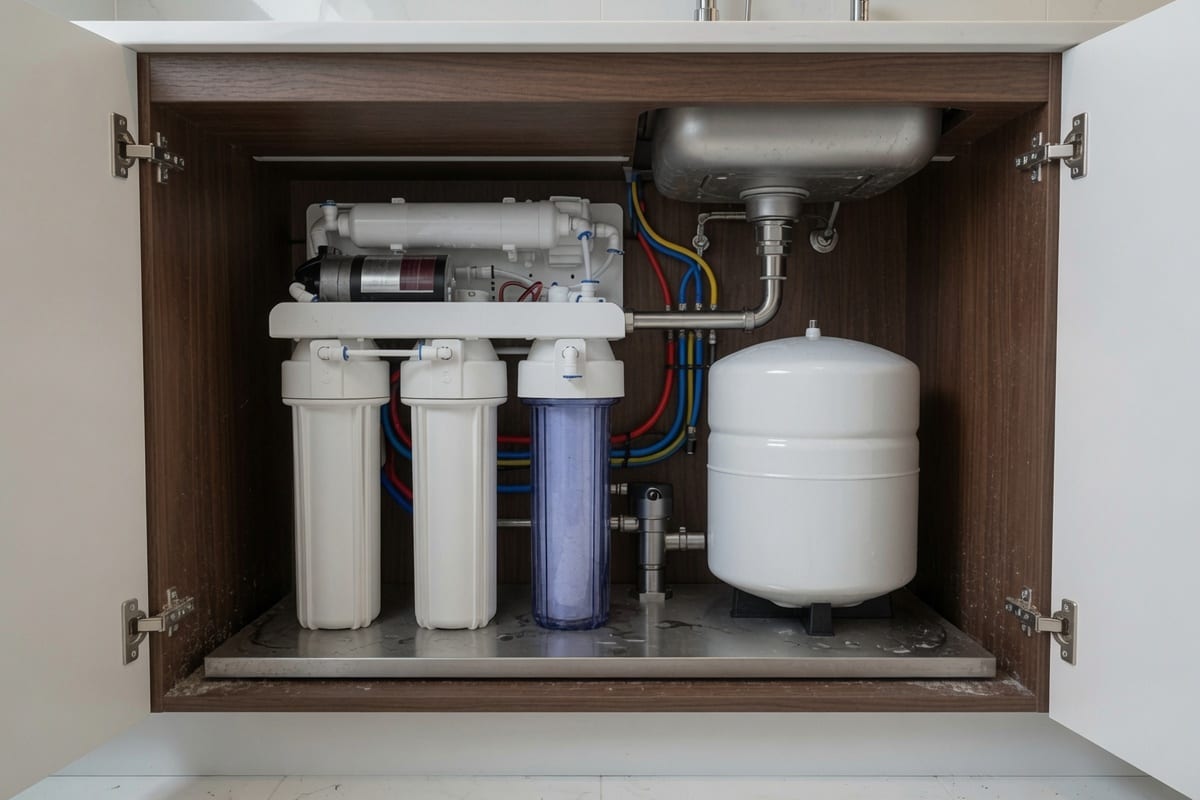
Reverse osmosis at the sink, optionally. At $350 to $900 installed it polishes drinking and cooking water and covers anything your own plumbing contributes. See our reverse osmosis page.
Usually not a softener. Your city already softened it. Selling a softener into a centrally softened, phosphate-dosed, deliberately rehardened system is a claim you can check in one click, and we would rather you checked.
Not a PFAS system. Zero detections across 240 results.
Frequently Asked Questions
Does New Bern water come from the Neuse or the Trent?
Neither. Despite sitting at the confluence of both rivers, the city is entirely a groundwater system drawing from the Castle Hayne and Black Creek aquifers.
Am I on city water or Craven County water?
Check your bill, because it changes the answer to almost everything on this page. The City of New Bern, the Craven County Water System and First Craven Sanitary District are three separate utilities with separate plants and separate reports.
Why does my water smell like chlorine in the spring?
That is the annual reversion to free chlorine, which runs four to six weeks and is deliberate. It ends when the city switches back to chloramines, and the taste goes with it.
Why is my water discoloured after the city works on the mains?
High velocity flushing follows the reversion period, and it stirs up sediment that normally sits still. Run a tap for five minutes to clear your service line. If it persists, call the water treatment division rather than buying anything.
Should I still filter if the city already treats this much?
For taste and chloramine, yes, and that is a reasonable thing to want. For hardness, almost certainly not. The difference between those two answers is the whole point of getting a reading before you buy.
I am on a private well in Craven County. Is any of this relevant?
Very little of it. Wells here tap the same aquifers the city does, but without the aeration, greensand filtration and softening that the plant applies, which means iron, manganese and hydrogen sulfide are live issues rather than solved ones. Our guide to what NC well testing misses sets out what to add to the state panel, and our water testing visit covers the readings that decide equipment.
How does New Bern compare on PFAS?
It is at the clean end. Several North Carolina systems report detections above the coming federal limit, notably Fayetteville and Greensboro. New Bern reported none at all. The statewide PFAS table puts every city side by side.
Sources and reporting dates
Every figure above comes from the sources below. Water quality changes between reports, and a reported average does not describe conditions at every address on every day, so check the current report before acting on any number here.
- City of New Bern Water Treatment Division annual water quality report, covering calendar year 2025. Source of the hardness, disinfectant, byproduct, lead and copper figures.
- EPA Safe Drinking Water Information System, for population served, violation history and compliance dates.
- EPA UCMR5 occurrence data, the national PFAS monitoring round, for any result described as federal monitoring.
- NC DEQ Source Water Assessment Program, for source water susceptibility ratings.
- EPA PFAS drinking water rule, for the limits and their compliance dates.
Getting New Bern water right
New Bern runs one of the more thorough treatment trains in the state on one of the more demanding groundwater sources, and it publishes a frank explanation of why it does not soften all the way. The result is compliant water with no PFAS, low byproducts and no violations.
The filter conversation here is about chloramine, and the answer is catalytic carbon. The softener conversation is mostly over before it starts, and your utility is the one who ended it.
Compare this supply with other cities in our North Carolina water quality guide, or see how we approach city water treatment.
We serve New Bern, Jacksonville, Greenville and the rest of North Carolina. Every visit starts with a free consultation: we test your water, compare it against what the city publishes, and give you an up-front written price for only what the numbers support. Call (984) 384-6991 or request a free consultation.