Water Purification Systems in Wake Forest NC (2026)
Raleigh Water Pros • September 20, 2026 • 10 min read
If you are pricing water purification systems in Wake Forest, one fact settles most of the answer before anyone quotes you: Wake Forest does not run its own water plant. The town is served by Raleigh Water, inside public water system NC0392010, and drinks the same treated water as Raleigh, Garner, Rolesville, Knightdale, Wendell and Zebulon, from the same two plants, under one annual report.
That matters, because Raleigh Water publishes more detail than almost any utility in the state, and those numbers are Wake Forest’s numbers. They rule some equipment in and other equipment straight out. The water here is soft by the utility’s own printed classification, carries a chloramine residual year round, and shows PFOA and PFOS at a few parts per trillion.
Below: what each system costs installed in 2026, what carbon and reverse osmosis do on this supply, why a softener has very little to do on town water, and what changes if your Wake Forest address is on a private well.
What do water purification systems cost in Wake Forest?
A whole house carbon filter runs $1,500 to $3,500 installed, and an under-sink reverse osmosis unit runs $350 to $900. Those two cover what Raleigh Water’s own reports actually show in Wake Forest: a chloramine residual at every tap, and low-level PFAS plus seasonal disinfection byproducts in the water you drink.
| System | What it does on the Wake Forest supply | Installed, typical |
|---|---|---|
| Whole house catalytic carbon | Takes out chloramine taste and smell at every fixture | $1,500 to $3,500 |
| Under-sink reverse osmosis | Drinking and cooking water: PFAS, byproducts, taste | $350 to $900 |
| Whole home water softener | Very little to do at about 1.5 grains per gallon | $1,500 to $3,500 |
| Salt-free conditioner | Same problem, same verdict on this supply | $1,200 to $2,500 |
| Well treatment, if you are not on town water | Iron, sulfur, pH, bacteria, hardness once measured | $4,000 to $8,000+ |
Every figure above is a planning range, not a quote. What moves it is pipe size, where the main enters the house, peak flow, and whether the tank has somewhere to drain. The breakdown sits in our Raleigh price guide.
Want the number for your own address rather than the town average? Request a free consultation and we test your water first, then quote in writing.
Who actually supplies Wake Forest’s water?
Raleigh Water does, and Wake Forest sits inside its system rather than buying from it. The utility’s treatment plants page lists the communities it supplies as Raleigh, Garner, Rolesville, Wake Forest, Knightdale, Wendell and Zebulon, and the 2025 Consumer Confidence Report repeats the same seven-community list. One public water system number, NC0392010, covers all of them.
The source is two surface reservoirs: Falls Lake, in northern Wake County, and Lake Benson, in Garner. Falls Lake feeds the E.M. Johnson plant, rated at 86 million gallons a day and averaging 41. Lake Benson feeds the Dempsey E. Benton plant, rated at 20 and averaging 10. Raleigh Water does not publish which parts of the service area get which plant’s water, so nobody can honestly say which one reaches your tap.
One local detail most residents have never heard: Raleigh Water’s certified drinking water laboratory, which the utility calls its first, sits at 10700 Star Road in Wake Forest. The lab reading your water is in your town.
Does Wake Forest need a water softener?
No, not on town water, and the utility says so in print. Raleigh Water’s 2025 Annual Finished Water Quality Report publishes hardness in two units, plant by plant: 1.49 grains per gallon (25.5 mg/L) at E.M. Johnson and 1.44 grains per gallon (24.7 mg/L) at Dempsey E. Benton. In the column where a legal limit would normally sit, it prints Classified as "Soft" on both rows. System-wide, the 2025 report gives 25.2 mg/L, range 21.9 to 35.3, about 1.5 grains per gallon.
Softeners start earning their keep somewhere around 7 grains per gallon. At 1.5 there is almost nothing for the resin to strip out, and you would be adding a salt bill, a drain line and a service interval to fix a problem the numbers do not show.
Hardness does drift with the season: at the E.M. Johnson plant tap it ran 22.0 mg/L in January 2026 and 31.2 mg/L in August. Even at the summer peak that is about 1.8 grains per gallon, still soft. The same argument for the rest of the system is in do you need a softener on Raleigh city water.
Pro tip: Raleigh Water publishes a monthly finished water report, and the numbers move across the year. At the E.M. Johnson plant tap, trihalomethanes ran 11 ppb in March 2026 and 32 ppb in August. Anyone quoting you the annual average as though it were a constant has not opened the monthly file. Size carbon for the August number.
What does carbon filtration do on Wake Forest water?
It handles chloramine, which is the one thing every tap in town has in common. The 2025 report gives a chloramine residual of 2.80 ppm, range 0.02 to 4.00, against a 4 ppm maximum, and both plants feed ammonia alongside chlorine to form it.
Chloramine is why leaving a jug on the counter overnight does nothing here. It does not gas off, and standard activated carbon reacts with it too slowly to finish the job at household flow rates. Catalytic carbon is the correct specification, year round, and the difference is set out in our catalytic versus standard carbon comparison.
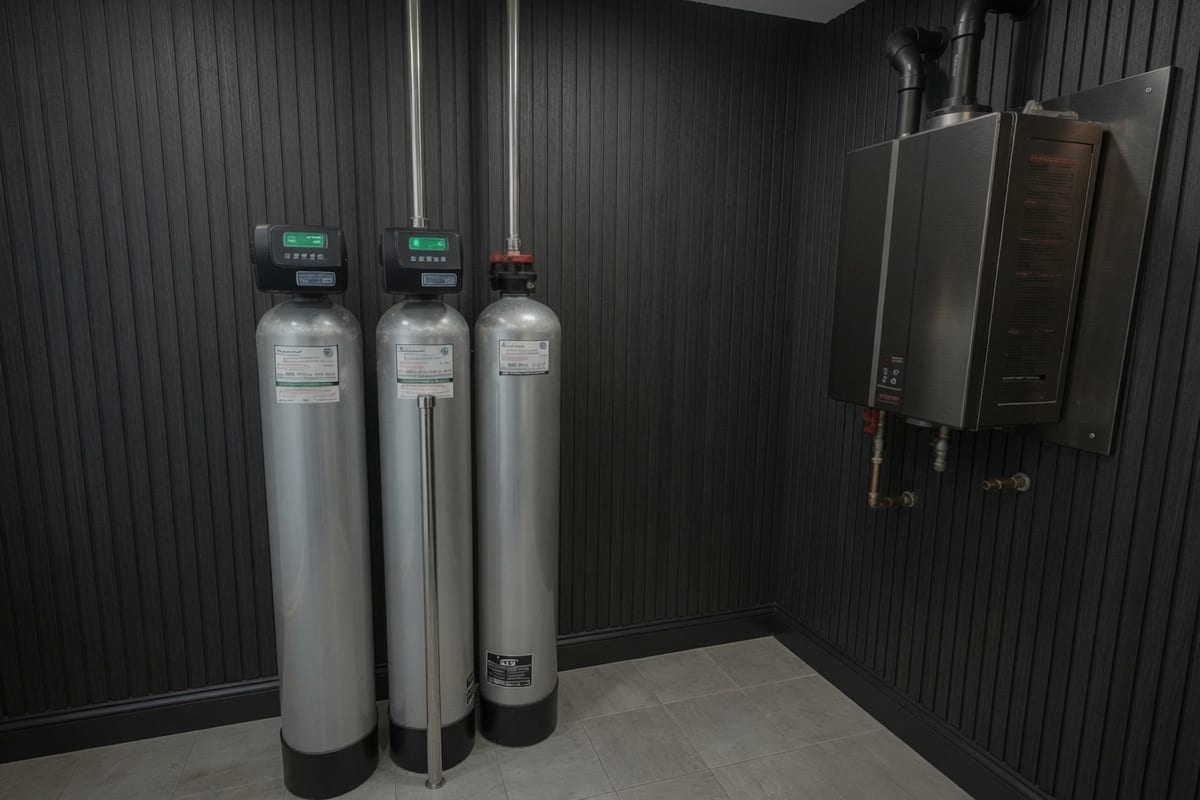
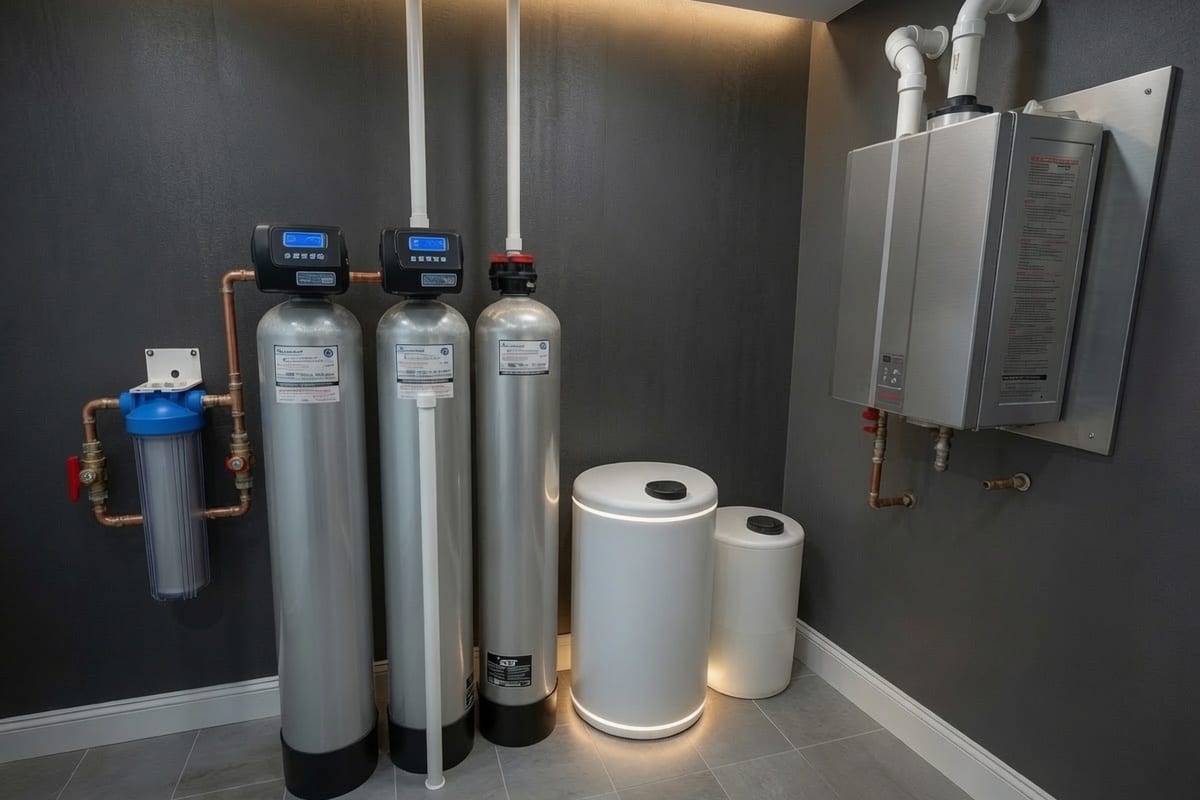
There is one scheduled exception, and it is published. Raleigh Water converts the whole system to free chlorine for about five weeks each late winter, on NC DEQ’s recommendation, and the 2026 window was printed as a footnote on the utility’s monthly report: 26 February to 2 April 2026. Standard carbon would cope for those five weeks and fall behind for the other forty-seven. A properly sized tank on the main line is what carbon filtration means in practice: media type, bed size, and a backwash schedule that keeps the bed from channelling.
Is reverse osmosis worth it in Wake Forest?
For drinking and cooking water, it has the clearest case of anything on the list. Raleigh Water tests its finished water for PFAS every quarter and publishes the results: PFOA around 2.4 to 3.1 parts per trillion and PFOS around 1.2 to 3.0 parts per trillion at the two plants, against a federal maximum contaminant level of 4.0 parts per trillion for each. The 2025 annual averages at E.M. Johnson were PFOA 2.69 and PFOS 2.60. GenX has been a non-detect in every published quarter, which is what you would expect on the Neuse rather than the Cape Fear.
Read that in both directions. Wake Forest water is not a PFAS-free supply, and it is not a supply in violation of anything either.
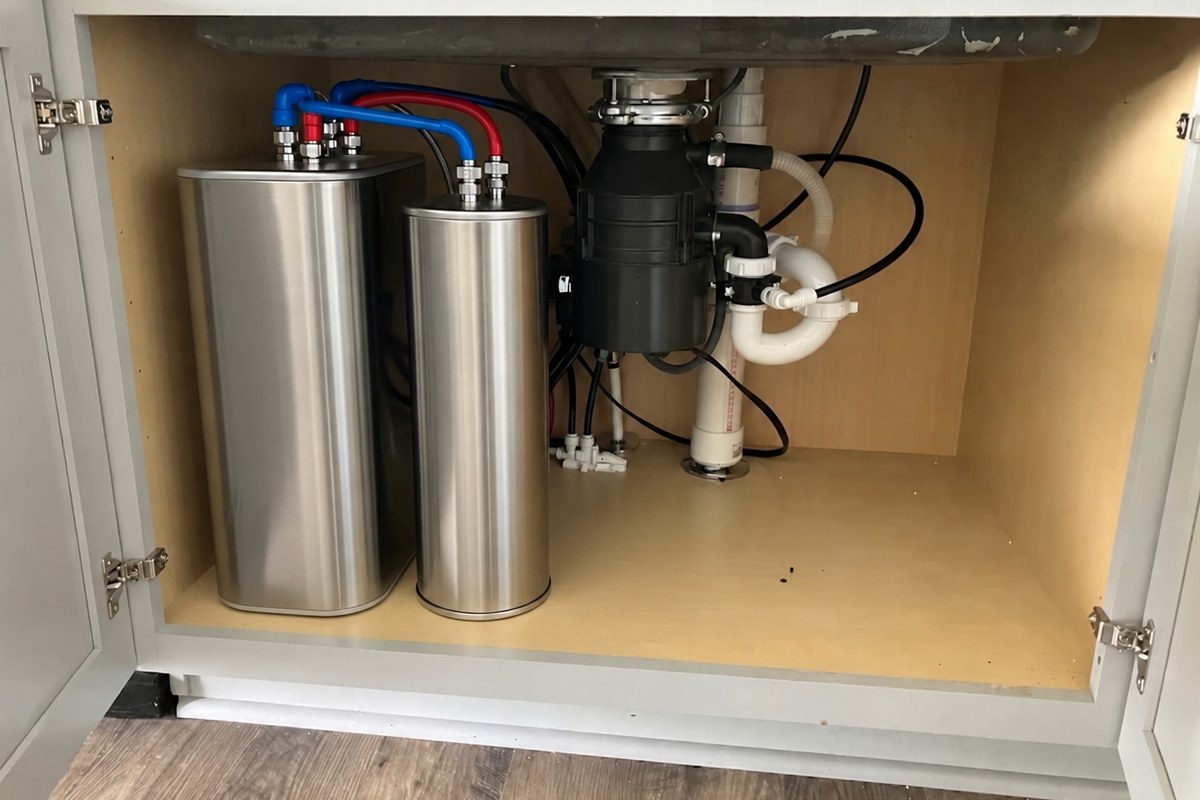
The second reason for a drinking water unit is disinfection byproducts. Across the distribution system in 2025, trihalomethanes averaged 34.2 ppb against an 80 ppb limit and haloacetic acids 22.0 ppb against 60, both legal, both higher in late summer than in winter. An under-sink reverse osmosis drinking water system takes on both, with its carbon prefilters doing the chloramine work ahead of the membrane. At $350 to $900 installed it is the cheapest meaningful upgrade here.
What you do not need is a lead panic. The 2025 tap sampling round put the lead 90th percentile at non-detect across 85 sites, and the utility states it has never found a lead pipe.
What if your Wake Forest home is on a well?
Then none of the above applies and the order of operations reverses. Where the mains end, past the edges of town, homes draw from private wells, and a private well carries no disinfectant residual, so catalytic carbon has nothing to do. Those homes deal with iron staining, hydrogen sulfide smell, low pH that eats copper, bacteria after heavy rain, and red clay sediment instead.
Hardness on a well is a separate question with an unsatisfying answer. we have no representative dataset that would predict yours. The required panel for a newly constructed private well under NCGS 87-97(h) names 19 items, including iron, manganese, lead and bacterial indicators, and hardness is not one of them, which is why no statewide number exists to quote. The nearest official figure, from the USGS Ground Water Atlas, calls the Piedmont crystalline-rock aquifers soft at about 63 mg/L, roughly 3.7 grains per gallon, but that is a multi-state regional average and not a Wake County measurement. Private wells around the Triangle commonly run far harder than city water, though we have no representative dataset behind that, and yours could land anywhere.
So the conclusion on a well is always the same: measure it, then decide. A softener sized to a real grains-per-gallon result runs $1,500 to $3,500 installed. A staged well water treatment build handling iron, sulfur, pH and disinfection runs $4,000 to $8,000+, broken down in our well water treatment cost guide. Drilling, pumps and pressure tanks are a well contractor’s work.
Frequently Asked Questions
Is Wake Forest water hard or soft?
Soft, and Raleigh Water prints the word itself. Its 2025 report publishes 1.49 and 1.44 grains per gallon at the two plants and labels both Classified as "Soft". Wake Forest drinks that same water, so a softener is not indicated on hardness grounds. The statewide picture sits in our North Carolina hard water guide.
Does Wake Forest have its own water treatment plant?
No. Wake Forest is inside Raleigh Water’s public water system NC0392010, alongside Raleigh, Garner, Rolesville, Knightdale, Wendell and Zebulon. The water is treated at E.M. Johnson on Falls Lake and Dempsey E. Benton on Lake Benson, and one annual report covers every town on that list.
Why does Wake Forest water smell like a swimming pool in late winter?
Because the utility switches the system from chloramine to free chlorine for about five weeks every year, on NC DEQ’s recommendation, and free chlorine smells stronger. The 2026 window ran 26 February to 2 April. The full story is in Raleigh’s annual chlorine switch.
Does a whole house filter remove PFAS in Wake Forest?
A correctly specified carbon filter reduces PFAS, but reverse osmosis at the kitchen tap is the more reliable answer for the water you actually drink, and far cheaper than sizing a whole house system for that job. Raleigh Water’s published PFOA and PFOS both sit below the 4.0 parts per trillion federal limit, so this is a preference rather than an emergency.
What does a purification system cost to run in Wake Forest?
A carbon tank needs its media replaced on a schedule, and a reverse osmosis unit needs prefilters and a membrane on a cycle. Install a softener anyway and budget $50 to $150 a year in salt on top. Our Raleigh water filtration cost page sets out running costs by system.
Do I need to test my water if I am on Raleigh Water?
Not for compliance, because the utility tests constantly and publishes the results. Testing at your own fixture is still worth doing before you buy, because a citywide average describes the distribution system, not your kitchen sink. Our whole house water filtration cost guide covers what a test changes.
Sources
Every utility figure above comes from Raleigh Water’s own published reports, read in September 2026. Reports update annually, so check the current one before buying.
- Raleigh Water reports index: the 2025 Consumer Confidence Report, the 2025 Annual Finished Water Quality Report and the monthly reports.
- Raleigh Water treatment plants page: the seven communities served and the plant capacities.
- Raleigh Water perfluorinated chemicals data: the quarterly PFAS results.
- NCGS 87-97: the required new-well panel, which does not include hardness.
- USGS Ground Water Atlas, Piedmont and Blue Ridge aquifers: the regional crystalline-rock hardness average.
Getting the right purification system in Wake Forest
On Raleigh Water, in Wake Forest, Rolesville, Knightdale or Raleigh itself, the shortlist is short: catalytic carbon on the main line for chloramine, reverse osmosis at the kitchen tap, and no softener unless a test at your own fixture gives you a reason. That is cheaper than most people expect, and it is what the published numbers support.
We install and size city water treatment across northern Wake County. Call (984) 384-6991 or book a free consultation, and you get an up-front written price with the media type, the bed size and the service interval on it.