What Size Water Softener Do You Need in NC?
Raleigh Water Pros • September 20, 2026 • 10 min read
A softener quote lands in your inbox with a number on it. Forty-eight thousand grains, or sixty-four thousand, or whatever box the company stocks. Nothing on the page shows how they got there.
Working out what size water softener you need is not difficult or proprietary: one line of arithmetic with three inputs. Run it once and you can check any quote in the Triangle in about a minute.
Below is that arithmetic, a table turning it into a tank size, and a worked example. It also carries the North Carolina part vendor pages leave out: on Raleigh city water the calculation returns a number so small that the result is no softener at all. On a private well twenty minutes away it can return a large one. Only a measurement at your tap decides which.
What size water softener do I need?
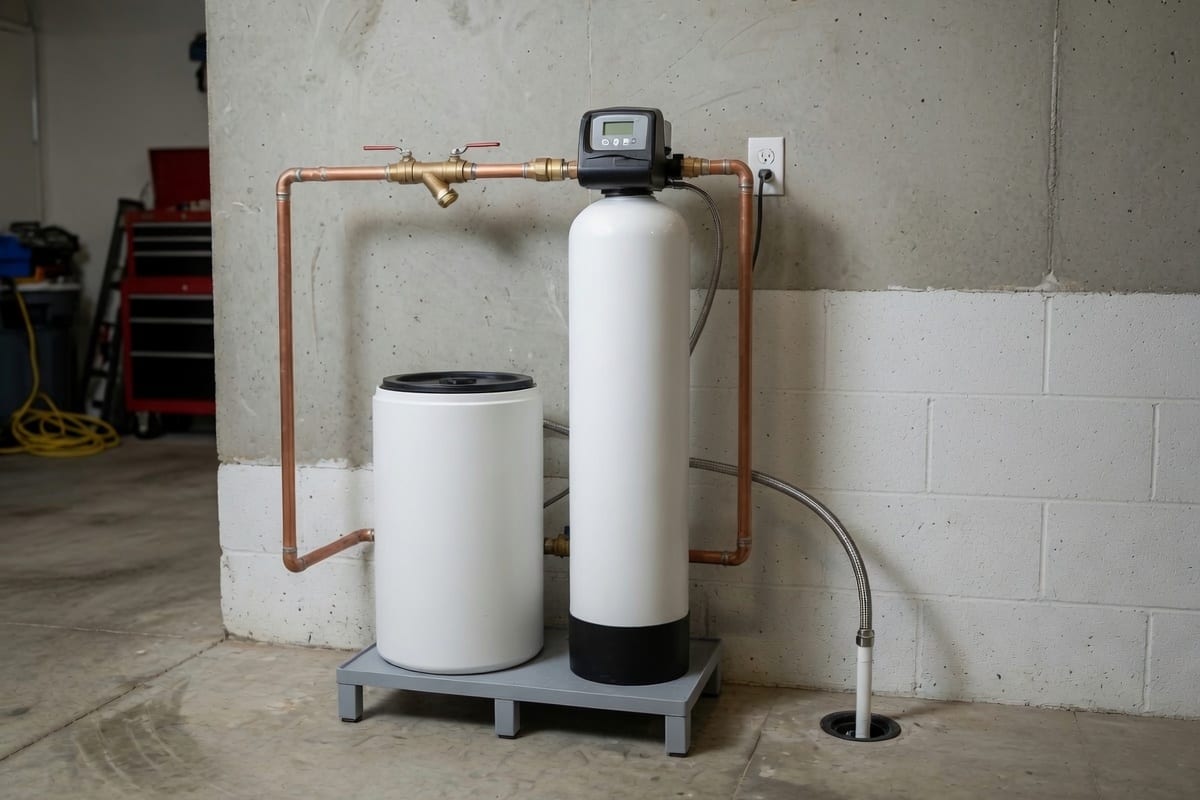
The right size is the unit that regenerates every three to seven days at your household’s real load, which means three numbers have to exist before anyone can answer: how many people live there, how much water they use, and your measured hardness in grains per gallon. Tank size falls out of those, not out of square footage, bathroom count, or the installer’s standard box.
| Your supply | Published hardness | What the calculation returns |
|---|---|---|
| Raleigh Water | 25.2 mg/L, about 1.47 grains | Nothing. The smallest tank sold sits a month between cycles |
| Cary and Apex | 30 mg/L, about 1.8 grains, “moderately soft” | The same. Scale is not the local problem |
| NC city water generally | 0.25 to 4.2 grains in published reports | The smallest common unit, at worst |
| A Triangle private well | None published in the state | Anything. It has to be measured |
The sizing calculation, line by line
Step 1: get your hardness into grains per gallon
Labs report hardness in milligrams per litre as calcium carbonate. Divide by 17.1 for grains per gallon. Raleigh Water’s 25.2 mg/L becomes 1.47 grains; Cary and Apex at 30 mg/L becomes about 1.8. The US Geological Survey scale calls under 60 mg/L (3.5 grains) soft, 60 to 120 moderately hard, 120 to 180 hard, above 180 very hard.
Step 2: add the iron adjustment
Dissolved iron loads softener resin the way calcium and magnesium do, so count it. The usual trade adjustment adds 4 to 5 grains per gallon for every 1 part per million of dissolved iron, so twelve grains plus 1 ppm is sized as roughly 16 to 17. That multiplier is a working convention, not a physical constant.
There is a ceiling. Much above 1 to 2 ppm of clear water iron, or with any orange oxidised iron visible, the resin fouls and the fix is iron and sulfur removal ahead of the softener, not a bigger one. That threshold is field judgement, not a published standard.
Step 3: multiply out your grains per day
Grains per day equals people, times gallons per person per day, times compensated hardness.
Softener sizing conventionally uses 75 gallons per person per day. Cross-check it: the US Geological Survey puts typical use at 80 to 100 gallons per person, and EPA WaterSense puts an average family above 300 gallons a day. Use your own water bill if you have it.
Step 4: choose the regeneration interval
Multiply the daily figure by the days you want between regenerations. Three to seven is the band to aim at, and that interval, not the tank, is what you are buying.
What the grain rating on the box actually buys
This is where do-it-yourself sizing goes wrong. The label number is capacity at maximum salt dose, around 15 pounds per cubic foot of resin. Almost nobody runs a softener there, because salt efficiency falls off badly at the top of the curve. At an efficient 6 to 8 pounds per cubic foot the same resin delivers roughly 60 to 75 percent of the rated number.
| Rated | Resin | Working capacity, efficient setting | Daily load on a weekly cycle |
|---|---|---|---|
| 24,000 | 0.75 cu ft | 15,000 to 18,000 | about 2,100 a day |
| 32,000 | 1.0 cu ft | 20,000 to 24,000 | about 2,800 a day |
| 40,000 | 1.25 cu ft | 25,000 to 30,000 | about 3,500 a day |
| 48,000 | 1.5 cu ft | 30,000 to 36,000 | about 4,200 a day |
| 64,000 | 2.0 cu ft | 40,000 to 48,000 | about 5,700 a day |
Brands vary, so read the capacity table for the unit being quoted.
Want this run on your own water? Request a free consultation and we measure at your tap first, then quote in writing.
A worked example: four people on a Triangle well
Suppose a test comes back at 12 grains per gallon with 0.3 ppm dissolved iron. Not a regional prediction, just a number to run the method on.
- Compensated hardness. 0.3 ppm of iron at 4 grains per ppm adds about 1.2, so call it 13 grains per gallon.
- Daily water. Four people at 75 gallons each is 300 gallons a day.
- Grains per day. 300 times 13 is 3,900 grains a day.
- Match the table. A 40,000 grain unit carries 25,000 to 30,000 working grains: six to eight days at that load.
A 48,000 is defensible if the household is about to grow or peak flow demands it. A 64,000 is not: at 3,900 grains a day it takes more than ten days to exhaust, past the point where things go wrong.
Why is a bigger softener not a safer choice?
Because resin that sits too long between regenerations stops behaving like a bed and starts behaving like a set of channels. Water finds preferential paths through the undisturbed resin, touches less of it, and hardness leaks through while the valve still believes it has capacity. Metered valves carry a calendar override for this reason, commonly set at seven or fourteen days, so an oversized unit regenerates on the clock regardless. You pay for the bigger tank and still burn the salt.
Undersizing fails the other way. A unit cycling every two or three days burns softener salt and backwash water at a rate the bill shows, and on a single tank delivers hard water during every cycle.
Pro tip: there is one legitimate reason to size up, and it is not capacity. Every tank has a published service flow rate that climbs with resin volume. A three bathroom house in Holly Springs running two showers and a washer at once can outrun a one cubic foot tank’s rated flow. Ask for the service flow in gallons per minute, not just the grain number.
What size do you need on Raleigh or Cary city water?
Run the identical calculation on Raleigh Water and it returns a number no residential softener is built for. Four people, 300 gallons a day, 1.47 grains per gallon is 441 grains a day. The smallest common unit, 24,000 rated and roughly 15,000 working, takes about thirty-four days to exhaust. The calendar override fires four or five times before the resin is near spent.
Across a year that household passes about 161,000 grains, roughly 23 pounds. Raleigh Water prints its own one word verdict beside the hardness row: “Soft”. Cary and Apex at about 1.8 grains give 540 grains a day, the same conclusion. That covers most of the Raleigh Water service area, Garner and Wake Forest and Knightdale included.
If your city water complaint is taste, smell or film, the city water treatment that fixes it is carbon, not ion exchange, and whether you need both units works through that split.
How do you find your own hardness number?
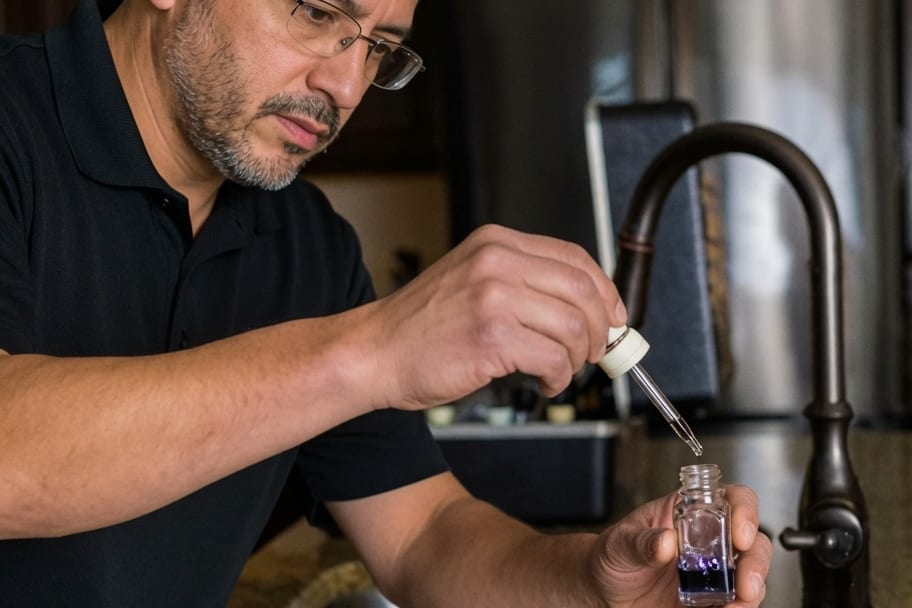
Measure it at your own tap, because on a private well there is nothing else to go on. North Carolina’s required panel for a newly constructed well is listed by name in NCGS 87-97(h): arsenic, barium, cadmium, chromium, copper, fluoride, lead, iron, magnesium, manganese, mercury, nitrates, nitrites, selenium, silver, sodium, zinc, pH and bacterial indicators. Hardness is not on it. Calcium is not either, so the results will not even let you derive it. That is why no North Carolina well hardness dataset exists. The state never collected one.
Private wells around the Triangle commonly run far harder than city water, and we have no representative dataset behind that. Your well could land anywhere. A neighbour’s reading in Fuquay-Varina or Clayton does not describe your water. A water testing visit gives you hardness, iron, pH and bacteria together, and on a well those four decide the layout, not just the tank.
Frequently Asked Questions
What size water softener do I need for a family of 4?
It depends on your hardness, but the arithmetic is fixed: four people at 75 gallons each is 300 gallons a day, so multiply 300 by your grains per gallon. At 12 grains that is 3,600 a day, and once you add the iron compensation described above it lands nearer 3,900, which is the figure a sizing conversation should work from. At Raleigh’s 1.47 grains the same house comes to 441 a day and points at no softener at all. The daily load is the starting point rather than the answer: usable capacity, the reserve between regenerations, the salt setting and your peak flow all move the final size, which is why a number off a chart is not a specification.
Is a 48,000 grain water softener too big for my house?
Possibly, and the test is the regeneration interval, not household size. A 48,000 grain unit carries roughly 30,000 to 36,000 working grains at an efficient setting, so divide that by your daily load. Past about ten days it is oversized, and the valve regenerates on its calendar override anyway.
How often should a water softener regenerate?
Every three to seven days. More often wastes salt, water and resin life; less often lets the bed sit undisturbed long enough to channel. A metered valve on a correctly sized tank lands there on its own.
Do I need a water softener in Raleigh?
Almost certainly not on hardness grounds. Raleigh Water reports total hardness at 25.2 mg/L, about 1.47 grains per gallon, and classifies its own water as soft. Our statewide hardness table shows the same pattern statewide, and whether a softener is worth it here covers the money side.
Does iron in my well water change the softener size?
Yes, and it can change whether a softener is right at all. Add roughly 4 to 5 grains per gallon for every 1 ppm of dissolved iron before sizing. Above about 1 to 2 ppm, or with visible orange staining, the move is a dedicated iron filter ahead of the softener, which well water treatment is built around.
How much does a correctly sized water softener cost in NC?
A whole home softener runs $1,500 to $3,500 installed here, and choosing 40,000 grains over 32,000 moves you inside that band rather than past it. Salt adds $50 to $150 a year. Those are planning ranges, not quotes; the Raleigh water filtration cost guide sets out what moves them.
Sources
- Raleigh’s 25.2 mg/L as CaCO3 and its own classification “Soft” come from Raleigh Water’s 2025 annual reports. The 1.47 grains is our conversion at 17.1 mg/L to the grain; Raleigh also publishes per-plant grains at 1.49 and 1.44.
- Cary and Apex at 30 mg/L, about 1.8 grains converted and labelled “moderately soft”, comes from the Cary/Apex Water Treatment Facility’s 2025 testing summary.
- The required analyte list for a new NC well is NCGS 87-97(h).
- Use figures come from the US Geological Survey and EPA WaterSense. The 75 gallon figure is a sizing convention; resin capacities are typical manufacturer values.
Getting the size right for your own house
In Raleigh, Garner or Wake Forest on city water, the calculation above will likely tell you to spend the money on taste rather than hardness, and we will say so. On a well around Fuquay-Varina, Holly Springs or Clayton the number can come back high enough that tank size genuinely matters, with iron and pH alongside it.
Either way it starts the same. A free consultation, a measurement at your tap, the grains-per-day figure written where you can check it, and an up-front written price for a unit sized to it. Call (984) 384-6991 or book a free consultation, and we will show you the arithmetic before the tank.