White Residue From Well Water: Causes and Fixes
Raleigh Water Pros • September 26, 2026 • 8 min read
A chalky white crust inside the kettle. Glasses that come out of the dishwasher with a haze you cannot rub off. A white ring where water dried on the shower door, and a showerhead with half its holes blocked. On a private well, white residue like this is one of the most common complaints, and it usually has a plain explanation.
White residue from well water is, most of the time, dissolved minerals left behind when the water evaporates or boils. Calcium and magnesium, the minerals that make water hard, are the usual suspects. The catch in North Carolina is that, unless you asked for it, nobody has measured your well for them, because the state’s required well test leaves hardness off entirely.
This post covers what the white residue is, how to tell mineral scale from the things that look like it, why a well that has been “tested” may still have no hardness number, how an acid neutralizer can make the problem worse, and what fixes it.
What Is the White Residue From My Well Water?
It is almost always mineral content left behind when the water dries or boils, and on most wells that means hardness: calcium and magnesium carbonate. The water carries the minerals dissolved and invisible. When it evaporates on a glass or boils in a kettle, the water leaves and the minerals stay.
The EPA’s secondary drinking water standards list “hardness; deposits” among the noticeable effects of high total dissolved solids, and “deposits” among the effects of high pH (EPA secondary standards).
Virginia Tech’s household water program gives a threshold worth knowing: water “exceeding about 7 to 8 grains per gallon … may cause mineral deposits (scale) on dishes, appliances, and plumbing fixtures” (Virginia Cooperative Extension, 442-670).
How Do You Tell Mineral Scale From Other White Residue?
Scale is hard, chalky and dissolves in vinegar, and it builds up where water sits and dries. A few other things leave white marks, and each points somewhere different.
| What you see | Where | Vinegar test | Most likely cause |
|---|---|---|---|
| Chalky crust, hard to scrape | Kettle, showerhead, faucet aerator | Fizzes or softens, wipes away | Hardness scale |
| White spots on glass and fixtures | Wherever drops dried | Wipes away | Hardness or high dissolved solids |
| Milky water in the glass that clears from the bottom up | In the glass only, no residue | Not needed | Air bubbles, not minerals |
| Cloudy water that stays cloudy | In the glass | Not needed | Sediment or fine particles |
| Film on glasses that vinegar will not touch | Dishwasher glassware | No change | Etching of the glass, not deposit |
The milky-glass case belongs to another guide. If your water looks white or cloudy in the glass rather than leaving residue after it dries, start with cloudy well water.
Not sure which row fits? Request a free consultation and we test first, then quote in writing.
Pro tip: soak a crusted faucet aerator in white vinegar overnight. If the white crust dissolves and the grit left behind is sandy or orange, you are looking at two problems at once, hardness and sediment or iron, and the order of the equipment will matter.
Why Hasn’t My Well Ever Been Tested for Hardness?
Because North Carolina’s required new-well test does not include it. G.S. 87-97(h) lists the panel the county runs within 30 days of a new well’s certificate of completion: “arsenic, barium, cadmium, chromium, copper, fluoride, lead, iron, magnesium, manganese, mercury, nitrates, nitrites, selenium, silver, sodium, zinc, pH, and bacterial indicators” (NCGS 87-97). Hardness is not on it, and because the list includes magnesium but not calcium, you cannot even work hardness out from the results.
That is why there is no statewide hardness map for private wells. The published numbers that do exist come from small or old studies, and they swing widely.
| Where (dataset) | Hardness reported | Caveat |
|---|---|---|
| Piedmont and Blue Ridge crystalline-rock aquifers, multi-state (USGS Ground Water Atlas) | Average about 63 mg/L, 3.7 grains per gallon, “soft” | A regional average across several states, not a county number |
| Craven County, Castle Hayne aquifer (USGS, 21 wells, 1986 to 1988) | Median 210 mg/L, about 12.3 grains per gallon | One military installation, nearly forty years old |
| Moore County (USGS Water Quality Portal, 1948 to 2012) | Median 35 mg/L, maximum 227 mg/L | 19 samples over six decades, mixed geology |
| Cumberland County (USGS Water Quality Portal, 1950s) | Median 14 mg/L | 11 samples |
The spread is the point: limestone aquifers in the east can be hard, sand aquifers soft, and one county can hold both. Around the Triangle, our field observation is that many private wells run harder than city water, and some are hard enough to scale a kettle. That is an observation from the wells we see, not a dataset, and it cannot predict yours. Measure it. Our water testing and analysis page covers asking a lab for total hardness, and the NC well water testing guide explains what else the state panel leaves out.
Can an Acid Neutralizer Cause White Residue?
Yes. Acid neutralizers raise pH by letting acidic water dissolve calcite media, and calcite is calcium carbonate. Virginia Tech’s extension program says it directly: “Using an acid water neutralizing filter will likely increase the hardness of the water,” and “depending on the amount of hardness added, a water softener may also be needed.”
Plenty of North Carolina wells need a neutralizer. In the NC Division of Public Health’s county summaries of private well samples from 1998 to 2010, 21.45 percent of tested Wake County wells and 38.55 percent in Johnston County came back below pH 6.5 (NC DPH, Wake County). Correcting that protects copper plumbing, and the calcium it adds can then show up as white scale on fixtures.
That is not a reason to skip the neutralizer. It is a reason to test hardness after it goes in, and to size it honestly. A neutralizer runs $1,200 to $2,200 installed on the band in our Raleigh water filtration cost guide, and what moves the price is in our acid neutralizer cost guide. Those are planning ranges, not quotes.
How Do You Get Rid of White Residue From Well Water?
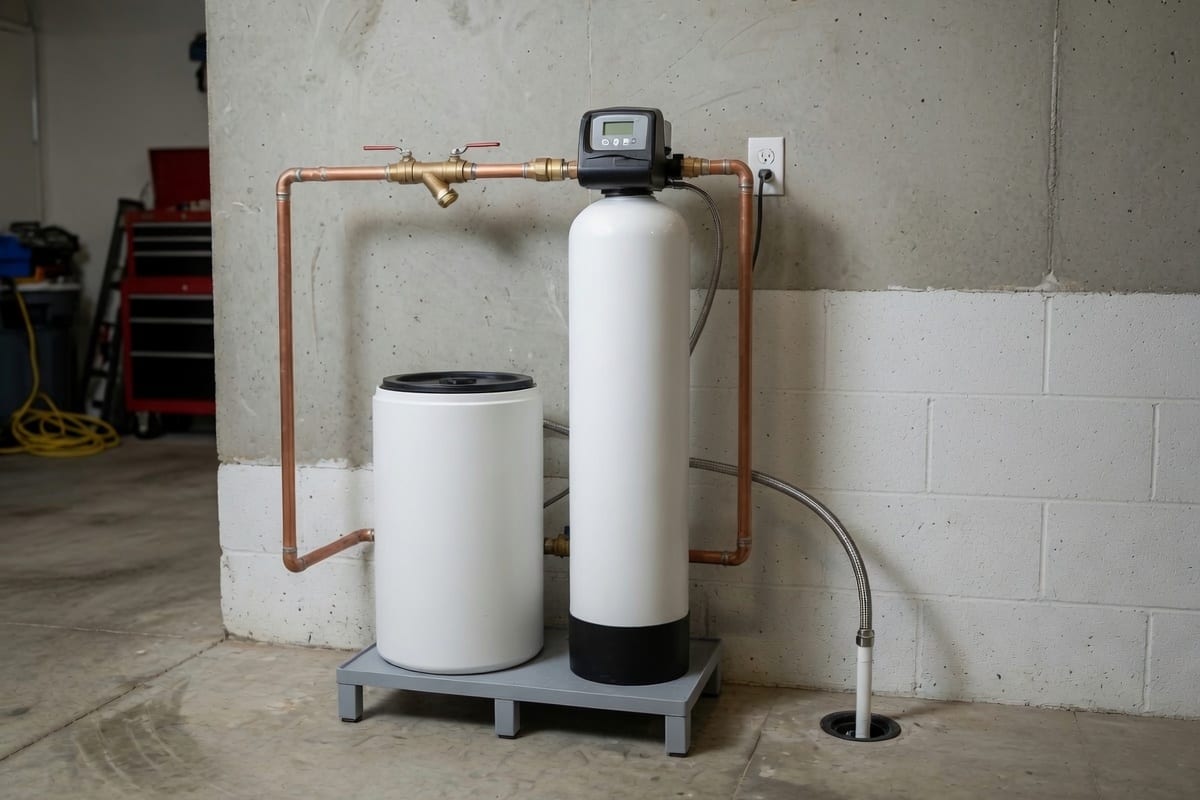
If the lab confirms hardness, a water softener removes the calcium and magnesium that leave the residue. A whole-home softener runs $1,500 to $3,500 installed on the same cost-page band. Sizing depends on your hardness number and household use, which is why the number has to come first; our guide to what size water softener you need walks through the arithmetic, and our water softener installation page covers the work.
Three things change the plan on a well.
Iron alongside hardness. NC State Extension notes that iron and manganese decrease the efficiency of softeners, so a well with meaningful iron usually needs it handled separately and ahead of the softener.
A neutralizer on the line. The softener goes after the neutralizer so it catches the hardness the calcite adds.
Low hardness. If the lab says the water is not hard, a softener is the wrong purchase, and the residue needs a different explanation.
For existing deposits, vinegar or a mild acid cleaner made for bathroom surfaces removes scale from fixtures, and a descaling cycle clears the kettle and coffee maker. That is cleaning, not a fix, and the residue will come back until the water changes. Full well treatment options are on our well water treatment page.
Frequently Asked Questions
What is the white stuff in my kettle after boiling well water?
It is scale, mostly calcium carbonate that comes out of hard water as it heats. It dissolves in vinegar or citric acid. If it builds up quickly, your well is likely hard, and a lab hardness result gives you the number.
Is white residue from well water harmful?
Hardness is not listed as a health standard; it is a nuisance that costs money in scale, soap and appliance life. The same white residue does not tell you anything about bacteria, nitrate or arsenic, so a well that is scaling still needs its safety tests on the usual schedule.
Why did white spots start after we installed a treatment system?
If the system was an acid neutralizer, it adds calcium as it raises pH, which can turn soft water hard enough to spot. On a well in Fuquay-Varina or elsewhere in southern Wake, a hardness test after installation shows whether a softener is now needed.
Will a whole house filter stop white residue?
No. Filters remove particles and, with carbon, taste and odour, but calcium and magnesium are dissolved minerals that pass straight through. Removing hardness takes a softener.
Does NC test well water for hardness?
Not as part of the required new-well panel. Hardness is absent from the G.S. 87-97(h) list, so homeowners in Wake Forest and across the state have to ask a lab for it separately.
How much does it cost to fix white residue from well water?
A whole-home softener runs $1,500 to $3,500 installed on our cost band, and the right size depends on your hardness number. Test first, then book a free consultation for a written price.
Sources
- EPA, Secondary Drinking Water Standards, observed 26 September 2026: deposits from dissolved solids and high pH.
- Virginia Cooperative Extension, 442-670, Household Water Treatment, 22 October 2024: the 7 to 8 grains per gallon scale threshold and neutralizers adding hardness.
- NCGS 87-97: the required new-well panel, which omits hardness.
- USGS Ground Water Atlas, Piedmont and Blue Ridge aquifers and USGS WRI 88-4034: regional crystalline-rock hardness and Craven County Castle Hayne hardness; Moore and Cumberland figures from the USGS Water Quality Portal.
- NC DPH county well water reports, 1998 to 2010 State Laboratory of Public Health samples: Wake and Johnston pH.
Stop White Residue at the Source
White residue from well water is a measuring problem before it is an equipment problem. Get a hardness number, check whether a neutralizer is adding to it, and size a softener to the result.
We test, size and install water softeners and well water treatment across Raleigh, Wake Forest, Fuquay-Varina, Holly Springs and Clayton, and we read the water before quoting anything.
Call (984) 384-6991 or schedule a free consultation for an up-front written price on stopping the white residue.